THE STUDY AND ANALYSIS OF EDITING STYLES TO CREATE MEANING AND EMOTION OF A SHORT FILM “STORY OF MY HOMETOWN”
Article Sidebar
Main Article Content
Abstract
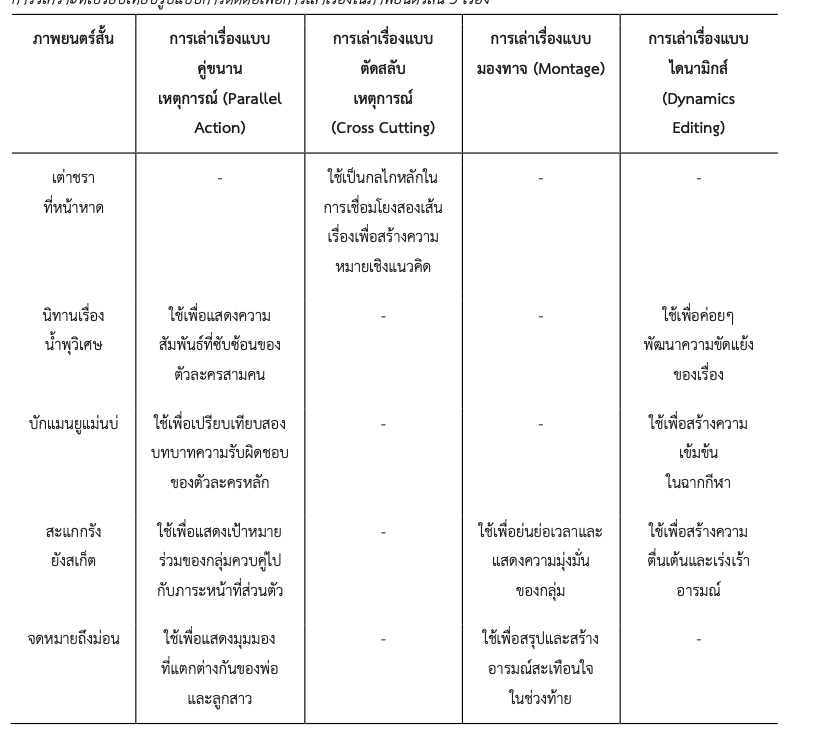
Introduction: Film editing serves as “the final rewriting” playing a critical role in organizing narrative information and emotional resonance. Objective: This qualitative research aims to examine the editing styles used to construct meaning and emotion in five short films from the “Creative Media My Home, Your Home” project. Method: The study employs qualitative content analysis grounded in the theoretical frameworks of Montage Theory and Continuity Editing as its primary methodology. Results: The findings reveal that emerging filmmakers effectively adapt universal editing techniques to convey local contexts; specifically, continuity editing is strictly utilized to maintain narrative flow and establish verisimilitude, while cross - cutting is applied in a manner akin to “intellectual montage” to foster thematic resonance. Additionally, montage and dynamic editing are strategically used for temporal compression and pacing to heighten abstract emotional intensity, though flashback and flashforward techniques were absent due to the focus on present-day narratives. Conclusion: Ultimately, the research concludes that the strategic selection of editing styles significantly influences the creation of an “emotional syntax” and enhances content quality, demonstrating how universal cinematic language can be powerfully adapted to articulate Thai local identity. These insights provide a valuable foundation for integrating the art and science of film sequencing into digital film and creative media curricula to develop the potential of future editors.
Downloads
Article Details

This work is licensed under a Creative Commons Attribution-NonCommercial-NoDerivatives 4.0 International License.
The author(s) is only responsible for data appearing in the submitted manuscript of Interdisciplinary social sciences and communication journal.Besides, this journal encourages and enables you to share data such as statements, contents, figures, etc. that support your research publication where appropriate, and enables you to interlink the data with proper citation.
References
Kosallawat, B. (1986). Cinematography and Film Production. In Teaching Materials for Introduction to Still Images and Film (Unit 12) [In Thai]. Sukhothai Thammathirat University.
Sarasombat, P., Anantasomboon, E., Phuphanna, T., Jedsadawan, J., & Bunnont, S. (2023). Research Report on Creative Media: My Home, Your Home Short Film Project [In Thai].Ramkhamhaeng University and Thai Media Fund.
Wiwatansinodum, R. (2002). Filmmakers, Filmmaking, and Short Films [In Thai]. Chulalongkorn University.
Wiwatansinodum, R. (2004). Casting Dreams into Films: Screenwriting [In Thai]. Baan Fah Publishing.
Detket, W. (2008). Film Editing. In Teaching Materials for Introduction to Film Production (Unit 13) [In Thai]. Sukhothai Thammathirat Open University.
Taisangka, I. (2000). The Science and Art of Storytelling [In Thai]. Kasetsart University Press.
Chandler, G. (2004). Cut by cut: Editing your film or video. Michael Wiese Productions.
Chandler, G. (2009). Film editing: Great cuts every filmmaker and movie lover must know. Michael Wiese Productions.
Dancyger, K. (2000). The technique of film and video editing: History, theory, and practice. Focal Press.
Katz, S. D. (1991). Film directing shot by shot: Visualizing from concept to screen. Michael Wiese Productions.
Kenworthy, C. (2009). Master shots: 100 advanced camera techniques to get an expensive look on your low-budget movie. Michael Wiese Productions.
