STRATEGY FOR DEVELOPING THE QUALITY OF MONKS AND NOVICES IN THE PALI TRAINING COURSE BEFORE THE SANAM LUANG EXAMINATION AT WAT HONG RATTANARAM RATCHAWORAWIHAN, BANGKOK
Article Sidebar
Main Article Content
Abstract
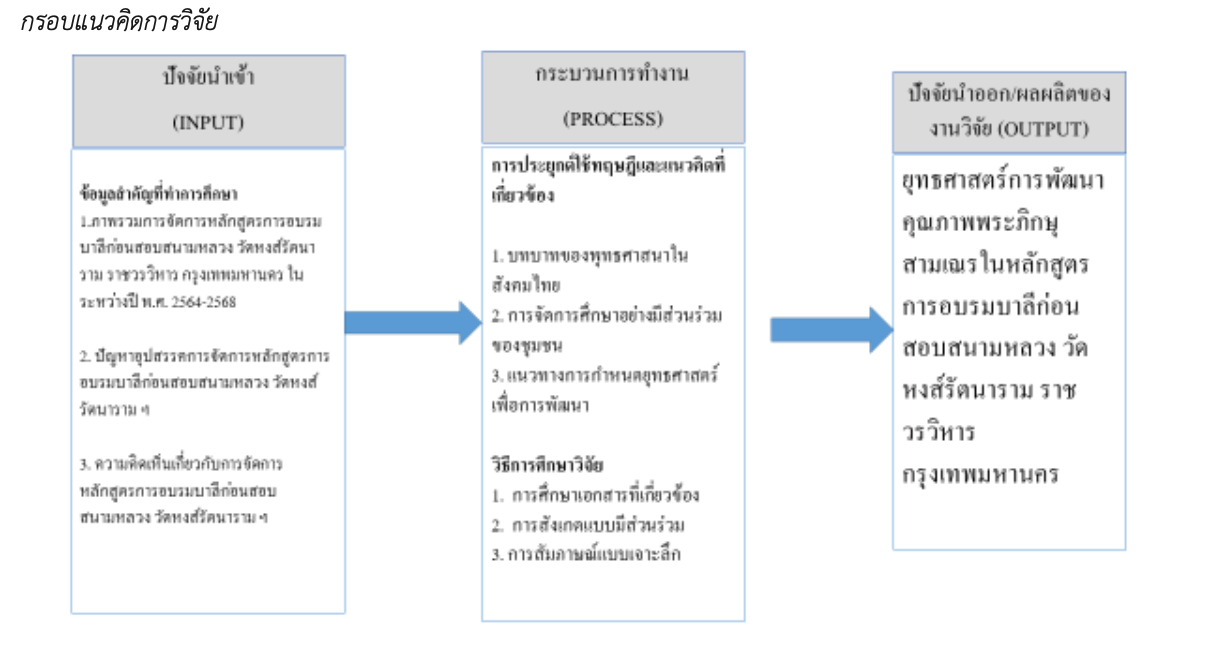
Introduction: Thailand has long upheld Buddhism as its national religion. In addition, Thai society is fundamentally rooted in a Buddhist way of life, which is centered on three key institutions: the home, the temple, and the school. These three institutions have been closely interconnected and have continuously supported and complemented one another throughout history. Objective: 1) Study the management of the Pali training course before the Sanam Luang examination at Wat Hong Rattanaram Ratchaworawihan, Bangkok. 2) Study the problems and obstacles in the management of the said course. 3) Suggest strategies for developing the quality of monks and novices in the said course at Wat Hong Rattanaram Ratchaworawihan, Bangkok. Method: This research used content analysis to process data from in-depth interviews and summarize as qualitative research results. The sample consisted of administrators/instructors, those involved in teaching and learning, and students at Wat Hong Rattanaram Ratchaworawihan, Bangkok, totaling 11 monks/persons. Results: 1) The management of the Pali training course before the Sanam Luang examination at Wat Hong Rattanaram Ratchaworawihan, Bangkok, during 2021-2025, the teaching curriculum was organized in accordance with the criteria and standards of the Office of the Chief of Pali, Sanam Luang, and learners could apply the knowledge to their lives and propagate Buddhism in accordance with the objectives of the Buddhist Education Act B.E. 2562 (2019). 2) Problems and obstacles in the management of the said curriculum consist of 3 aspects: human resources, teaching media / equipment / learning location, and management. And 3) The strategy for developing the quality of monks and novices in the said curriculum at Wat Hong Rattanaram Ratchaworawihan, Bangkok consists of strategies to solve problems related to internal factors of the curriculum and strategies to solve problems related to external factors of the curriculum. Conclusions: The administration of the Pali preparatory course, integrating modern management principles with religious institutional management. It emphasizes collaboration among all sectors, alongside the application of technology and innovation to enhance management efficiency.It also develops online communication strategies to build a national network for moral and ethical development.
Downloads
Article Details

This work is licensed under a Creative Commons Attribution-NonCommercial-NoDerivatives 4.0 International License.
The author(s) is only responsible for data appearing in the submitted manuscript of Interdisciplinary social sciences and communication journal.Besides, this journal encourages and enables you to share data such as statements, contents, figures, etc. that support your research publication where appropriate, and enables you to interlink the data with proper citation.
References
Department of Religious Affairs. (2007). Handbook for moral learning centers in temples [In Thai]. The Printing Plant, the Agricultural Co-operative Federation of Thailand, Ltd.
Department of Religious Affairs. (2009). Sunday Buddhist Study Centers: Sources of community moral and ethical development [In Thai]. The Printing Plant, the Agricultural Co-operative Federation of Thailand, Ltd.
Hill, T. & Westbrook, R. (1997) SWOT Analysis: It’s Time for a Product Recall. Long Range Planning, 30(3), 46 - 52, http://dx.doi.org/10.1016/S0024-6301(96)00095-7
Koontz, H., O'Donnell, C., & Weihrich, H. (1980). Management. McGraw-Hill.
Phonpirun, P. (2023). The role of temples in sustainable development [In Thai].https://nida.ac.th/temple-sustainable-development/.
Phra Thawatchai Kaewsings, Charoenwiriyakoon, C., & Charoenratchapak, N. (2023). A Causal factors affecting effectiveness of phrapariyattidhamma school [Article in Thai]. Journal of MCU Social Development, 8(1). 43 – 51.
Phumathon, M., Duangloy, D. & Phrapaladraphin Buddhisro (2021). Lessons Learned in Buddhist Management: Buddhist Charity School, Buddhist College, Chang Hua Man Royal Project, and Thewaphum Farmin Phetchaburi Province [Article in Thai]. Journal of MCU Kanchana Review, 1(2). 32 – 41.
Rattanasuwan, R., Navakijpaitoon, N., & Temrat, S. (2021). Guidelines for community participation in the administration of educational institutions under Nakhon si thammarat primary educational service area office 2 [Article in Thai]. Journal of Buddhistic Sociology, 6(3), 79 – 93.
Royal Society of Thailand. (1982). Royal Institute Dictionary B.E. 2525 [In Thai].Aksorncharoentat.
Thongsawang, T. (1994). The Thai society. Bangkok: Department of Sociology [In Thai]. Srinakharinwirot University.
Waitayakul, P. (1995). The role of monks on human resource development: A case study of Phra Payom Kalayano of Wat Suan Kaew [In Thai]. [Unpublished master’s thesis]. National Institute of Development Administration.
