THE INFLUENCE OF DIGITAL TECHNOLOGY FACTORS AND ENVIRONMENTAL, SOCIAL, AND GOVERNANCE (D-ESG) ON SME SUSTAINABILITY
Article Sidebar
Main Article Content
Abstract
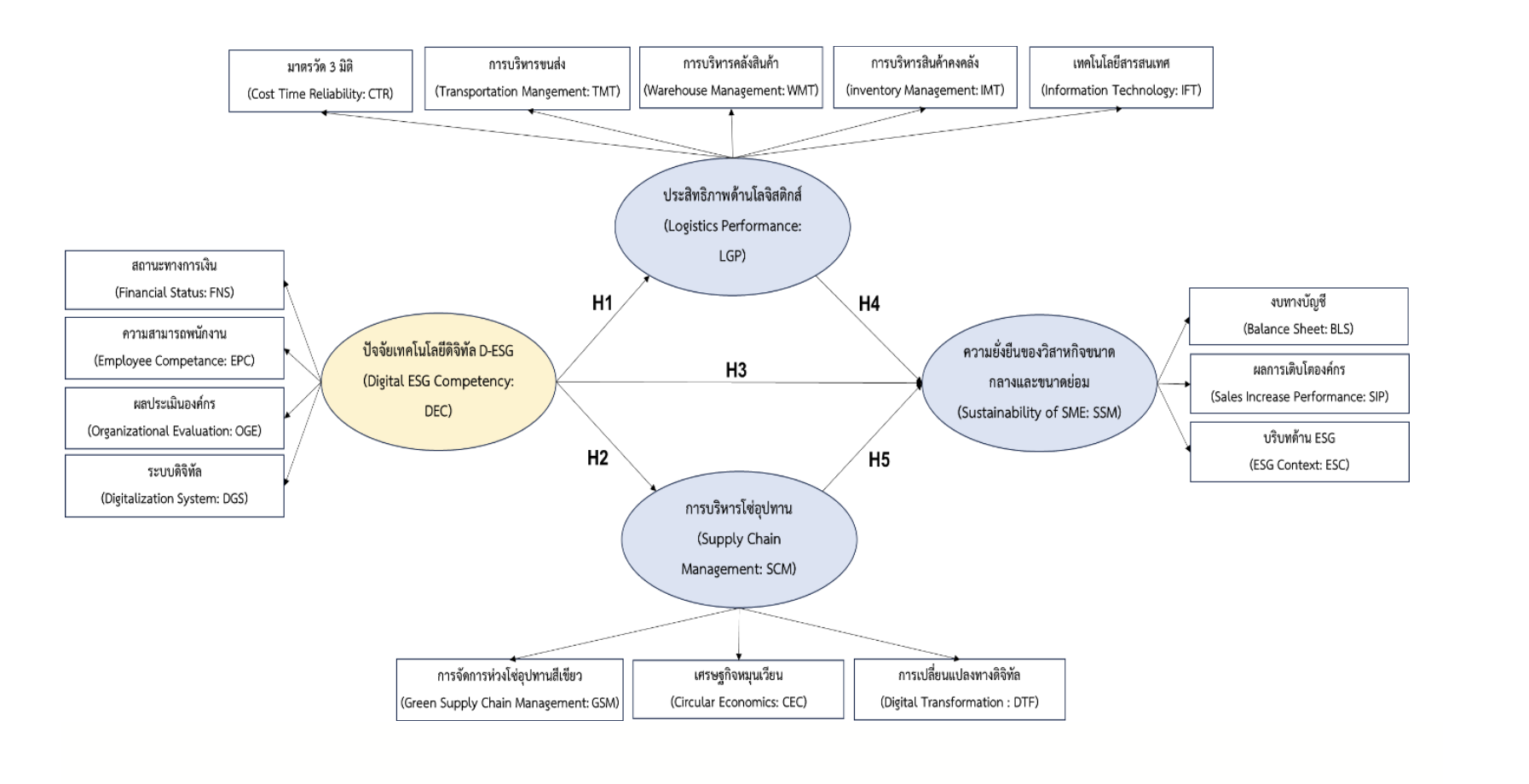
Introduction: In an era of global economic challenges and uncertainties, research highlights the necessity for small and medium-sized enterprises (SMEs), crucial drivers of the national economy, to adapt and enhance their competitiveness for survival and sustainable growth. The application of digital technology in conjunction with the concept of sustainable organizational development (ESG), known as D-ESG, has therefore become a widely recognized strategic priority. Objective: 1) analyze the causal factors of digital D-ESG technology's impact on the sustainability of SMEs; 2) examine the direct and indirect influence of digital D-ESG factors on sustainability through variables such as logistics efficiency and supply chain management; and 3) propose strategic approaches to promote the sustainability of Thai enterprises through the application of digital ESG technologies. Method: This research combines quantitative and qualitative approaches. For the quantitative research, the population consisted of 459 registered and government-certified small and medium-sized enterprise (SME) entrepreneurs. Data were collected using questionnaires and analyzed using descriptive statistics, inferential statistics, and structural equation modeling with statistical software for social science research. For the qualitative research, in-depth interviews were conducted with 20 key informants using purposive sampling, and data were analyzed using content analysis. Results: findings reveal that the causal model of D-ESG technology factors directly and indirectly influences the sustainability of SME entrepreneurs, showing a significant fit with empirical data (χ²/df = 1.17, CFI = 1.00, GFI = 0.99, AGFI = 0.96, RMSEA = 0.020, SRMR = 0.006). Hypothesis testing confirmed that D-ESG technology has a significant positive direct influence on logistics performance, supply chain management, and enterprise sustainability, as well as a significant positive indirect influence through logistics performance and supply chain management at the 0.01. Conclusion: The qualitative findings support and enhance the understanding of quantitative results, highlighting the importance of integrating digital technology with ESG management to gain competitive advantage and long-term sustainability. Furthermore, it provides concrete strategic recommendations for entrepreneurs and policymakers to foster sustainable development through the application of D-ESG technology.
Downloads
Article Details

This work is licensed under a Creative Commons Attribution-NonCommercial-NoDerivatives 4.0 International License.
The author(s) is only responsible for data appearing in the submitted manuscript of Interdisciplinary social sciences and communication journal.Besides, this journal encourages and enables you to share data such as statements, contents, figures, etc. that support your research publication where appropriate, and enables you to interlink the data with proper citation.
References
Chainual, R. (2024). Environmental, social, and corporate governance (ESG) for Thai SMEs sustainability [In Thai]. NRCT. https://doi.nrct.go.th/admin/doc/doc_668721.pdf
Ijaz, M., Hassan, U. I., Awan, M. B., & Akhtar, S. (2024). Digital transformation and SME innovation: A comprehensive analysis of mediating and moderating effects. Journal of the Knowledge Economy, 23(2), 23-45.
Ministry of Higher Education, Science, Research and Innovation. (2025). Thailand logistics business situation: April 2025 issue [In Thai]. Trade Policy and Strategy Office
Nakkasame, V., & Vechvittayaklang, Y. (2024). The influence of product innovation and process innovation affecting sustainable competitive advantage through entrepreneurial capability in SMEs in Samut Prakan Province [Article in Thai]. Journal of Legal Entity Management and Local Innovation, 9(7), 779-790.
Noonin, S. (2023). Corporate sustainability practice in Thailand: An empirical study of listed companies on the Market for Alternative Investment [Article in Thai]. Journal of Management Sciences Suratthani Rajabhat University, 10(1), 165-190.
Office of Small and Medium Enterprises Promotion. (2024). MSME situation report 2024 [In Thai].
Porter, M. E., & Kramer, M. R. (2011). Creating shared value. Harvard Business Review, 89(1–2), 62–77.
Schwab, K. (2016). The fourth industrial revolution. Crown Business.
Smith, R., & Johnson, L. (2022). The rise of AI in strategic communications: A comprehensive review. Journal of Communication Management, 26(3), 178–195.
Srawasee, R., & Taiwan, A. (2024). Antecedents affecting performance of the logistics services providers in Thailand [Article in Thai]. Journal of Logistics and Supply Chain Operations, 10(2), 72–90.
Sukphoka, J. (2022). Change management potential for sustainable community enterprise development [In Thai] [Unpublished Master's thesis]. Silpakorn University.
Thailand Development Research Institute Foundation. (2019). SME credit rating with non-financial data under the SME promotion action plan. Office of Small and Medium Enterprises Promotion [In Thai].
Truant, E., Borlatto, E., Crocco, E., & Sahore, N. (2023). Environmental, social and governance issues in supply chains: A systematic review for strategic performance. Journal of Cleaner Production, 43(4),140-165.
Yamane, T. (1967). Elementary sampling theory. Prentice-Hall.
