KNOWLEDGE MANAGEMENT OF CRAB FARMING: A CASE STUDY OF COMMUNITY MODEL AMPHOE BANG PAKONG, CHACHOENGSAO PROVINCE
Article Sidebar
Main Article Content
Abstract
Introduction: Thailand is regarded as one of the world’s major seafood-producing countries, and the Thai seafood industry generates one of the highest levels of export revenue for the nation. Objective: 1) to study the context of sea crab farming in the prototype community of Bang Pakong District, Chachoengsao Province 2) to study the knowledge of sea crab farming in the prototype community of Bang Pakong District, Chachoengsao Province 3) to study the knowledge management of sea crab farming in the prototype community of Bang Pakong District, Chachoengsao Province 4) to study the guidelines for developing the prototype area in managing the knowledge of sea crab farming in the prototype community of Bang Pakong District, Chachoengsao Province Methods: This research used a mixed methodology research method by using survey research to study the context of sea crab farming in the prototype community and participatory action research to study the knowledge management of sea crab farming in order to extract lessons from the community and produce knowledge media. Sea crab farmer population in Bang Pakong District, Chachoengsao Province The sample group of 15 sea crab farmers in Bang Pakong District, Chachoengsao Province, through in-depth interviews and surveys of sea crab farmers in Khao Din area, found that: There were 59 crab farmers in total. The data collection tools included surveys and in-depth interviews, observation records, opinion and lesson-learning diagrams, and activity evaluation forms and satisfaction assessment forms after the activity. Data were analyzed using content analysis. Results: the study were as follow:
1) The context of crab farming in the Bang Pakong District Prototype Community, Chachoengsao Province Bang Pakong District, Chachoengsao Province is a lowland parallel to the Bang Pakong River. In the past, there were only natural aquatic species. Later, when aquatic species were bred for sale, some villagers bought the desired offspring and released them. “Khao Wang” or the watercourse around the rice fields is the wisdom of farmers in Chachoengsao Province in water management. Therefore, Khao Wang rice farming in Ban Pho District, Chachoengsao Province is a way to preserve and continue the wisdom of our ancestors so that it does not disappear and to create an ecosystem that is conducive to the creation of a food source.
2) Knowledge on crab farming in the Bang Pakong District Prototype Community, Chachoengsao Province The characteristics of crab farming in Bang Pakong District are different from those of crab farming in provinces in the southern region of Thailand. Due to the characteristics of the breeding area of Bang Pakong District as a mangrove forest, adjacent to the sea, the soil is muddy, and there are tides, both fresh, salt and brackish water. Therefore, farmers tend to breed sea crabs in a mixed way, using the same area for agriculture and marine animal breeding.
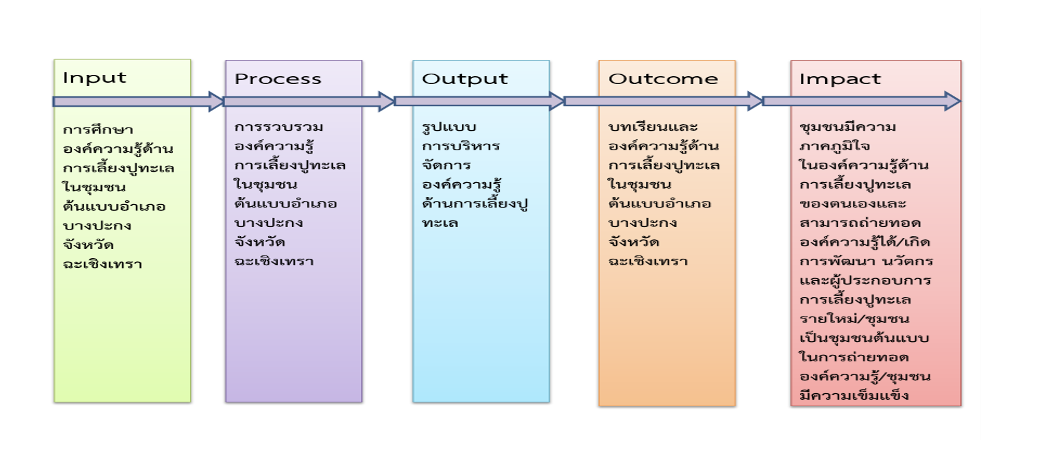
3) Knowledge management of sea crab farming in the prototype community of Bang Pakong District, Chachoengsao Province. Farmers have good knowledge and understanding of sea crab farming. They have their own techniques and methods for breeding crabs.
4) Guidelines for developing prototype areas in knowledge management of sea crab farming in the prototype community of Bang Pakong District, Chachoengsao Province. The prototype areas for breeding sea crabs in various forms, such as breeding areas, sea crab breeding processes, sea crab breeding steps, etc., have organized activities and brainstorming forums at the office of the large-scale rice field group, Khao Din Subdistrict, to gather opinions and create a process of participation with all relevant sectors, including the sea crab farmer group, community leaders, relevant government agencies, and academics, in order to obtain information and content for creating a sea crab knowledge set in the prototype area.
Downloads
Article Details

This work is licensed under a Creative Commons Attribution-NonCommercial-NoDerivatives 4.0 International License.
The author(s) is only responsible for data appearing in the submitted manuscript of Interdisciplinary social sciences and communication journal.Besides, this journal encourages and enables you to share data such as statements, contents, figures, etc. that support your research publication where appropriate, and enables you to interlink the data with proper citation.
References
Bandura, A. (1977). Social learning theory. Englewood Cliffs. NJ:Prentice-Hall.
Bertalanffy, L. von. (1968). General system theory: Foundations, development, applications.George Braziller.
Bronfenbrenner, U. (1979). Contexts of child rearing: Problems and prospects. American Psychologist, 34(10), 844.
Bampen Chaiyarak. (2024, 1 anuary ). Nakha Wang: Eastern local innovation disappearing due to “industry”. https://epigramnews.co/localry/nakhawang-model-chachoengsao/
Candy, P. C. (1991). Self-direction for lifelong learning: A comprehensive guide to theory and practice. Jossey-Bass.
Davenport, T., & Prusak, L. (1998). Learn how valuable knowledge is acquired, created, bought, and bartered. The Australian Library Journal, 47(3), 268–272.
Kolb, D. A. (1984). Experiential learning: Experience as the source of learning and development. Englewood Cliffs. NJ: Prentice Hall.
Nattawut, S., Cholakanda, N., Jitti, M., & Cholanat, S. (2024). Development of innovative products from mangrove resources to promote community economy: A case study of Khlong Huajak Community, Bang Pakong Subdistrict, Bang Pakong District, Chachoengsao Province. MCU Social Development Journal, 10(1), 113–124.
Nonaka, I., & Takeuchi, H. (1995). The knowledge-creating company: How Japanese companies create the dynamics of innovation. Oxford University Press.
Office of Fisheries, Chachoengsao Province. (2024, 1 January ). Fisheries database in Chachoengsao Province. https://www4.fisheries.go.th/local/index.php/main/view_activities/14/69867
Saranaya, T. & Teera, S. (2024). The influence of corporate social responsibility projects on marine environmental conservation of communities: A case study of marine ecosystem conservation and restoration projects. Journal of Social Research and Development, 6(4), 10–25.
Sumpan, T. & colleagues. (2017). Participatory action research of communities in developing restoration and conservation models of fishery resources: A case study of mud crab resources in Khlung District, Chanthaburi Province. Thaksin University Journal, 20(1), 18–28.
U.S. Army. (1993). A leader’s guide to after action reviews. Washington, DC: Department of the Army.
Wenger, E. (1998). Communities of practice: Learning, meaning, and identity. Cambridge: Cambridge University Press.
Wiig, K. M. (1997). Knowledge management: An introduction and perspective. Journal of Knowledge Management, 1(1), 6–14.
Wichian Thongkaew. (2017). Community participation in the conservation of aquatic species in Songkhla Lake: A case study of Ban Khok Mueang, Bang Riang Subdistrict, Khuan Niang District, Songkhla Province (Master’s thesis, Prince of Songkla University).
