
MODEL LOCAL ORDINANCE FOR THE DEVELOPMENT OF AN ECO-INDUSTRIAL CITY BY LOCAL GOVERNMENT ORGANIZATIONS: A CASE STUDY OF KHUN THALE SUBDISTRICT MUNICIPALITY, MUEANG DISTRICT, SURAT THANI PROVINCE
Article Sidebar
Main Article Content
Abstract
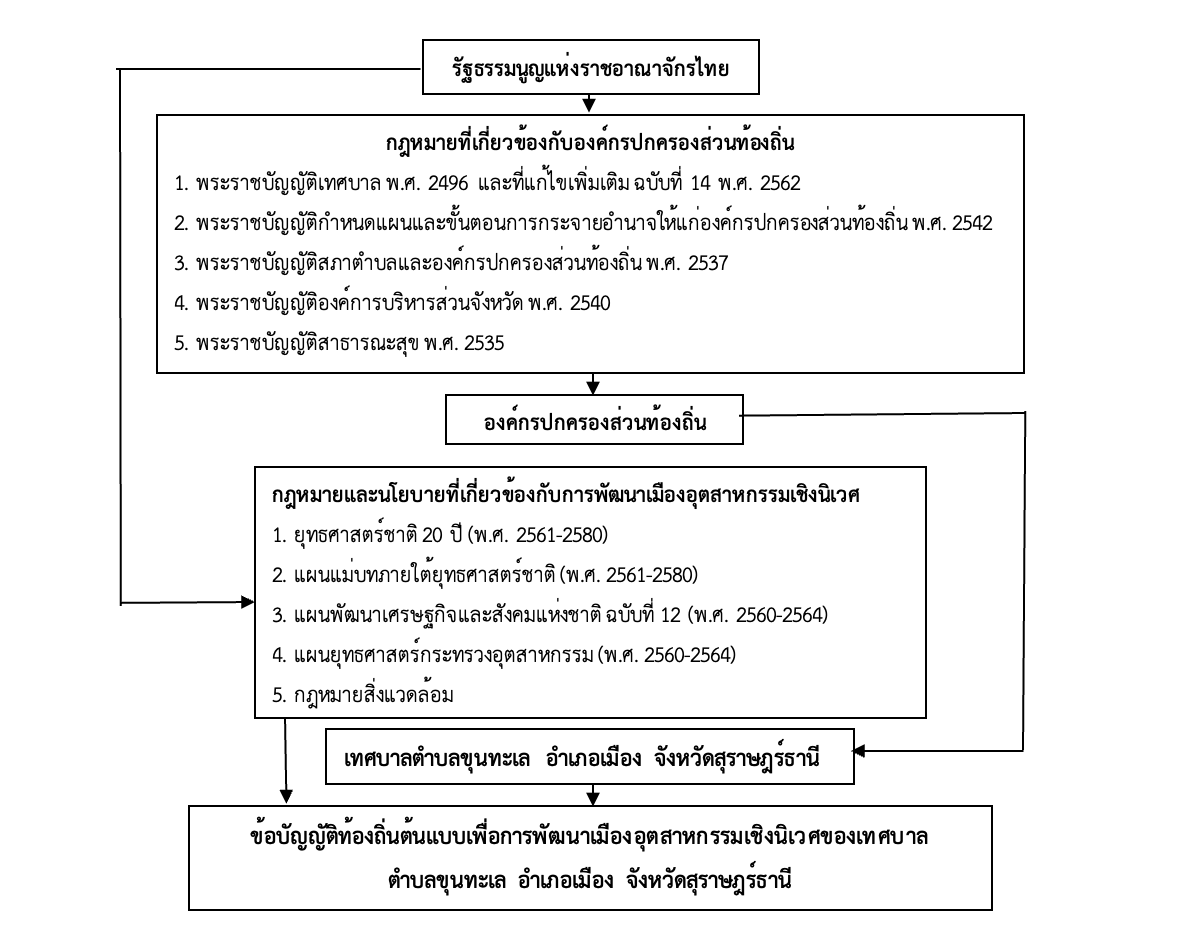
Introduction: Eco-industrial city development is an important approach to achieving a balance among economic, social, and environmental dimensions. Local administrative organizations play a significant role in issuing local ordinances to support such development. Khun Thale Subdistrict Municipality, Mueang District, Surat Thani Province, has experienced rapid industrial expansion, resulting in various problems. Therefore, appropriate local ordinances and public participation are essential for sustainable eco-industrial city development. Objectives: This research aimed to study: 1) the authority and duties related to issuing local ordinances for eco-industrial city development of Khun Thale Subdistrict Municipality, Mueang District, Surat Thani Province; 2) the problems and conditions of eco-industrial city development in the area; 3) community participation in drafting a model local ordinance; and 4) the formulation of a model local ordinance for eco-industrial city development. Method: This study employed qualitative research methods, including documentary research, in-depth interviews, and focus group discussions. The sample group consisted of 38 participants, including municipal administrators and officers, residents, and legal experts in Khun Thale Subdistrict Municipality. Result: The findings revealed that the issuance of local ordinances for eco-industrial city development by Khun Thale Subdistrict Municipality was in accordance with the legal framework prescribed by the Constitution of the Kingdom of Thailand B.E. 2560 (2017), the Municipal Act B.E. 2496 (1953), the Subdistrict Council and Subdistrict Administrative Organization Act B.E. 2537 (1994), and the Public Health Act B.E. 2535 (1992). The municipality could exercise only the powers explicitly granted by law and within the prescribed legal limits. Regarding development problems, physical issues included inappropriate urban planning and land use management. Economic problems arose from industrial factories being located near rapidly expanding communities, transforming agricultural societies into urban societies. Environmental problems included insufficient public utilities and industrial waste discharge. Social problems involved the increase of hidden populations and overcrowded communities due to industrial expansion. Administrative problems included a lack of cooperation among all sectors and unclear management policies. In terms of participation, most residents had limited involvement in eco-industrial city development; however, they suggested that industrial factories should adopt effective management practices that minimize environmental impacts and enhance the quality of life of local communities.
Downloads
Article Details

This work is licensed under a Creative Commons Attribution-NonCommercial-NoDerivatives 4.0 International License.
The author(s) is only responsible for data appearing in the submitted manuscript of Interdisciplinary social sciences and communication journal.Besides, this journal encourages and enables you to share data such as statements, contents, figures, etc. that support your research publication where appropriate, and enables you to interlink the data with proper citation.
References
Chakriksakuncha, J., Asa, R., & Dokkulab, N. (2019). Impacts of industrial factories on the quality of life of residents in Navanakorn Industrial Estate, Pathum Thani Province. Valaya Alongkorn Review, 14(3), 269–280.
Department of Industrial Promotion. (2015). Handbook of knowledge on eco-industrial development. Department of Industrial Promotion.
Jaijing, N., & Wongwisetthorn, K. (2022). Local ordinances. http://phothong101.go.th/index.php/page-id-56069/39-page-id-55007
Khun Thale Subdistrict Municipality. (2018). Four-year local development plan (2018–2021) of Khun Thale Subdistrict Municipality, Mueang District, Surat Thani Province. Khun Thale Subdistrict Municipality.
Kodsuwan, N., Anantanathorn, A., & Phuriphanik, T. (2022). Sustainable industrial city development: A case study of Laem Chabang Municipality, Chonburi Province [Unpublished master’s thesis]. Burapha University.
Kongklam, U. (2025). Community attitudes toward coexistence between local communities and industrial factories [Unpublished manuscript].
Meksuk, C., & Chantuek, T. (2018). Application of eco-efficiency for sustainable development in the automotive parts industry. Journal of Industrial Technology, 14(1), 65–76.
Muichin, S. (2014). Guidelines for eco-industrial city development in Map Ta Phut Municipality [Unpublished master’s thesis]. National Institute of Development Administration.
Surit, P. (2018). Development of appropriate indicators for local administrative organizations in implementing eco-industrial city operations. Journal of Environmental Management,14(2), 6–19.
Tuntiwadakarn, C. (2017). Final research report: Development of Northern Industrial Estates toward an eco-industrial city model. Good Governance Institute for Social and Environmental Development.
Uttamamunee, S. (2020). A study of urban expansion trends in peri-urban areas: A case study of Songkhla and Hat Yai urban areas [Unpublished master’s thesis]. Thammasat University.
