PERCEPTION, SATISFACTION, AND PURCHASE BEHAVIOR REGARDING WINONA COSMETIC PRODUCT COMMUNICATION VIA THE WEBSITE CHANNEL
Article Sidebar
Main Article Content
Abstract
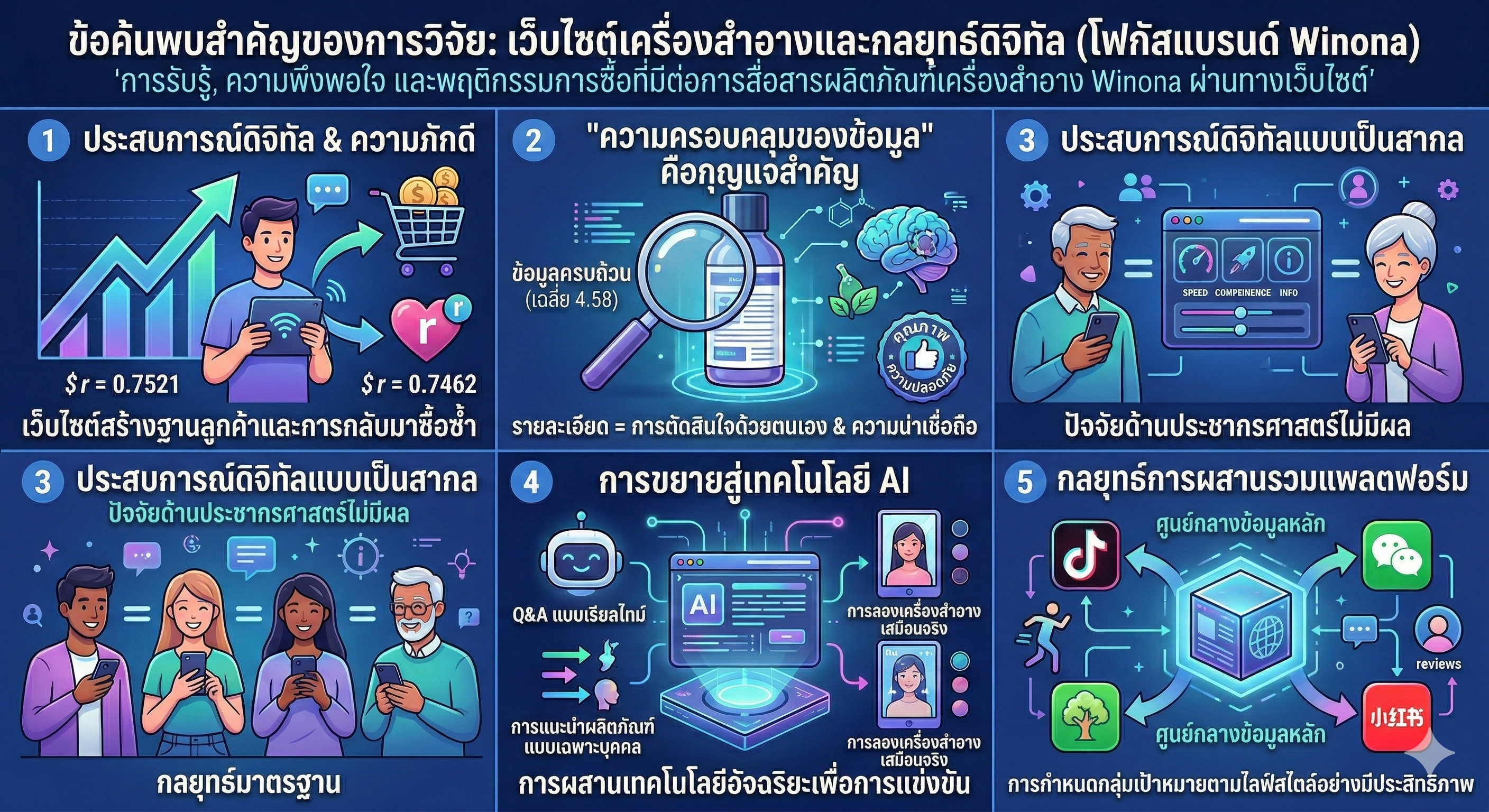
Introduction: Winona cosmetic product buying behavior relies on communication to create awareness through website channels. Objectives: this study aims to examine the perception, satisfaction, and purchasing behavior of Winona product users regarding Winona’s product communication through the website channel and investigate the relationship between perception and satisfaction toward website communication and purchasing behavior and brand loyalty toward Winona products. Methods: Quantitative research using questionnaires as a tool to collect cognitive data. The data were analyzed by percentage, average, standard deviation, and t-test and f-test values. Results: Consumers’ perception, satisfaction, and purchasing behavior of Winona products towards website communication were generally high (average 4.40), with awareness of information completeness (average 4.58) and ease of access to the website (average 4.57), and consumer satisfaction with the website was very high (average 4.51), with satisfaction with the convenience of using the website was the highest (average 4.60), and purchasing behavior and loyalty to Winona products were high. Consumers repurchased Winona products (average 4.45) and recommended Winona products to others (average 4.55), and hypothesis tests showed that demographic factors had no effect on consumer perception and satisfaction. But perception and satisfaction were significantly correlated with purchasing behavior and loyalty to Winona products (r = 0.7521 and r = 0.7462, respectively). Conclusion: Websites are an important tool for creating awareness. Entrepreneurs should develop their websites to provide a better user experience, such as adding AI chatbot features, automated product recommendation systems, and multimedia data presentations, to meet customer needs and increase competitiveness in China’s cosmetic product market.
Downloads
Article Details

This work is licensed under a Creative Commons Attribution-NonCommercial-NoDerivatives 4.0 International License.
The author(s) is only responsible for data appearing in the submitted manuscript of Interdisciplinary social sciences and communication journal.Besides, this journal encourages and enables you to share data such as statements, contents, figures, etc. that support your research publication where appropriate, and enables you to interlink the data with proper citation.
References
Aaker, D. A. (1991). Managing brand equity: Capitalizing on the value of a brand name. Free Press.
Assael, H. (1998). Consumer behavior and marketing action (6th ed.). South-Western College Publishing.
Berkman, H. W., Lindquist, J. D., & Sirgy, M. J. (1996). Customer behavior. NTC Publishing Group.
Boone, L. E., & Kurtz, D. L. (1998). Contemporary marketing wired (9th ed.). Harcourt Brace.
Butcher, K., Sparks, B., & O’Callaghan, F. (2001). Evaluative and relational influences on service loyalty. International Journal of Service Industry Management, 12(4), 310 - 327.
China Internet Network Information Center. (2021). The 48th statistical report on China’s internet development. https://www.cnnic.com.cn/IDR/ReportDownloads
Choeichanaya, P., Wiwatthanukul, M., & Anawatchasiriwong, T. (1995). Core concepts of communication studies (4th ed.). Khaofang Publishing.
Gerson, R. F. (1993). Measuring customer satisfaction. Crisp Publications.
Gremler, D. D., & Brown, S. W. (1996). Service loyalty: Its nature, importance, and implications. In B.Edvardsson, S. W. Brown, & R. Johnston (Eds.), Advancing service quality: A global perspective (pp. 171 - 180). International Service Quality Association.
Hawkins, D. I., Best, R. J., & Coney, K. A. (1998). Consumer behavior: Building marketing strategy (7th ed.). McGraw-Hill.
Jacoby, J., & Chestnut, R. W. (1978). Brand loyalty: Measurement and management. John Wiley & Sons.
Kasetsuwan, R. (2002). Quality management: From TQC to TQM, ISO 9000, and quality assurance.Bophit Printing.
Kim, A. J., & Ko, E. (2012). Do social media marketing activities enhance customer equity. An empirical study of luxury fashion brand. Journal of Business Research, 65(10), 1480 -1486. https://doi.org/10.1016/j.jbusres.2011.10.014
Kongkijkul, P. (2003). A practical guide to measuring customer satisfaction. Thammakorn Printing.
Kotler, P., & Armstrong, G. (1999). Principles of marketing. Prentice Hall.
Malithong, K. (1999). Web page and web graphic design. Chulalongkorn University Press.
Mowen, J. C., & Minor, M. (1998). Consumer behavior (5th ed.). Prentice Hall.
Oliver, R. L. (1997). Satisfaction: A behavioral perspective on the consumer. McGraw-Hill.
Parasuraman, A., Zeithaml, V. A., & Berry, L. L. (1988). SERVQUAL: A multiple-item scale for measuring consumer perceptions of service quality. Journal of Retailing, 64(1), 12 - 40.
Rust, R. T., & Oliver, R. L. (1994). Service quality: New directions in theory and practice. SAGE Publications.
Semenik, R. J. (2002). Promotion and integrated marketing communications. South-Western Thomson Learning.
Serirat, S. (1995). Consumer behavior. Phatthanasuksa.
Solomon, M. R. (2020). Consumer behavior: Buying, having, and being (13th ed.). Pearson.
Supachutikul, A. (1998). The first step of TQM/CQI in hospitals. Health Systems Research Institute.
Winona. (2024). Product. https://en.winona.cn/gw/index.html
