อิทธิพลของปัจจัยภายนอกและปัจจัยภายในที่ส่งผลต่อการรับรู้ประโยชน์และการรับรู้ความเสี่ยงที่จะเช่าพื้นที่ของห้างสรรพสินค้าของกลุ่มผู้ประกอบการสินค้าโอทอป ตามมุมมองทฤษฎี S-O-R
Article Sidebar
Main Article Content
บทคัดย่อ
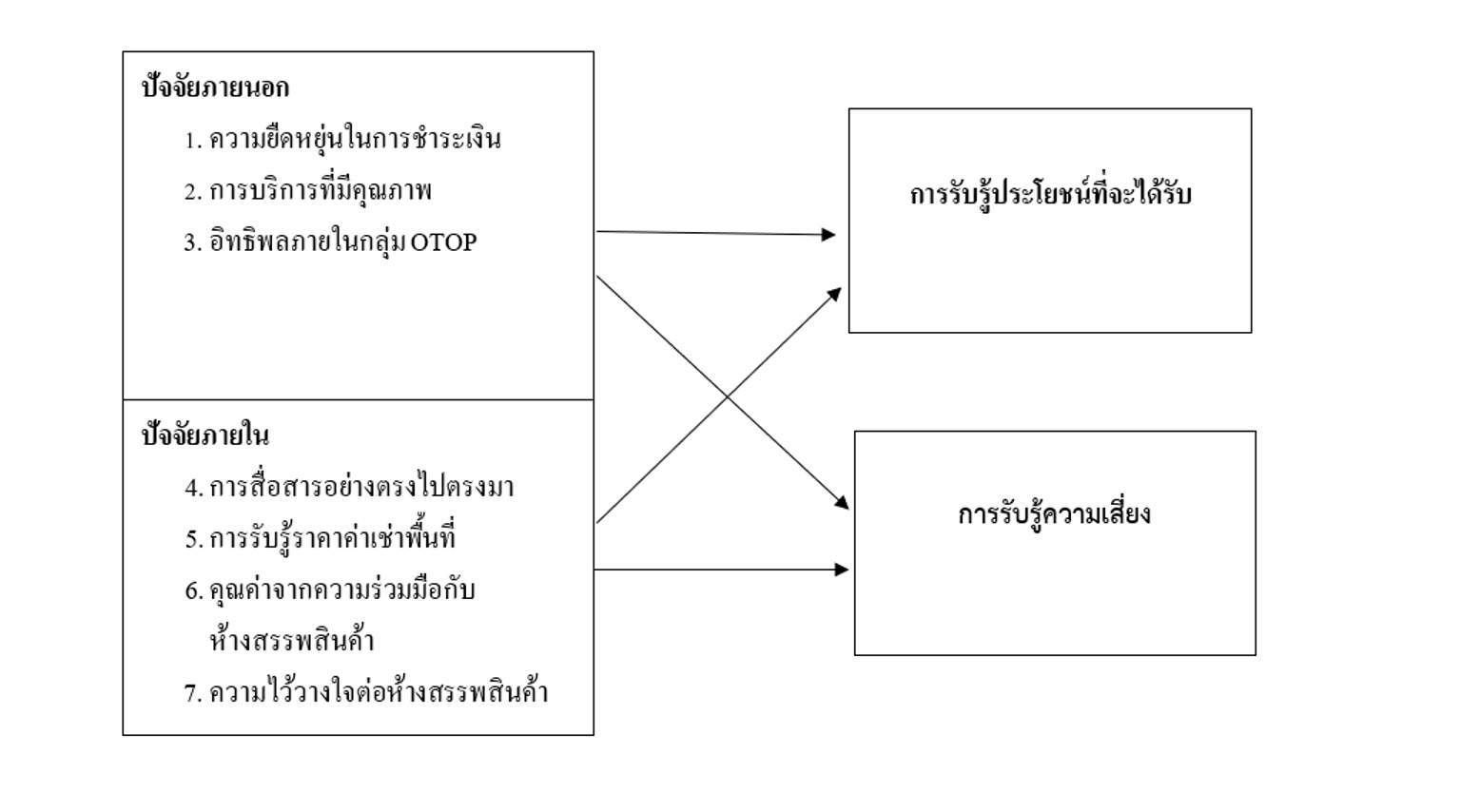
บทนำ: ช่องว่างของงานวิจัยนี้คือการศึกษาถึงตัวแปรอิทธิพลภายในกลุ่มผู้ประกอบการโอทอปด้วยกันเองที่ส่งผลต่อการรับรู้ประโยชน์และการรับรู้ความเสี่ยงในการเช่าพื้นที่ของห้างสรรพสินค้าและการนำทฤษฎี S-O-R มาใช้เพื่ออธิบายอิทธิพลของปัจจัยภายในและปัจจัยภายนอกที่ส่งผลต่อการรับรู้ประโยชน์และการรับรู้ความเสี่ยง วัตถุประสงค์ของการวิจัย: งานวิจัยนี้มีวัตถุประสงค์เพื่อศึกษา อิทธิพลของปัจจัยภายนอกและปัจจัยภายในที่ส่งผลต่อการรับรู้ประโยชน์และการรับรู้ความเสี่ยงที่จะเช่าพื้นที่ของห้างสรรพสินค้าของกลุ่มผู้ประกอบการสินค้าโอทอป ตามมุมมองทฤษฎี S-O-R ระเบียบวิธีวิจัย: โดยการศึกษานี้เป็นการวิจัยเชิงพรรณนาและวิจัยเชิงปริมาณ ใช้แบบสอบถามเป็นเครื่องมือในการเก็บรวบรวมข้อมูลจากกลุ่มตัวอย่างกลุ่มผู้ประกอบการสินค้าโอทอป จำนวน 270 ตัวอย่าง ในงานวิจัยครั้งนี้ผู้วิจัยใช้วิธีการเลือกตัวอย่างแบบไม่ใช้ความน่าจะเป็นและเลือกใช้วิธีเลือกตัวอย่างแบบเจาะจงสำหรับ ผลการวิจัย: พบว่าตัวแปรความยืดหยุ่นในการชำระเงิน การบริการที่มีคุณภาพ อิทธิพลภายในกลุ่ม โอทอป การสื่อสารอย่างตรงไปตรงมา การรับรู้ราคาค่าเช่าพื้นที่ ความไว้วางใจต่อห้างสรรพสินค้าส่งผลต่อการรับรู้ประโยชน์ที่จะเช่าพื้นที่ของห้างสรรพสินค้าของกลุ่มผู้ประกอบการสินค้าโอทอป และตัวแปรปัจจัยอิทธิพลภายในกลุ่ม โอทอป ส่งผลต่อการรับรู้ความเสี่ยงที่จะเช่าพื้นที่ของห้างสรรพสินค้าของกลุ่มผู้ประกอบการสินค้าโอทอป สรุป: งานวิจัยนี้พบว่าอิทธิพลของปัจจัยภายในและปัจจัยภายนอกที่ส่งผลต่อการรับรู้ประโยชน์และการรับรู้ความเสี่ยงที่จะเช่าพื้นที่ของห้างสรรพสินค้าตามมุมมองด้วยทฤษฎี S-O-R โดยงานวิจัยนี้ยังได้เสนอข้อเสนอแนะในเชิงวิชาการ ข้อเสนอแนะในเชิงการจัดการและข้อเสนอแนะในอนาคต
Downloads
Article Details

อนุญาตภายใต้เงื่อนไข Creative Commons Attribution-NonCommercial-NoDerivatives 4.0 International License.
** ข้อความ ข้อคิดเห็น หรือข้อค้นพบ ในวารสารสหวิทยาการสังคมศาสตร์และการสื่อสารเป็นของผู้เขียน ซึ่งจะต้องรับผิดชอบต่อผลทางกฎหมายใด ๆ ที่อาจเกิดขึ้นจากบทความและงานวิจัยนั้น ๆ โดยมิใช่ความรับผิดชอบของคณะนิเทศศาสตร์ มหาวิทยาลัยราชภัฏรำไพพรรณี **
เอกสารอ้างอิง
Armstrong, G., Adam, S., Denize, S., & Kotler, P. (2014). Principles of marketing. Pearson Australia.
Bagozzi, R. P. (1986). Attitude formation under the theory of reasoned action and a purposeful behaviour reformulation. British Journal of Social Psychology, 25(2), 95–107.
Brehm, J. W. (1989). Psychological reactance: Theory and applications. Advances in Consumer Research, 16(1). 43 -57.
Festinger, L. (1954). A theory of social comparison processes. Human Relations, 7(2), 117–140.
Hair, J., Black, W., Babin, B., & Anderson, R. (2010). Multivariate data analysis (7th ed.). Pearson Prentice Hall.
Hemaphan, P. (2022). Success of OTOP Nawattwithi tourism communities: Processes and institutional entrepreneurship [Article in Thai]. Journal of Community Development and Life Quality, 10(1), 22–34.
Jariangprasert, S., & Sirichai, P. (2023). Effects of website quality on perceived trust, perceived benefits, and perceived risk in purchasing cosmetics online among young adults [Article in Thai]. Journal of Business Administration and Liberal Arts, Rajamangala University of Technology Lanna, 11(2), 189–204.
Kaiyai, H., Pommarang, S., Wongla, P., & Sriburin, K. (2023). Mushroom product development,branding and packaging in Nong Bua Subdistrict, Phu Ruea District, Loei Province using the BCG concept for resource efficiency and value creation [Article in Thai]. Journal of Management Science Review, 25(2), 220–232. https://so03.tci-thaijo.org/index.php/msaru/article/view/269954
Khunkaew, A. (2019). Statistics for research (2nd ed.) [in Thai].Chulalongkorn University Press.
Mehrabian, A., & Russell, J. A. (1974). An approach to environmental psychology. MIT Press.
Morgan, R. M., & Hunt, S. D. (1994). The commitment-trust theory of relationship marketing.Journal of Marketing, 58(3), 20–38.
Mukherjee, A., & Nath, P. (2003). A model of trust in online relationship banking. International Journal of Bank Marketing, 21(1), 5–15.
Natsuda, K., Igusa, K., Wiboonpongse, A., & Thoburn, J. (2012). One Village One Product - rural development strategy in Asia: The case of OTOP in Thailand. Canadian Journal of Development Studies, 33(3), 369–385.
Nunnally, J. C. (1959). Tests and measurements. McGraw-Hill.
Phoeyamnat, S., Thamrongsinthaworn, S., Wiriyasuebphong, P., & Tangphatthanakij, C. (2020).Relationship investment, trust, and flexibility norms affecting the commitment of traditional retailers toward level-2 wholesalers in Chonburi Province [Article in Thai]. Journal of Management Science, Ubon Ratchathani University, 9(2), 38–54.https://so03.tci-thaijo.org/index.php/jms_ubu/article/view/215679
Piyaphimonlasit, C. (1998). Regression analysis [In Thai]. Walailak University.
Rithkharp, K., & Wisedphanit, N. (2025). A relationship model among perceived risk, perceived benefits, and trust of investors affecting investment intention of Generation Y investors [Article in Thai]. Journal of Applied Economics and Management Strategy, 12(1), 75–93.
Simon, H. A. (1990). Bounded rationality. In Utility and probability (pp. 15–18). Palgrave Macmillan.
Somboonsuniti, P., Thamrongsinthaworn, S., & Wiriyasuebphong, P. (2019). Influence of shared values, communication, and non-deceptive behavior on trust in health supplement companies via online social networks [Article in Thai]. Journal of Academic UMT Poly, 16(2), 112–124.https://so06.tci-thaijo.org/index.php/umt-poly/article/view/230242
Srithong, C., & Srithong, O. (2022). Business model development for community enterprise products: A case study of homemade fruit and herbal ice cream [Article in Thai].Journal of Management Science Review, 24(1), 21–32. https://so03.tci- thaijo.org/index.php/msaru/article/view/258483
Thomas, K. W. (2008). Thomas-Kilmann conflict mode. TKI Profile and Interpretive Report, 1(11),1–11.
Zhang, J., Jiang, N., Turner, J. J., & Pahlevan-Sharif, S. (2022). The impact of scarcity on consumers' impulse buying based on the SOR theory. Frontiers in Psychology, 13,792419.
