THE DEVELOPMENT OF PATTERN DESIGNS FROM NORA BEAD COSTUMES FOR PRODUCT DESIGN
Article Sidebar
Main Article Content
Abstract
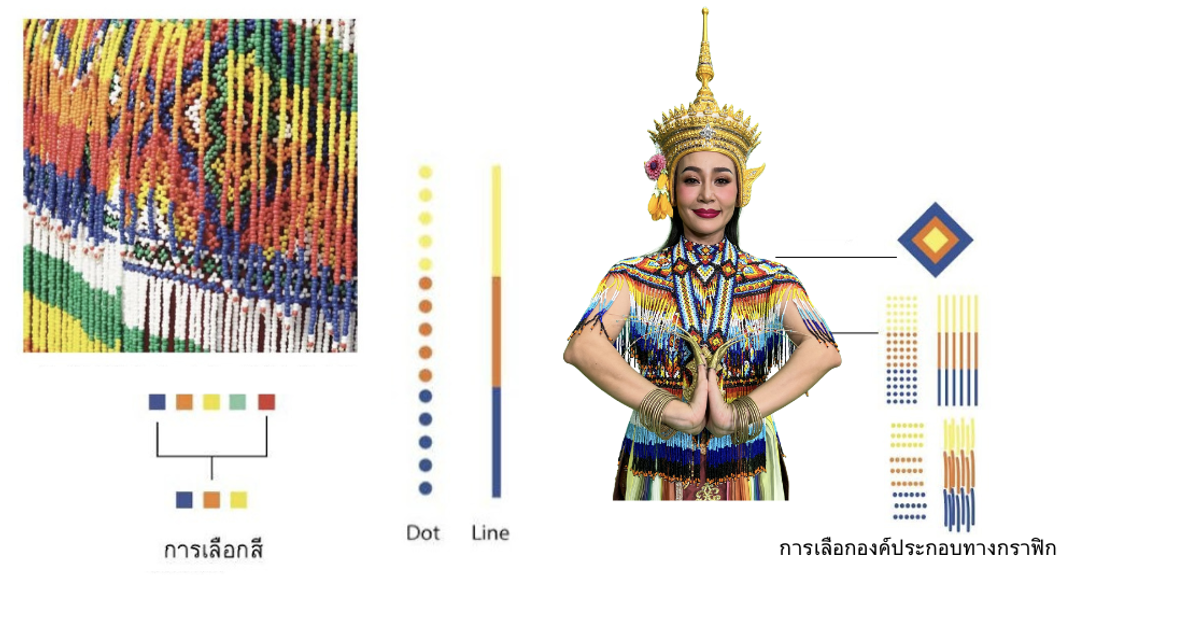
Introduction: The Development of Pattern Designs from Nora Bead Costumes for Product Design Objective: Nora beaded costumes and their application in product development. Using a qualitative approach Methods: the research involved four stages: (1) analyzing the pattern components of Nora bead costumes, (2) designing and developing graphic patterns, (3) evaluating the designs by experts, and (4) assessing user satisfaction with prototype products. Instruments included a pattern quality evaluation form by five experts and a satisfaction questionnaire conducted with 100 participants. Results: The study found that (1) Nora bead costume patterns feature dots arranged in straight and geometric formations, with vivid colors such as blue, orange, yellow, green, and red; (2) the design process involved creating six black-and-white line pattern sketches by the researchers, evaluated by experts, from which three suitable designs were refined using warm tones to convey brightness and energy; and (3) three types of prototype products were developed: (a) clothing (men’s and women’s shirts), (b) multi-purpose fabrics (curtains and furniture textiles), and (c) handmade crafts (mobile phone cases and handbags). Conclusion: The prototypes achieved high satisfaction ratings (M = 3.50, SD = 0.72), particularly for handbags and phone cases. High satisfaction was reported in four areas: (a) the patterns’ clarity and universality, (b) the appropriateness and distinctiveness of design elements, (c) the novelty of the designs, and (d) the integration of Nora identity. Overall, the study highlights the potential contribution of Nora cultural identity to the advancement of contemporary creative industries.
Downloads
Article Details

This work is licensed under a Creative Commons Attribution-NonCommercial-NoDerivatives 4.0 International License.
The author(s) is only responsible for data appearing in the submitted manuscript of Interdisciplinary social sciences and communication journal.Besides, this journal encourages and enables you to share data such as statements, contents, figures, etc. that support your research publication where appropriate, and enables you to interlink the data with proper citation.
References
Bamroongraks, C., & Phonphong, S. (2016). Design and Meaning Communications Analysis of Selected Snack’s Packing. Siam Communication Review, 15(18), 158–167. https://so05.tci-thaijo.org/index.php/commartsreviewsiamu/article/view/174011/124672.
Chongchitphotha, S. (2011). Ongprakop sinlapa [Elements of Art]. Watsin.
Chulnauln, S. (2013). The study of Nora performance for Home Furnishing Design. [Unpublished master's thesis]. Silpakorn University.
Dechana, S. (2019). The creation of contemporary painting by dotting method: A case study of colors and patterns from Nora costume. Patanasilpa Journal, 3(2), 35 – 42. https://so05.tci-thaijo.org/index.php/Patanasilpa/article/view/252168/170588.
Matchika, A. (2015). Nora : The creation of textile art for decoration of Nora Buri Resort & Spa, Koh Samui. [Unpublished master's thesis]. Silpakorn University.
Natchanalit, P. (2017). The design principle development of bite size food style based on art principlesand visual art elements. Veridian E-Journal,Silpakorn University (Humanities, Social Sciences and arts), 10(2), 1563-1565. https://he02.tci-thaijo.org/index.php/Veridian-E-Journal/article/view/99595/77394.
Nikomrat, T. (2014). Nora kap khotsana [Nora with advertising]. Walailak Abode of Culture Journal, 14(1), 11-26. https://so06.tci-thaijo.org/index.php/cjwu/article/view/95328/74460.
Nippon Color&Design Research Institute. (2021, March 22). Image Scale System. http://www.ncd-ri.co.jp/Introduction/ImageScaleSystem.html.
Pholboon, J., & Isamo, O. (2019).The Pattern Created from The Cempedak Fruit Handcraft Products (Khro). Proceedings of the 13th Rambhai Barni Rajabhat University National Research Conference pp. 436–444). Research and Development Institute, Rambhai Barni Rajabhat University.
Poomahapinyo, S. (2020). Pattern Graphic Design of Printed Fabric to Present the Identity of Phetchaburi Karen’s Woven Fabric. Journal of Humanities and Social Sciences Review (JHSSR). 22(2), 100 - 121. https://so05.tci-thaijo.org/index.php/hspbruacthjournal/article/view/252895/171333.
Singhkhum, I. (2014). Analysis of Khit Baisi patterns using Shape Grammars principles. Built Environment Inquiry – BEI, 13(11), 55-68. https://so01.tci-thaijo.org/index.php/arch-kku/article/view/45473/37613.
