
BRAND LOYALTY AND MARKETING MIX INFLUENCES ON THE PURCHASE DECISION PROCESS FOR DOG AND CAT FOOD AMONG WORKING ADULTS IN PET SHOPS IN BANGKOK
Article Sidebar
Main Article Content
Abstract
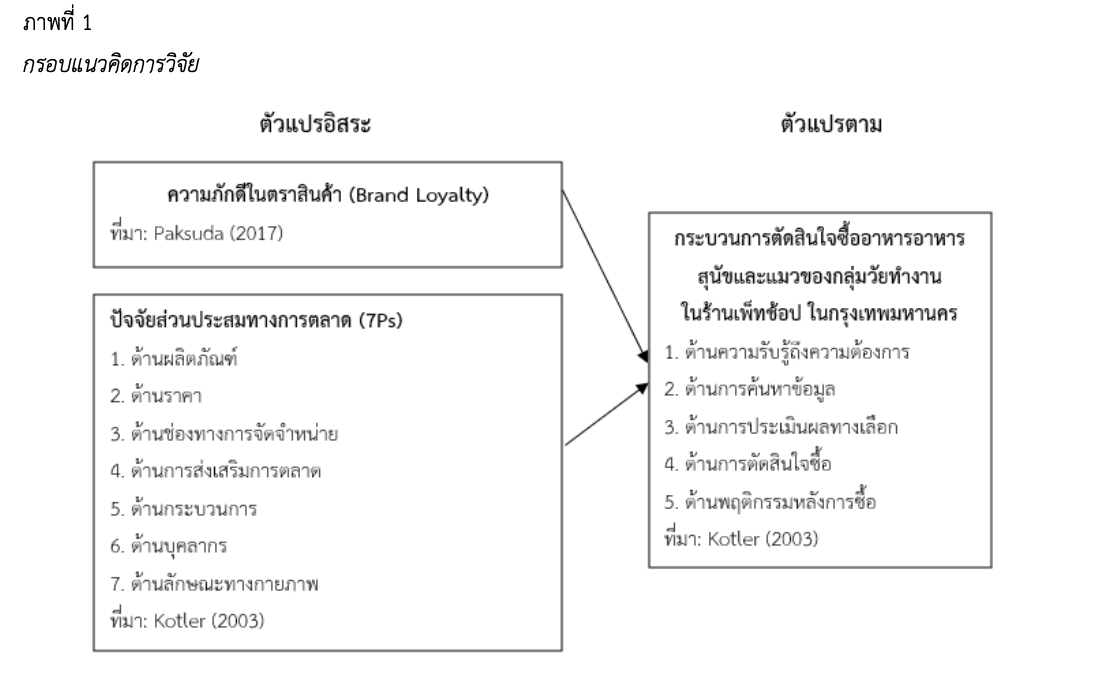
Introduction: The practice of raising dogs and cats as family members, with some even generating income, has significantly boosted the pet industry, leading to the growth of the pet food market. Additionally, post-COVID lifestyle changes have resulted in more people purchasing products in-person at pet shops, thus further driving the market's expansion. This research will benefit pet shop owners and pet food manufacturers. Objective: is to study brand loyalty and the marketing mix factors (7Ps) that influence the purchasing decision process of dog and cat food among working-age consumers at pet shops in Bangkok. Methods: This is quantitative research. The tool used for data collection was a questionnaire distributed to a sample group of working individuals aged 25-55 years who own dogs and cats in Bangkok and had experience purchasing dog and cat food in pet shops, totaling 408 samples. Descriptive statistics, including percentages, means, and standard deviations, were used. Inference Statistics uses simple regression analysis and multiple regression analysis. Results: brand loyalty influences the decision-making process for purchasing dog and cat food products among working age groups. In the pet shop in Bangkok as for the marketing mix (7Ps), there are 5 aspects that influence the decision-making process for buying dog and cat food: Product, Price, Distribution Channel (Place), Marketing Promotion (Promotions) and Process aspect has a positive influence with statistical significance at the 0.05 level. Conclusion: This research can benefit pet business operators in developing marketing strategies and responding to consumer needs, thereby enhancing competitiveness and fostering long-term brand loyalty.
Downloads
Article Details

This work is licensed under a Creative Commons Attribution-NonCommercial-NoDerivatives 4.0 International License.
The author(s) is only responsible for data appearing in the submitted manuscript of Interdisciplinary social sciences and communication journal.Besides, this journal encourages and enables you to share data such as statements, contents, figures, etc. that support your research publication where appropriate, and enables you to interlink the data with proper citation.
References
โกศล น่วมบาง. (2562). การสร้างการรับรู้ตราสินค้าใหม่เพื่อความภักดีต่อตราสินค้าของผู้บริโภค [วิทยานิพนธ์ปริญญามหาบัณฑิต, มหาวิทยาลัยราชภัฏสวนสุนันทา]. ฐานข้อมูลวิทยานิพนธ์อิเล็กทรอนิกส์
Aaker, D.A. (1991). Managing Brand Equity, Capitalizing on the value of a brand name. New York: The Free Press.
Atit, B. (2023). Brand Factors that Affect Decide to Purchasing. Master of Business Administration, Bangkok
University. Retrieved from http://dspace.bu.ac.th/handle/123456789/5589
Chotivith, K. (2020). Consumers decision making process of buying dog and cat food from fresh market in
Muang district, Chiang Mai province, Independent Study, Master of Business Administration, Chiang Mai Rajabhat University.
Kotler, P. (2003). Marketing management (11th ed.). Prentice-Hall.
Kotler, P., & Keller, K. L. (2022). Marketing Management (16th ed.). Pearson Education.
Krit Papavee. (2023). A Study of Brand Equity, Integrated Marketing Communications and Marketing Mix that Affected Buying of Pork Crackers of the Consumers in Bangkok and Vicinity. Bangkok University. Retrieved from http://dspace.bu.ac.th/handle/123456789/5578
Manager Online. (2023, February 6). ‘Pet care business’ in Thailand booms, growing by 91% in 2022 due
to societal changes. Pets are treated as family members. MGR Online. Retrieved from
https://mgronline.com/smes/detail/9660000011613
Nattanon, C. (2020). Trust, buying behavior, values and brand loyalty affecting customer’s purchase
decision to buy mirrorless digital Camera in Bangkok. Bangkok University. Retrieved from http://dspace.bu.ac.th/handle/123456789/4365
Nattaporn, C. (2022). Factors influencing consumer satisfaction in selecting pets through online channels.
Mahidol University. Retrieved from https://archive.cm.mahidol.ac.th/handle/123456789/4537?mode=simple
Nunnally, J. C. (1978). Psychometric theory. McGraw-Hill.
Oliver, R. L. (1999). Whence consumer loyalty? The Journal of Marketing, 33-44.
Paksuda, P. (2017). Factors affecting Scotch brand loyalty. Rajamangala University of Technology Phra
Nakhon. Retrieved from https://repository.rmutp.ac.th/handle/123456789/2452
Polit, D. F., & Beck, C. T. (2008). Nursing research: Generating and assessing evidence for nursing practice (8th ed.). Lippincott Williams & Wilkins.
Siriwan, S., & others. (1998). New era marketing management. Teerafilm and Scitex
ttbbank. (2024, March 15). TTB Analytics expects the pet market value to grow by 12.4% in 2024.
Retrieved from https://www.ttbbank.com/th/newsroom/detail/ttba-pet-market-202.
Wannakamon, K. (2020). Brand Loyalty, value, and marketing mix affecting decision to Buy DoiKam Brand
of consumers in Bangkok. Master of Business Administration, Bangkok University. Retrieved from http://dspace.bu.ac.th/handle/123456789/4452
Weerada, S. (2018). Marketing mix (7Ps) factors affecting customers' decisions to purchase products from
The Pharma drugstore in Bangkok. Mahidol University. Retrieved from
https://archive.cm.mahidol.ac.th/handle/123456789/3230
WP. (2023, February 18). "Pet Humanization" when humans raise pets like children - willing to spend
heavily, driving the "Petconomy" growth. MarketingOops. Retrieved from
https://www.marketingoops.com/reports/industry-insight/pet-humanization-petconomy/
