
THE DEVELOPMENT OF AN INFORMATION SYSTEM TO PROMOTE ONLINE MARKETING FOR SAFE AGRICULTURAL PRODUCT STANDARD NO. 8 USING QR CODE IN PHANOM SARAKHAM DISTRICT, CHACHOENGSAO PROVINCE
Article Sidebar
Main Article Content
Abstract
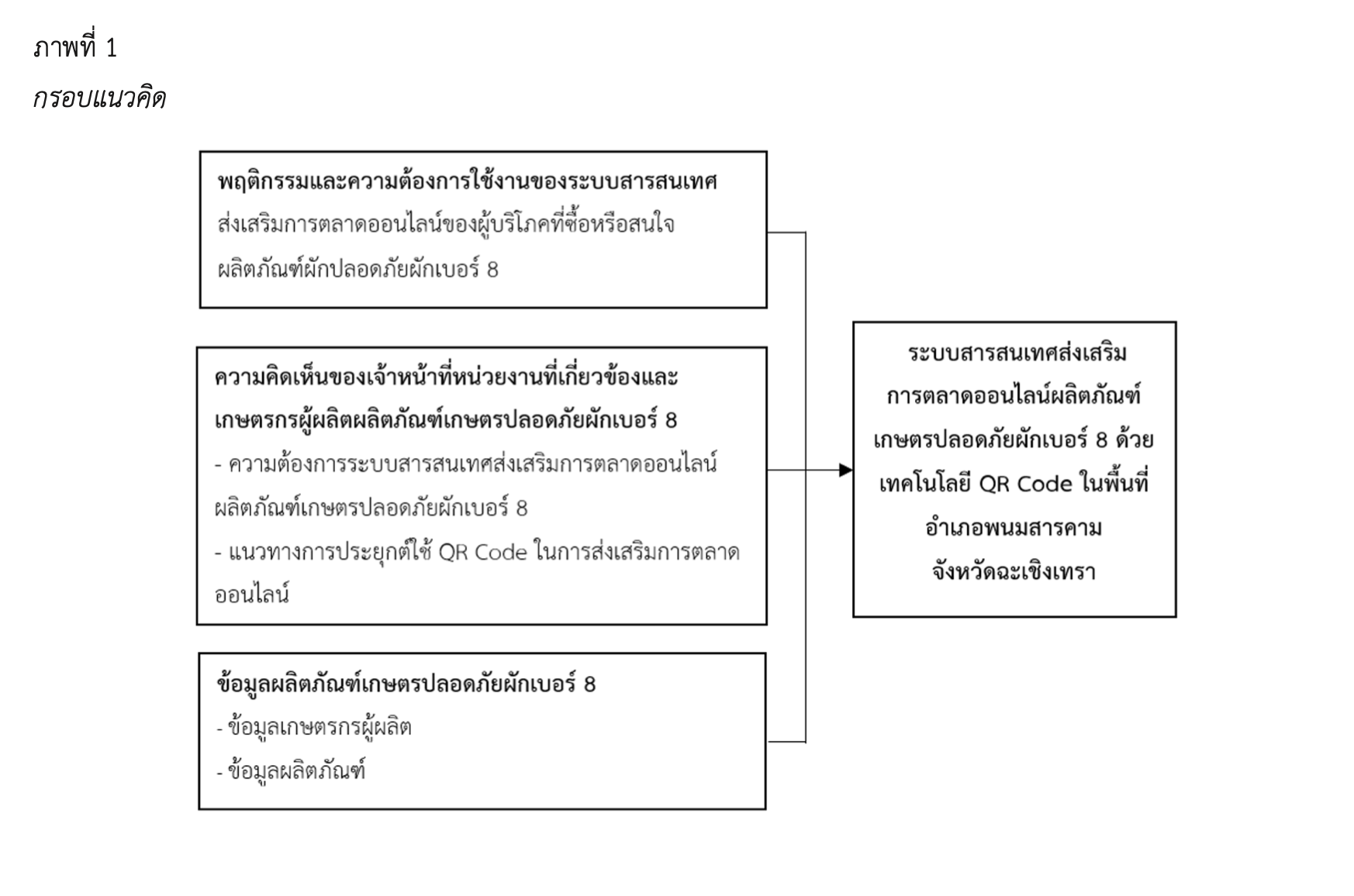
The objectives of this research are: 1) to study consumer behavior and demand for an online marketing promotion information system for safe agricultural products, 2) to study the requirements of an online marketing promotion information system for farmers who produce safe agricultural products, 3) to survey and gather basic information about safe agricultural products from farmers in Phanom Sarakham District, Chachoengsao Province, and 4) to develop and evaluate the suitability of the online marketing promotion information system. The sample groups for this research included: 1) 400 consumers who purchased or were interested in safe agricultural products, 2) 10 officials and farmers involved in producing safe agricultural products, and 3) 400 consumers who used the online marketing promotion information system and were interested in safe agricultural products. The instruments used in the study included: 1) a survey form on consumer behavior and demand for the online marketing promotion information system, 2) an interview form, 3) a survey form for Safe Agricultural Product Standard No. 8 in Phanom Sarakham District, and 4) a questionnaire on the suitability of the online marketing promotion information system for safe agricultural products using QR Code technology. The findings are divided into 4 phases: Phases 1: The results of the survey on consumer behavior and demand for an online marketing promotion information system for safe agricultural products showed that respondents had a high overall demand, with a mean score of 4.10 and a standard deviation of 0.42. Phases 2: The results of in-depth interviews with officials and farmers revealed that the current data collection system does not cover basic information. It was suggested that product standards, basic farmer information, environmental details, activities, highlights, and communication channels be disseminated through an online system using QR codes to facilitate faster and more efficient information usage. Phase 3: Results of the survey and collection of basic information on safe agricultural products revealed that there were 54 farmers in Phanom Sarakham District, Chachoengsao Province, who had been certified under Safe Agricultural Product Standard No. 8 across all five sub-districts in the area. Phase 4: Results of the development and suitability assessment of the online marketing promotion information system for safe agricultural products standard No. 8 using QR code technology in Phanom Sarakham District followed the 5-step System Development Life Cycle (SDLC) process. The system was developed as a web-based database using HTML5, PHP, and Bootstrap to support various devices such as computers, tablets, and smartphones. The system was disseminated via the Internet under the domain www.pak8riew.com. The assessment of system suitability found that the system achieved an overall score of 4.54, with a standard deviation of 0.55, indicating a very high level of appropriateness.
Downloads
Article Details

This work is licensed under a Creative Commons Attribution-NonCommercial-NoDerivatives 4.0 International License.
The author(s) is only responsible for data appearing in the submitted manuscript of Interdisciplinary social sciences and communication journal.Besides, this journal encourages and enables you to share data such as statements, contents, figures, etc. that support your research publication where appropriate, and enables you to interlink the data with proper citation.
References
กลุ่มส่งเสริมและพัฒนาการผลิต สำนักงานเกษตรจังหวัดฉะเชิงเทรา. (2560). คู่มือการดำเนินงานโครงการพัฒนาสินค้าเกษตรปลอดภัยสูง ปี 2560 จังหวัดฉะเชิงเทรา.
จักรกฤษณ์ หมั่นวิชา. (2556). การประยุกต์ใช้บาร์โค้ดสองมิติ (2D Barcode) เพื่อการจัดการระบบเทคโนโลยีสารสนเทศสำหรับธุรกิจ. วารสารหาดใหญ่วิชาการ, 12(2), 183-193.
ชิดชนก ศาสตรานนท์. (2550). แผนกลยุทธ์เพื่อการสร้างระบบตรวจสอบย้อนกลับสำหรับสินค้ากลุ่มผักและผลไม้. (วิทยานิพนธ์ วิทยาศาสตรมหาบัณฑิต, มหาวิทยาลัยเกษตรศาสตร์). ศูนย์ข้อมูลการวิจัย Digital วช. https://dric.nrct.go.th/direct_fulltext.php?bid=DRL001819&file=5215000107.pdf
ชูศรี วงศ์รัตนะ. (2560). เทคนิคการใช้สถิติเพื่อการวิจัย. อมรการพิมพ์.
ณัฐพล ใยไพโรจน์. (2563). Digital Marketing Concept & Case Study. ไอดีซี พรีเมียร์.
ดวงใจ ธรรมนิภานนท์. (2557). กลยุทธ์การตลาดผลิตภัณฑ์ความงามผ่านช่องทางการค้าแบบดิจิทัล. (วิทยานิพนธ์ บริหารธุรกิจมหาบัณฑิต, มหาวิทยาลัยเนชั่น). สำนักงานวิจัยแห่งชาติ. https://doi.nrct.go.th//ListDoi/listDetail?Resolve_DOI=10.14458/NTU.res.2014.18
ธัญญลักษณ์ พลวัน และคณะ. (2557). การศึกษาพฤติกรรมการใช้เทคโนโลยีและปัจจัยที่มีผลต่อการยอมรับเทคโนโลยี QR Code ของกลุ่มประชากรในเขตกรุงเทพมหานคร. วารสารวิศวกรรมสาร มก. 27(88), 29-40.
นราศรี ไววนิชกุล และชูศักดิ์ อุดมศรี. (2549). ระเบียบวิธีวิจัยธุรกิจ (พิมพ์ครั้งที่ 17). โรงพิมพ์แห่งจุฬาลงกรณ์มหาวิทยาลัย.
ภัทศา ผุงเพิ่มตระกูล และชุติมา ไวศรายุทธ์. (2555). แนวทางการพัฒนาระบบการจัดการคุณภาพและความปลอดภัยของสินค้าเกษตรและอาหารของประเทศไทย. คณะอุตสาหกรรมเกษตร มหาวิทยาลัยเกษตรศาสตร์.
ภาวุธ พงษ์วิทยภานุ และสุธน โรจน์อนุสรณ์. (2551). e-Marketing เจาะเทคนิคการตลาดออนไลน์. พงษ์วรินการพิมพ์.
วิมาลี วิวัฒนกุลพาณิชย์. (2559). การตลาด QR Code. วารสาร K SME Inspired. 10(37), 48-49.
อุไรพร ชลสิริรุ่งสกุล. (2554). Digital Marketing ไอเดียลัดปฏิวัติการตลาด. กรุงเทพธุรกิจ.
โอภาส เอี่ยมสิริวงศ์. (2555). การวิเคราะห์และออกแบบระบบ. ซีเอ็ดยูเคชั่น.
ฮาบิบ บิณอะฮมัด, อับดุลมายิ มูดอ และมารีแย สนิแจ๊ะนะ. (2557). การพัฒนาระบบติดตามผลิตภาพการผลิตโดยใช้รหัส
คิวอาร์ กรณีศึกษาอุตสาหกรรมเครื่องนุ่งห่มและสิ่งทอ. มหาวิทยาลัยนราธิวาส.
