COST MANAGEMENT STRATEGIES FOR SPA PRODUCTS ONLINE PURCHASING OF WELLNESS SPA ENTREPRENEURS IN BANGKOK
Article Sidebar
Main Article Content
Abstract
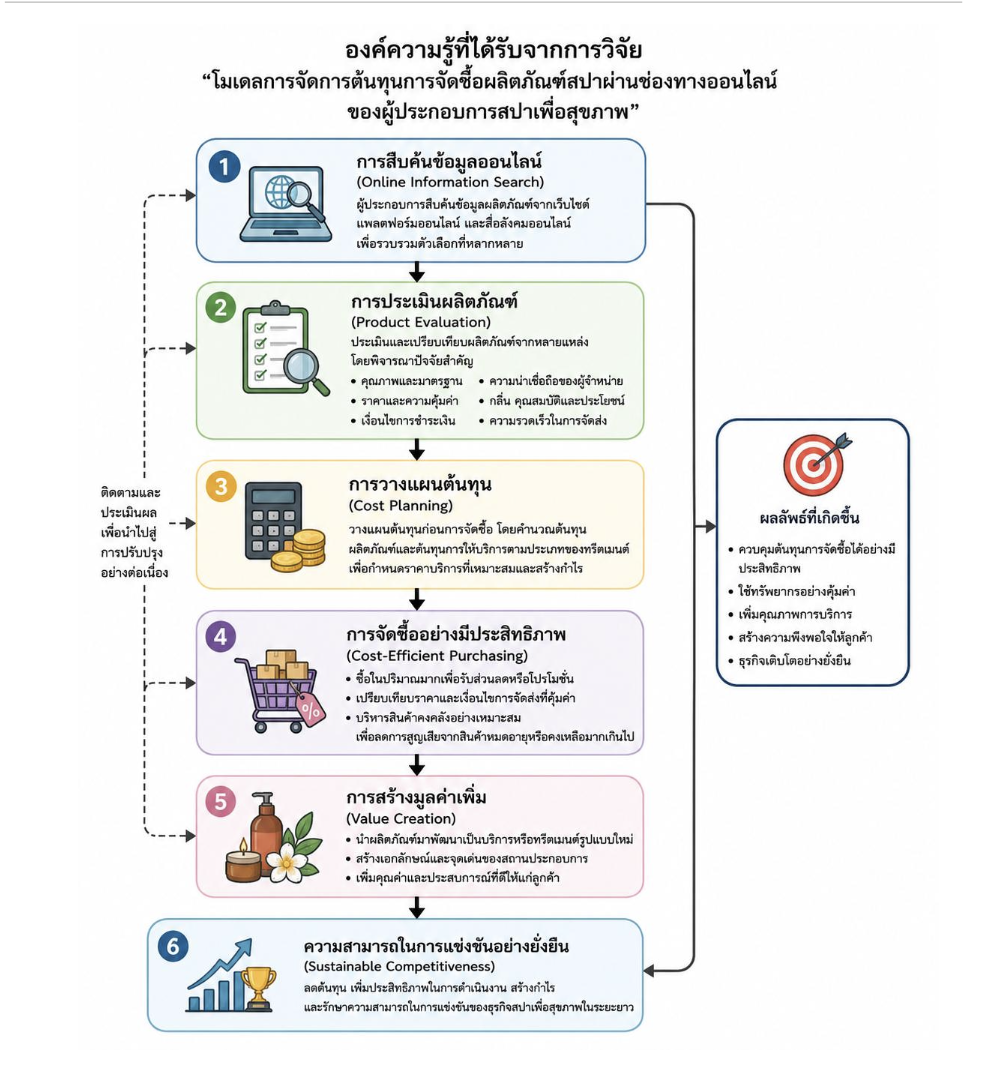
Introduction: The growth of the wellness spa business and the increasing use of digital technologies have encouraged spa entrepreneurs to purchase spa products through online channels. Online purchasing provides convenience, access to product information, price comparisons, and promotional offers, which can contribute to more effective cost management and business operations. Objective: 1) To study the patterns and processes of purchasing spa products through online channels among wellness spa entrepreneurs in Bangkok; and 2) To investigate cost management strategies in purchasing spa products through online channels among wellness spa entrepreneurs in Bangkok. Method: This study employed a qualitative research approach using in-depth interviews. Data were collected from 10 wellness spa entrepreneurs in Bangkok selected through purposive sampling. A semi-structured interview guide was used as the research instrument, and the data were analyzed using content analysis. Results: The findings revealed that wellness spa entrepreneurs searched for product information through online channels and considered product characteristics, appearance, quality standards, scents, benefits, pricing, and supplier credibility before making purchasing decisions. They also compared quotations and product samples to evaluate quality and reliability. Payment methods included cash and bank transfers, while accurate and timely delivery was considered an important factor. Regarding cost management strategies, entrepreneurs planned purchases in advance to calculate actual costs based on service activities and treatment requirements. Purchasing products in bulk, obtaining discounts and promotional offers, reducing excessive inventory, preventing product expiration, and creating added value through new products and services were identified as important strategies for cost reduction and business competitiveness. Conclusion: Online purchasing enables wellness spa entrepreneurs to access product information efficiently, compare alternatives, and manage procurement costs effectively. Strategic cost management through planning, inventory control, promotional purchasing, and value creation contributes to operational efficiency and sustainable competitiveness in the wellness spa business.
Downloads
Article Details

This work is licensed under a Creative Commons Attribution-NonCommercial-NoDerivatives 4.0 International License.
The author(s) is only responsible for data appearing in the submitted manuscript of Interdisciplinary social sciences and communication journal.Besides, this journal encourages and enables you to share data such as statements, contents, figures, etc. that support your research publication where appropriate, and enables you to interlink the data with proper citation.
References
Thornsiripunnarote, T., Tunpow, K., & Kanchanathaveeku, K. (2019). Marketing strategy to success of spa entrepreneurs through digital channels in Bangkok metropolitan region. Journal of the Association of Researchers, 24(1), 72–84. https://so04.tci-thaijo.org/index.php/jar/article/view/240876/164030
Department of Health Services Support. (2020). Number of licensed establishments. https://data.go.th/dataset/hss_11_38
Cherdboonmuang, S., Lomprakhon, C., & Klaharn, V. (2014). Marketing factors and purchasing behaviors through electronic commerce among consumers in Bangkok. Panyapiwat Journal, 5(Special Issue), 76–91.
Nawchampa, S., et al. (2016). Guidelines for holistic wellness spa business management. Journal of Health Research and Development, 9(3), 210-223.
Ueajiraphan, P. (2006). Strategic cost management. Top Publishing.
Tunsakul, Y. (2009). Online marketing management and information technology for competitiveness. Journal of Management Sciences, 26(2), 45-58.
Sangkatat, S. (2021). Strategic cost management of product organizations during COVID-19. Journal of Humanities and Social Sciences, Rajapruk University, 7(1), 1–13. https://so03.tci-thaijo.org/index.php/rpu/article/view/251634
Fongsamuth, S. (2015). Linking logistics concepts to personal financial planning. Journal of Logistics and Supply Chain, 11(2), 89-102.
Udon, R. (2011). Application of activity-based costing system to improve cost calculation in printing business [Unpublished master’s thesis]. Thammasat University].
Junead, J., Jamnongchob, A., Wanichakorn, A., & Manirochana, N. (2018). The study on potential of Thai identity in spa business and traditional Thai massage toward world-class health tourism sector. Panyapiwat Journal, 10(2), 1-16.
