DEVELOPING SERVICE EMPLOYEES IN THE SPA BUSINESS TO SUPPORT THE ASEAN COMMUNITY
Article Sidebar
Main Article Content
Abstract
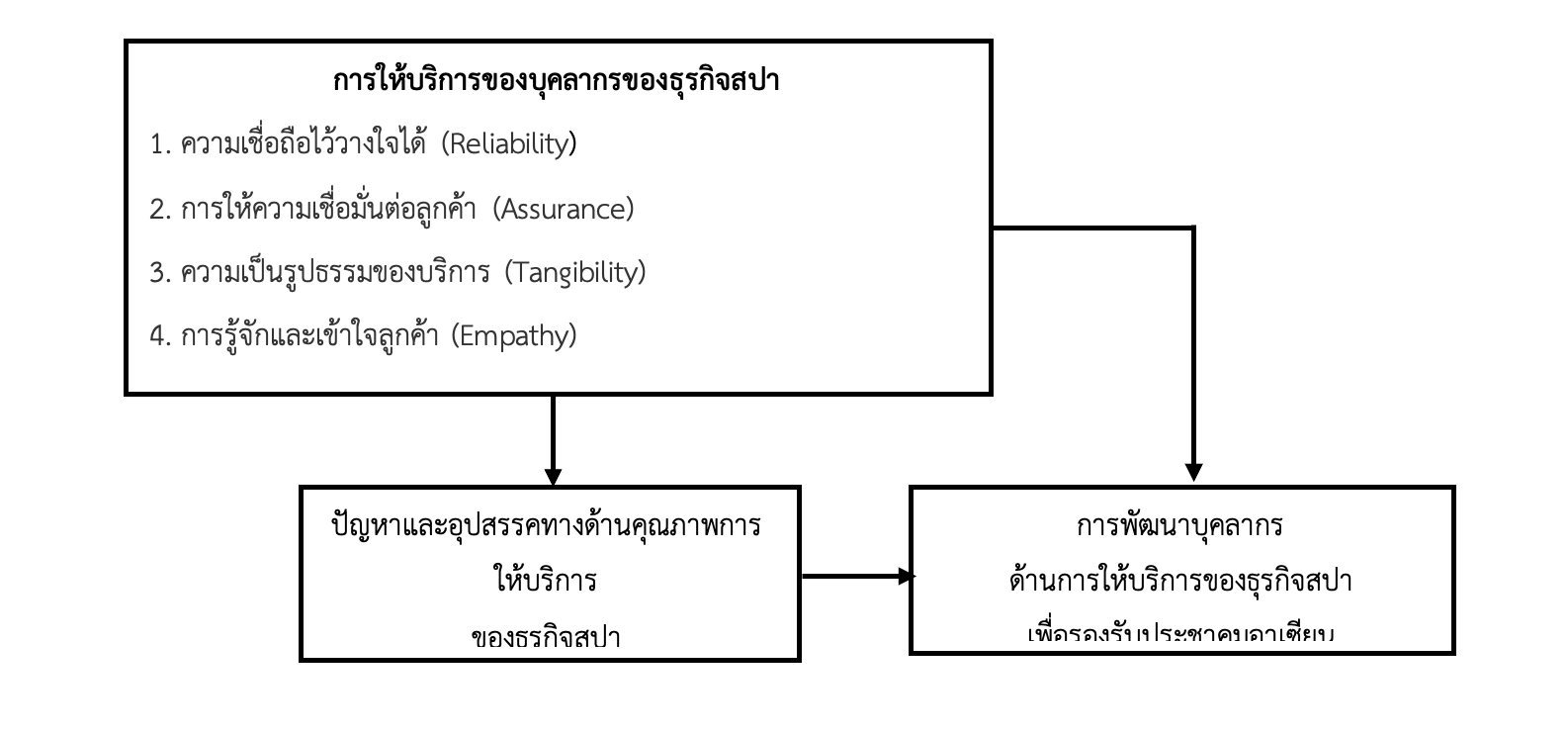
The objectives of this research study were to study 1) services provided by spa business employees; 2) challenges and obstacles regarding the service quality of spa business employees; and 3) guidelines for improving service employees in the spa business to support the ASEAN community. This research was mixed methods research included both a quantitative and qualitative. The quantitative research population consisted of people who had used spa business services. The exact number was not known, so the sample size was determined by a formula with a 95% reliability and an error of no more than 5%. The population proportion was 0.50, resulting in a sample size of 400 people. The data was analyzed using descriptive statistics, including percentage, mean, and standard deviation for the quantitative data. A semi-structured questionnaire was employed for qualitative research. The key informants consisted of 10 spa business owners and 10 spa business employees. The data was analyzed using content analysis.
The results of the research found that:
- The overall service level of spa business employees in terms of concreteness of service, response to customers, giving confidence to customers, trustworthiness, and knowing and understanding customers was at the highest, with an average of 4.38 and a standard deviation of 0.09.
- Problems and obstacles to the quality of services provided by spa business employees were found as a shortage of spa employees with necessary skills and certifications, employees' use of foreign languages, a lack of knowledge of public relations and marketing, unsystematic management, and quality control problems in services.
3. The guidelines for improving the quality of employee service in spa businesses to support the ASEAN community included developing foreign languages for entrepreneurs and service employees in the spa business, obtaining a health spa operating license from the Ministry of Public Health for entrepreneurs, improving service employees' knowledge of spa science, and developing good service quality
Downloads
Article Details

This work is licensed under a Creative Commons Attribution-NonCommercial-NoDerivatives 4.0 International License.
The author(s) is only responsible for data appearing in the submitted manuscript of Interdisciplinary social sciences and communication journal.Besides, this journal encourages and enables you to share data such as statements, contents, figures, etc. that support your research publication where appropriate, and enables you to interlink the data with proper citation.
References
กระทรวงการท่องเที่ยวและกีฬา. (2564). รายงานสภาวะเศรษฐกิจการท่องเที่ยว. สืบค้นเมื่อ 1 กรกฎาคม 2567, จากhttps://www.mots.go.th/more_news_new.php?cid=411.
กันยาวีร์ เมฆีวราพันธุ์ (2556). ตัวแบบการพัฒนาขีดความสามารถของผู้ประกอบการในการดำเนินธุรกิจสปา ในเขตกรุงเทพมหานคร. วารสารวิชาการ มหาวิทยาลัยราชภัฏพระนคร, 4(2), 90-103.
กรมสนับสนุนบริการสุขภาพ กระทรวงสาธารณสุข. (2559). ยุทธศาสตร์การพัฒนาประเทศไทยให้เป็นศูนย์กลางสุขภาพนานาชาติ (Medical Hub) พ.ศ.2560-2569. สืบค้นเมื่อ 30 พฤษจิกายน 2566, จาก https://hss.moph.go.th/fileupload/2560-102.pdf
ชนิตา เดชวิทยานุศักดิ์. (2555). การบริหารจัดการบริการสปาเพื่อสุขภาพในจังหวัดภูเก็ต. วารสารวิชาการมหาวิทยาลัยราชภัฏภูเก็ต, 8(2), 100-101.
ธนพงษ์ ร่วมสุข. (2564). กรณีศึกษาการจัดการความเสี่ยงในธุรกิจสปาและนวดเพื่อสุขภาพ เพื่อรับมือกับสถานการณ์การแพร่ระบาดของไวรัสโคโรนาสายพันธุ์ใหม่ 2019. วารสารสหศาสตร์ศรีปทุม ชลบุรี, 7(2), 34-51.
ณัฐพล ลีลาวัฒนาพันท์. (2559). การท่องเที่ยวเชิงสุขภาพ (Wellness Tourism) รายงานภาวะเศรษฐกิจท่องเที่ยว ฉบับที่ 3 เดือนมกราคม-มีนาคม 2559. สืบค้นเมื่อ 20 กันยายน 2566, จาก http://www.mots.go.th/ewt_dl_link.php?nid=7622.
เบญจวรรณ ศฤงคาร และสันติกร ภมรปฐมกุล. (2563). การศึกษาความแตกต่างระหว่างคุณลักษณะของผู้ประกอบการกับมาตรฐานการให้บริการของธุรกิจสปาในเขตกรุงเทพมหานครและปริมณฑล. วารสารเครือข่ายส่งเสริมการวิจัยทางมนุษยศาสตร์และสังคมศาสตร์, 3(2), 43-55.
ภักดี กลั่นภักดี, อัศวิน แสงพิกุล และศิริเดช คำสุพรหม. (2563). การพัฒนาธุรกิจสถานประกอบการสปาเพื่อสุขภาพระดับสากลในประเทศไทยสู่ความยั่งยืน. วารสารวิชาการสาธารณสุข, 29(6), 1147-1156.
มัลลิกา บุนนาค. (2537). สถิติเพื่อการตัดสินใจ (พิมพ์ครั้งที่ 2). โรงพิมพ์แห่งจุฬาลงกรณ์ มหาวิทยาลัย.
ยศวดี แขวัฒนะ และเสาวนีย์ สมันตรีพร (2558). การพัฒนาธุรกิจสปาสู่ความยั่งยืน: วิธีการทางจิตวิทยาสู่ความยั่งยืน.วารสารวิชาการมหาวิทยาลัยกรุงเทพธนบุรี, 4(1), 174-84.
สารี ประชุมดี และทศพล ลือชาพัฒนพร. (2562). คุณภาพการให้บริการของร้านสปาที่มีผลต่อความพึงพอใจของลูกค้าในเขตเมืองพัทยา จังหวัดชลบุรี. วารสารวิชาการศรปทุม ชลบุรี, 16(1), 133-142.
แสงอรุณ วรากุลศิริศักดิ์ และอุมาวรรณ วาทกิจ. (2564). คุณภาพการบริการที่มีความสัมพันธ์กับการสื่อสารแบบบอกต่อของธุรกิจสปา ในเขตเทศบาลเมืองมหาสารคาม จังหวัดมหาสารคาม. วารสารวิชาการและวิจัย มหาวิทยาลัยภาคตะวันออกเฉียงเหนือ, 11(1), 87-99.
สุณีย์ ล่องประเสริฐ. (2557). การพัฒนามาตรฐานธุรกิจสปาในเกาะสมุยสู่ชุมชนเศรษฐกิจอาเซียน. วารสารวิทยาการจัดการ, วารสารวิทยาการจัดการ มหาวิทยาลัยราชภัฏสุราษฎร์ธานี, 1(1), 25-141.
เอกนันท์ ทองแย้ม. (2561). การศึกษาปัจจัยที่มีความสำคัญต่อการเลือกใช้ธุรกิจสปา. วารสารรัฐประศาสนศาสตร์ มหาวิทยาลัยราชภัฏสวนสุนันทา, 1(3), 49-55.
Basheer Abbas Al-alak Ghaleb Awad EL-refae, The Relationships between Service Quality, Satisfaction, and Behavioral Intentions of Malaysian Spa Center Customers. International Journal of Business and Social Science, 3(1), 20- 34.
Cochran, W. G. (1953). Matching in analytical studies. American Journal of Public Health and the Nations Health, 43(6), 684-691.
Lagrosen, Y., & Lagrosen, S. (2016). Customer perceptions of quality–a study in the SPA industry. European Business Review, 28(6), 657-675.
Latham, G. and Wexley, K. (1991). Developing and Training Human Resources in Organization. Harper Collins Publishers.
Lee, H., Lee, Y., & Yoo, D. (2000). The determinants of perceived service quality and its relationship with satisfaction. Journal of services marketing, 14(3), 217-231.
Mondy, R. W., & Noe, R. M. (1996). Human Resource Management (Edisi VI).
Swanson, R. A. (1995). Human resource development: Performance is the key. Human resource development quarterly, 6(2), 207-213.
Trihas, N., & Konstantarou, A. (2016). Spa-goers’ characteristics, motivations, preferences and perceptions: Evidence from Elounda, Crete. Almatourism-Journal of Tourism, Culture and Territorial Development, 7(14), 106-127.
Vryoni, S., Bakirtzoglou, P., & Ioannou, P. (2017). Customers’ satisfaction and service quality of spa centers in Greece. Acta Kinesiologica, 11(1), 12-18.
Zeithaml, V., Parasuraman, A., & Berry, L. (1990). Balancing Customer Perceptions and Expectations. Ed. Free Press. EE. UU.
