THE STUDY OF LEARNING MANAGEMENT TECHNOLOGY USING SKILLS DEVELOPMENT CURRICULUM EFFECTIVE IN ORGANIZING 21st CENTURY MATHEMATICS LEARNING ACTIVITIES FOR JUNIOR HIGH SCHOOL STUDENT
Article Sidebar
Main Article Content
Abstract
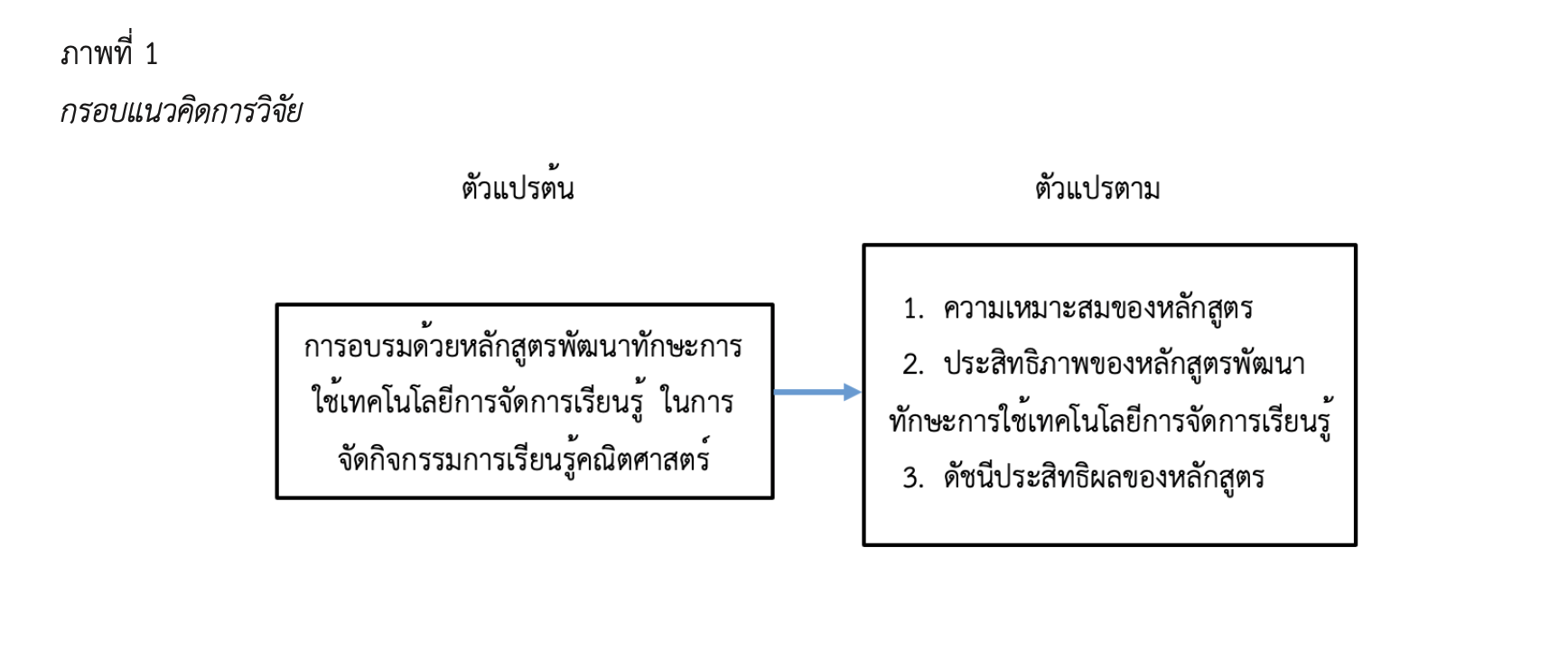
The study of learning management technology using skills development curriculum effective in organizing 21st-century mathematics learning activities for junior high school students, the objective was to: 1) Create and evaluate the suitability of the curriculum, 2) Experiment and find out the effectiveness of the curriculum, and 3) Determine the effectiveness index. The sample was 80 people: mathematics teachers at the junior high school level in the Office of Education Region 2 under the Ministry of Education, namely Nonthaburi Province and Pathum Thani Province, by Purposive Sampling. Research instruments were developing skills in using technology to manage learning, Curriculum Suitability Assessment form, and the skills of using technology in mathematics learning management tests. Statistics used to analyze data were percentage, mean, standard, and deviation.
The results of the research were as follows:
1) The results of the assessment of the suitability of the curriculum in all aspects are appropriate at the highest level ( = 4.81, S.D. = 0.11). When considering each aspect, all aspects were most appropriate, including training methods ( = 4.86, S.D. = 0.13), course objectives ( = 4.83, S.D. = 0.32), curriculum content ( = 4.78, S.D. = 0.22), and evaluation ( = 4.75, S.D. = 0.31).
2) The effectiveness of the curriculum on the development of technology skills in learning management of master teachers in organizing 21st-century mathematics learning activities for junior high school students was 87.22/82.58.
3) The curriculum effectiveness index of 0.7038 shows that the knowledge of mathematics teachers increased by 0.7038 or 70.38%.
Downloads
Article Details

This work is licensed under a Creative Commons Attribution-NonCommercial-NoDerivatives 4.0 International License.
The author(s) is only responsible for data appearing in the submitted manuscript of Interdisciplinary social sciences and communication journal.Besides, this journal encourages and enables you to share data such as statements, contents, figures, etc. that support your research publication where appropriate, and enables you to interlink the data with proper citation.
References
จันทรรัตน์ จาดแห และปริญญภาษ สีทอง (2565). หลักสูตรส่งเสริมความสามารถในการอ่านจับใจความสำคัญโดยใช้กลวิธีการสอนแบบดี อาร์ ที เอ สำหรับนักเรียนชั้นประถมศึกษาปีที่ 3. วารสาร มจร. บาฬีศึกษาพุทธโฆสปริทรรศน์, 8(1), 153 – 165.
ชัยยงค์ พรหมวงศ์. (2556). การทดสอบประสิทธิภาพสื่อหรือชุดการสอน. วารสารศิลปากรศึกษาศาสตร์วิจัย, 5(1), 5-20.
เผชิญ กิจระการ. (2546). ดัชนีประสิทธิผล. มหาวิทยาลัยมหาสารคาม.
วรลักษณ์ คำหว่าง และนงลักษณ์ ใจฉลาด. (2560). แนวทางพัฒนาทักษะครูในศตวรรษที่ 21 สังกัดสำนักงานเขตพื้นที่การศึกษามัธยมศึกษา ในจังหวัดพิษณุโลก. วารสารมหาวิทยาลัยราชภัฏลำปาง, 6(1), 129 – 138.
วนิดา เขจรรักษ์. (2562). การพัฒนาหลักสูตรฝึกอบรมครู โดยใช้การบูรณาการภาษาอังกฤษกับวิชาคณิตศาสตร์ ระดับมัธยมศึกษาตอนต้น. [วิทยานิพนธ์ปริญญาดุษฎีบัณฑิต]. มหาวิทยาลัยราชภัฏมหาสารคาม.http://fulltext.rmu.ac.th/fulltext/2562/M127909/Kejornrak%20Vanida.pdf
วัชรี กาญจน์กีรติ. (2554). การจัดการเรียนรู้คณิตศาสตร์. มหาวิทยาลัยราชภัฏเพชรบุรี.
สมศักดิ์ คงเทศ. (2554). การใช้เทคโนโลยีสารสนเทศและการสื่อสาร (ICT) ของครูในสถานศึกษา ตำบลบางนายสี อำเภอตะกั่วป่า จังหวัดพังงา [วิทยานิพนธ์ปริญญามหาบัณฑิต]. มหาวิทยาลัยราชภัฏสวนดุสิต.
สำนักงานข้าราชการพลเรือน. (ม.ป.ป.). Digital literacy คืออะไร. https://www.ocsc.go.th/DLProject/mean-dlp
เอกชัย กี่สุขพันธ์. (2564, 30 เมษายน). คุณภาพชีวิตสังคม: 5 'ทักษะสมรรถนะ' พัฒนาครูในยุคดิจิตอลแพลตฟอร์ม. กรุงเทพธุรกิจ, https://www.bangkokbiznews.com/social/935435.
Cradler, J., McNabb, M., Freeman, M., & Burchett, R.. (2002). How does Technology Influence Student Learning?. Learning & Leading with Technology. 29(8), 46-49.
National Council of Teachers of Mathematics (NCTM).(2000). Principles and standards for school mathematics. NCTM.
