CAUSAL RELATIONSHIP MODEL OF EMPLOYEE RELATIONSHIP MANAGEMENT AND CUSTOMER RELATIONSHIP MANAGEMENT FOR COMPETITIVE ADVANTAGES OF COMPANIES LISTED ON THE MARKET FOR ALTERNATIVE INVESTMENT (MAI)
Article Sidebar
Main Article Content
Abstract
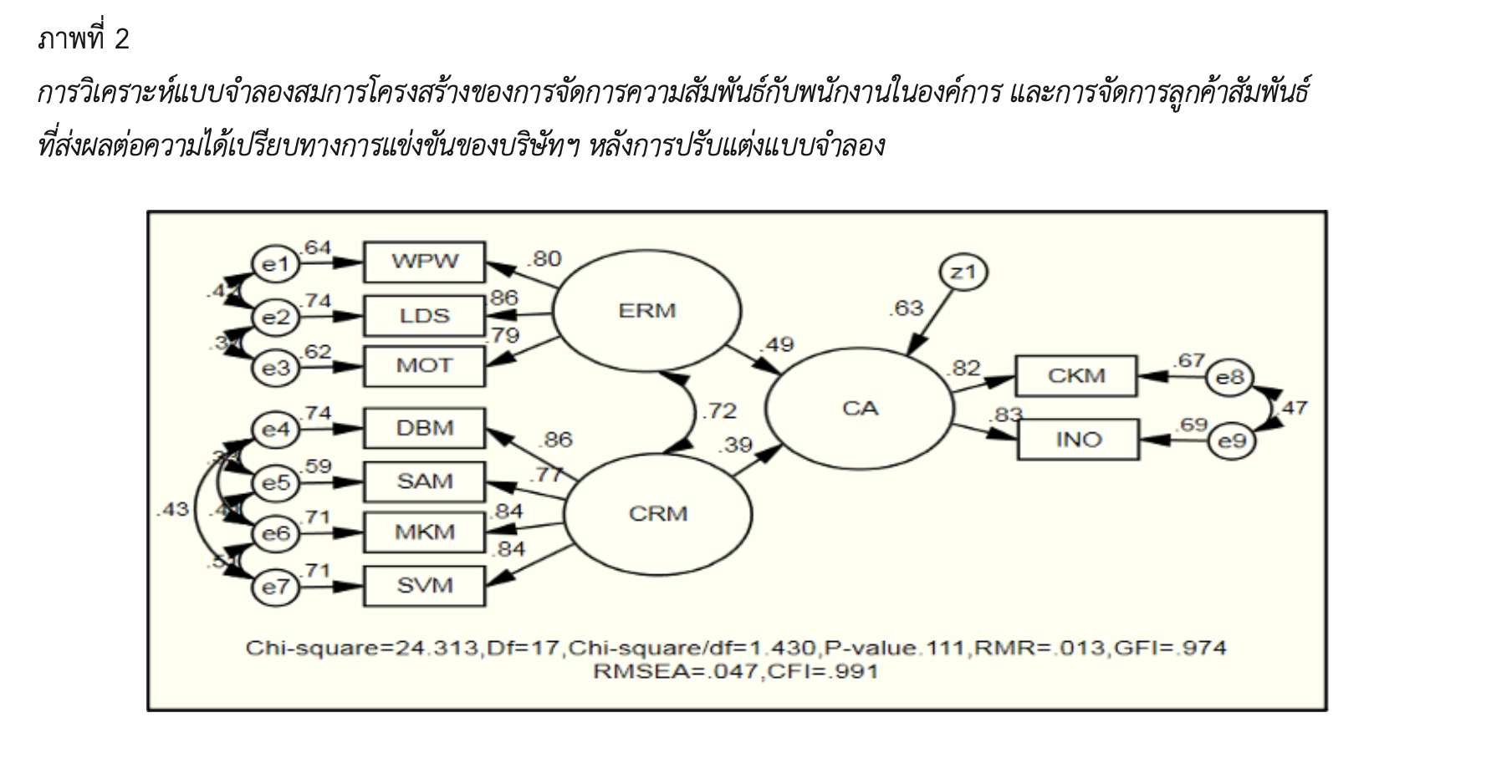
The purposes of this research aimed to 1) examine the congruence of the causal relationship model and empirical data and 2) analyze the employee relationship management and customer relationship management affected the competitive advantages of companies listed on the Market for Alternative Investment (MAI). Information was collected through 125 questionnaires distributed to companies listed on the Market for Alternative Investment (MAI). The research samples were obtained from stratified random sampling and simple random sampling. Inferential statistics using structure equation modeling (SEM) were used to test hypotheses. The results showed that: (1) the causal relationship modelwas congruent with the empirical data (c2=24.313, df=17, c2/df=1.430, p-value=.111, RMR=.013, GFI=.974, RMSEA=.047 and CFI=.991) (2) the causal relationship between employee relationship management and customer relationship management influences the competitive advantages of companies listed on the Market for Alternative Investment (MAI) with a value of .49 and .39, respectively. This research can be used for SMEs as a guideline for the development of employee relationship management and customer relationship management for competitive advantages.
Downloads
Article Details

This work is licensed under a Creative Commons Attribution-NonCommercial-NoDerivatives 4.0 International License.
The author(s) is only responsible for data appearing in the submitted manuscript of Interdisciplinary social sciences and communication journal.Besides, this journal encourages and enables you to share data such as statements, contents, figures, etc. that support your research publication where appropriate, and enables you to interlink the data with proper citation.
References
ตลาดหลักทรัพย์ เอ็ม เอ ไอ. (2564). โครงสร้างการจัดกลุ่มอุตสาหกรรมในตลาดหลักทรัพย์ เอ็ม เอ ไอ.สืบค้นจาก https://classic.set.or.th/mai/th/company/industry_group_p1.html
ปิยารมย์ ปิยะไทยเสรี. (2561). IPO Roadmap เส้นทางสู่การเป็นบริษัทจดทะเบียน. กรุงเทพฯ: ศูนย์ส่งเสริมการพัฒนาความรู้ตลาดทุน (TSI).
Abu Daqar, M., & Smoudy, A. (2019). The Impact of Consumer Buying Behavior on Customer. International Review of Management and Marketing, 9(4), 39-46.
Alani, E., Kamarudin, S., Alrubaiee, L., & Tavakoli, R. (2019). A model of the relationship between strategic orientation and product innovation under the mediating effect of customer knowledge management. Journal of International Studies, 12(3), 232-242.
Alshura, M. S. (2018). Customer relationship management (CRM) capabilities & building a sustainable competitive advantage in mobile phone operators in Jordan. International Journal of Business and Management, 13(3), 262-269.
Anitha, J. (2014). Determinants of employee engagement and their impact on employee performance. International journal of productivity and performance management, 63(3), 308-323..
Arimie, J. C., & Oronsaye, A. O. (2020). Assessing employee relations and organizational performance: a literature review. International Journal of Applied Research in Business and Management, 1(1), 1-17.
Bernarto, I., Bachtiar, D., Sudibjo, N., Suryawan, I. N., Purwanto, A., & Asbari, M. (2020). Effect of transformational leadership, perceived organizational support, job satisfaction toward life satisfaction: Evidences from indonesian teachers, International Journal of Advanced Science and Technology, 29(3), 5495-550.
Boyatzis, R. E. (2011). Managerial and leadership competencies: A behavioral approach to emotional, social and cognitive intelligence. Vision, 15(2), 91-100.
Brhane, H., & Zewdie, S. (2018). A literature review on the effects of employee relation on improving employee performance. International Journal in Management and Social Science, 6(4), 66-76.
Cepeda-Carrion, I., Martelo-Landroguez, S., Leal-Rodríguez, A. L., & Leal-Millán, A. (2017). Critical processes of knowledge management: An approach toward the creation of customer value. European Research on Management and Business Economics, 23(1), 1-7.
Chandrika, P. (2017). Impact of internal marketing on Human Resource Management–A study. IOSR Journal of Business and Management (IOSR-JBM), 6(4), 15-20.
Chen, C. Y., Chen, C. H. V., & Li, C. I. (2013). The influence of leader’s spiritual values of servant leadership on employee motivational autonomy and eudaemonic well-being. Journal of religion and health, 52(2), 418-438.
Chen, Y. C., & Lin, S. (2013). Modeling internal marketing and employee loyalty: A quantitative approach. Asian Social Science, 9(5), 99-109.
Cronbach, L. J. (1970). Essentials of Psychological Testing. New York: Harper & Row.
Distanont, A., & Khongmalai, O. (2020). The role of innovation in creating a competitive advantage. Kasetsart Journal of Social Sciences, 41(1), 15-21.
ElFarmawi, W. (2020). The Relationship between Customer Relationship Management and Product Innovation. Journal of Systems Integration, 10(4), 10-16
Freeman, R. (1984). Strategic Management: A Stakeholder Approach, Ballinger, Boston, MA.
Gambeta, E., Koka, B. R., & Hoskisson, R. E. (2019). Being too good for your own good: A stakeholder perspective on the differential effect of firm‐employee relationships on innovation search. Strategic Management Journal, 40(1), 108-126.
Gil-Gomez, H., Guerola-Navarro, V., Oltra-Badenes, R., & Lozano-Quilis, J. A. (2020). Customer relationship management: digital transformation and sustainable business model innovation. Economic Research-Ekonomska Istraživanja, 33(1), 2733-2750.
Grönroos, C. (2020). service marketing research priorities: service and marketing. Journal of Services Marketing, 29(4), 1-14.
Gupta, S., Hanssens, D., Hardie, B., Kahn, W., Kumar, V., Lin, N., & Sriram, S. (2006). Modeling customer lifetime value. Journal of service research, 9(2), 139-155.
Haerani, S., Sumardi, S., Hakim, W., Hartini, H., & Putra, A. H. P. K. (2020). Structural model of developing human resources performance: Empirical study of Indonesia states owned enterprises. The Journal of Asian Finance, Economics and Business, 7(3), 211-221.
Hair, J.F., Black, W.C., Babin, B.J. & Anderson, R.E. (2010). Multivariate Data Analysis. (7th ed.). New York: Pearson.
Hakanen, M. (2017). The development and management of interpersonal trust in a business network in health, exercise, and wellbeing markets. Jyväskylä studies in business and economics, UNIVERSITY OF JYVÄSKYLÄ.
Hasanian, G., Chong, C. W., & Gan, G. C. (2015). Application of knowledge management factors on customer relationship management process. Library Review, 64(8/9), 583-596.
Jobber, D., & Lancaster, G. (2020). Selling and sales management, 10th ed. Publisher: Pearson.
Koohang, A., Paliszkiewicz, J., & Goluchowski, J. (2017). The impact of leadership on trust, knowledge management, and organizational performance. Industrial Management & Data Systems, 117(3), 521-537.
Kotler, P., & Keller, K.L. (2012). Marketing management (14 th ed.). Upper Saddle River, New Jersey: Prentice Hall.
Kumar, V., & Dhiman, S. (2020). Happiness and Workplace Well-Being: Transformational Leadership and the Role of Ethical and Spiritual Values. The Palgrave Handbook of Workplace Well-Being, 1-44.
La Falce, J. L., De Muylder, C. F., & Santos, M. F. (2020). Competitiveness: Theoretical Reflections and Relation with Innovation. Revista Horizontes Interdisciplinares da Gestão, 4(2), 1-21.
Lestari, S. D., LEON, F. M., Widyastuti, S., BRABO, N. A., & Putra, A. H. P. K. (2020). Antecedents and consequences of innovation and business strategy on performance and competitive advantage of SMEs. The Journal of Asian Finance, Economics and Business, 7(6), 365-378.
Limaj, E., & Bernroider, E. W. (2019). The roles of absorptive capacity and cultural balance for exploratory and exploitative innovation in SMEs. Journal of Business Research, 94, 137-153.
Lina, M. A., Ali, M. M., & Hossain, M. A. (2016). Contemporary Challenges of Human Resource Management. International Journal of Ethics in Social Sciences, 4(1), 145-156.
Maheshwari, P., & Kushwah, B. S. (2019). Customer loyalty approach of CRM. Journal of the Gujarat Research Society, 21(16), 64-72.
Mavuram, S.R. (2013). Customer Relationship Management (Doctoral dissertation). Available from ProQuest Dissertations & Theses Full Text. (UMI No. EP69083).
McCarthy, E. J. (1960). Basic Marketing, A managerial approach. IL: Richard D. Irwin.
Mejía Trejo, J., Sánchez Gutiérrez, J., & Maldonado Guzman, G. (2016). The customer knowledge management and innovation. Contaduría y administración, 61(3), 456-477.
Migdadi, M. M. (2020). Knowledge management, customer relationship management and innovation capabilities. Journal of Business & Industrial Marketing, 36(1), 111-124.
Nafisa, S., Shayanrad, R., Hosseinifard, M., Molavi, H., & Narimisa, M. R. (2019). Integrating internal and external marketing function for a services management marketing model in Iran. Religación: Revista de Ciencias Sociales y Humanidades, 4(18), 233-237.
Ozmen, Y. S. (2017). How employees define organisational trust: analysing employee trust in organisation. Journal of Global Responsibility, 9(1), 21-40.
Pancasila, I., Haryono, S., & Sulistyo, B. A. (2020). Effects of work motivation and leadership toward work satisfaction and employee performance: Evidence from Indonesia. The Journal of Asian Finance, Economics, and Business, 7(6), 387-397.
Park, J. H., & Tran, T. B. H. (2018). Internal marketing, employee customer oriented- behaviors, and customer behavioral responses. Psychology & Marketing, 35(6), 412-426.
Porter, M. E. (1985). The Competitive Advantage: Creating and Sustaining Superior Performance. NY: Free Press.
Reinartz, W., & Kumar, V. I. S. W. A. N. A. T. H. A. N. (2002). The mismanagement of customer loyalty. Harvard business review, 80(7), 86-94.
Rovinelli, R. J., & Hambleton, R. K. (1977). On the use of content specialists in the assessment of criterion-referenced test item validity. Dutch Journal of Educational Research, 2, 49-60.
Schermelleh-Engel, K., Moosbrugger, H., & Muller H. (2003). Evaluating the fit of structural equation models: tests of significance and goodness-of-fit models. Methods of Psychological Research Online, 8, 23-74.
Seeck, H., & Diehl, M. R. (2017). A literature review on HRM and innovation–taking stock and future directions. The International Journal of Human Resource Management, 28(6), 913-944.
Sergeeva, A., & Andreeva, T. (2016). Knowledge sharing research: Bringing context back in. Journal of Management Inquiry, 25(3), 240-261.
Sever, I. (2015). Importance-performance analysis: A valid management tool?. Tourism management, 48, 43-53.
Shi, S., Wang, Y., Chen, X., & Zhang, Q. (2020). Conceptualization of omnichannel customer experience and its impact on shopping intention: A mixed-method approach. International Journal of Information Management, 50, 325-336.
Sigalas, C., Economou, V. P., & Georgopoulos, N. B. (2013). Developing a measure of competitive advantage. Journal of Strategy and Management, 6(4), 320-342.
Turner, P. (2020). Why Is Employee Engagement Important?. In Employee Engagement in Contemporary Organizations (pp. 57-84). Palgrave Macmillan, Cham.
Wang, H. (2014). Theories for Competitive Advantage. In H. Hasan (Eds.), Being Practical with Theory: A Window into Business Research, 33–43.
Yamane, T. (1973). Statistics: An Introductory Analysis. (3rdEd).New York: Harper and Row Publications.
