DIGITAL MARKETING THAT AFFECTS HEALTHY FOOD CONSUMPTION FOR THE ELDERLY IN BANGKOK
Article Sidebar
Main Article Content
Abstract
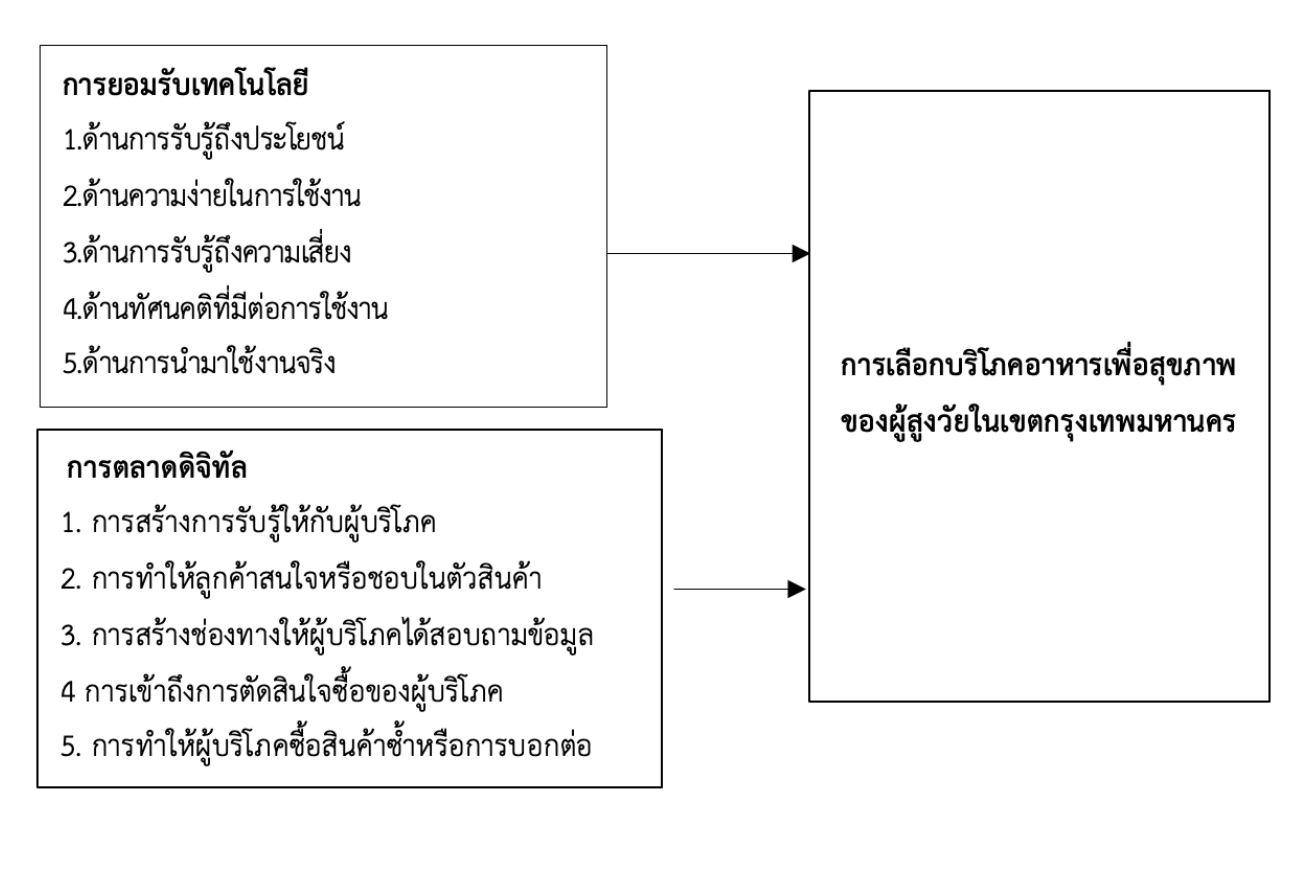
The purpose of this research was 1) to study healthy food consumption 2) to study the adoption of technologies that affect healthy food choices and 3) to study digital marketing that affects the healthy food consumption of elderly people in Bangkok. The data was collected from 400 elderly people in Bangkok by calculating Cochran samples and sampling them accordingly. Statistics used to analyze data include frequency, percentage, mean, and standard deviation, and test hypotheses by analyzing multiple regression equations.The results showed that1) respondents highly agreed on healthy food consumption for the elderly in Bangkok.2) Technology adoption consists of perceived benefits, ease of use, risk awareness, attitude towards use, and practicality affecting the healthy food choices of the elderly in Bangkok with statistically significant at 0.05, with a forecast of 75.6 percent.3) digital marketing consists of creating awareness for consumers, making customers interested or liking the product, creating channels for consumers to ask for information, consumer access to purchasing decisions and making consumers buy repeat products or word of mouth affected the healthy food consumption of the elderly in Bangkok with statistically significant at a level of 0.05.
Downloads
Article Details

This work is licensed under a Creative Commons Attribution-NonCommercial-NoDerivatives 4.0 International License.
The author(s) is only responsible for data appearing in the submitted manuscript of Interdisciplinary social sciences and communication journal.Besides, this journal encourages and enables you to share data such as statements, contents, figures, etc. that support your research publication where appropriate, and enables you to interlink the data with proper citation.
References
กระทรวงสาธารณสุข. (2565, 3 กุมภาพันธ์). โครงการสร้างสังคมห่วงใยใส่ใจสุขภาพผู้สูงวัย. http:// moph.go.th.
เจนจิรา รัตนเพียร. (2565). บทสัมภาษณ์การประชุมเชิงปฏิบัติการพัฒนาศักยภาพคนโสดรุ่นใหม่. โรงแรมแอมบาสซาเดอร์. กรุงเทพมหานคร
ชเนตตี พุ่มพฤกษ์. (2564). การตลาดอัตโนมัติ: เครื่องมือสู่ความสำเร็จในธุรกิจสำหรับนักการตลาดยุคดิจิทัล. วารสารวิทยาการจัดการปริทัศน์. 23(1). 221-230.
ธนาภา หิมารัตน์. (2559). ปัจจัยที่ส่งผลต่อการยอมรับเทคโนโลยีทางการเงินบริบทธนาคารพาณิชย์. [วิทยานิพนธ์ปริญญามหาบัณฑิต ไม่ได้ตีพิมพ์]. มหาวิทยาลัยธรรมศาสตร์.
สารัช สุธาทิพย์กุล. (2560). สภาพปัญหาและการเรียนรู้การใช้เทคโนโลยีของผู้สูงอายุในกรุงเทพมหานคร. มหาวิทยาลัย ศิลปากร.
สุมนา นุสรณ์. (2561). พฤติกรรมการตัดสินใจซื้อสินค้าผ่านเครือข่ายสังคมออนไลน์ของผู้สูงวัยกลุ่มเบบี้บูมเม. [วิทยานิพนธ์ ปริญญามหาบัณฑิต ไม่ได้ตีพิมพ์]. มหาวิทยาลัยศิลปากร.
สุทิพย์ ประทุม. (2564). การยอมรับเทคโนโลยีสารสนเทศในยุควิถีชีวิตใหม่. วารสารลวะศรี มหาวิทยาลัยราชภัฏเทพสตรี. 6(1), 1-18.
เยาวภา จันทร์พวง. (2557). ลักษณะรูปแบบการดำเนินชีวิตของผู้สูงวัยและการตัดสินใจซื้อผลิตภัณฑ์เสริมอาหารประเภท วิตามินในประเทศไทย. [วิทยานิพนธ์ปริญญามหาบัณฑิต ไม่ได้ตีพิมพ์].มหาวิทยาลัยเทคโนโลยีสุรนารี.
วสุธิดา นุริตมนต์ และ นันทพร ห้วยแก้ว. (2563). อิทธิพลของคุณลักษณะผลิตภัณฑ์ที่ส่งผลต่อการตัดสินใจซื้อผลิตภัณฑ์เสริม อาหารของผู้สูงวัย:การทดสอบเชิงประจักษ์ความเป็นตัวแปรส่งผ่านของการรับรู้คุณค่า. วารสารวิชาการและวิจัยมหาวิทยาลัยภาคตะวันออกเฉียงเหนือ, 11(1), 58-71.
สำนักงานคณะกรรมการอาหารและยา. (2561, 3 มกราคม). ผลิตภัณฑ์เสริมอาหารเพื่อสุขภาพ. http://oryor.com.
Davis, F.D., Bagozzi, R.P. and Warshaw, P.R. (1989). User Acceptance of Computer Technology: A Comparison of Two Theoretical Models. Management Science, 3(5), 982-1003.
Keller, K. L. (2003). Strategic brand management: Building, treasuring and managing brand Equity (2nd ed.). Prentice Hall.
W.G. Cochran. (1953). Sampling Techniques. John Wiley & Sons. Inc.
