FACTORS INFLUENCING THE QUALITY OF LIFE AND REVISIT INTENTION OF THE ELDERLY USING THE ELDERLY CARE SERVICES IN THAILAND
Article Sidebar
Main Article Content
Abstract
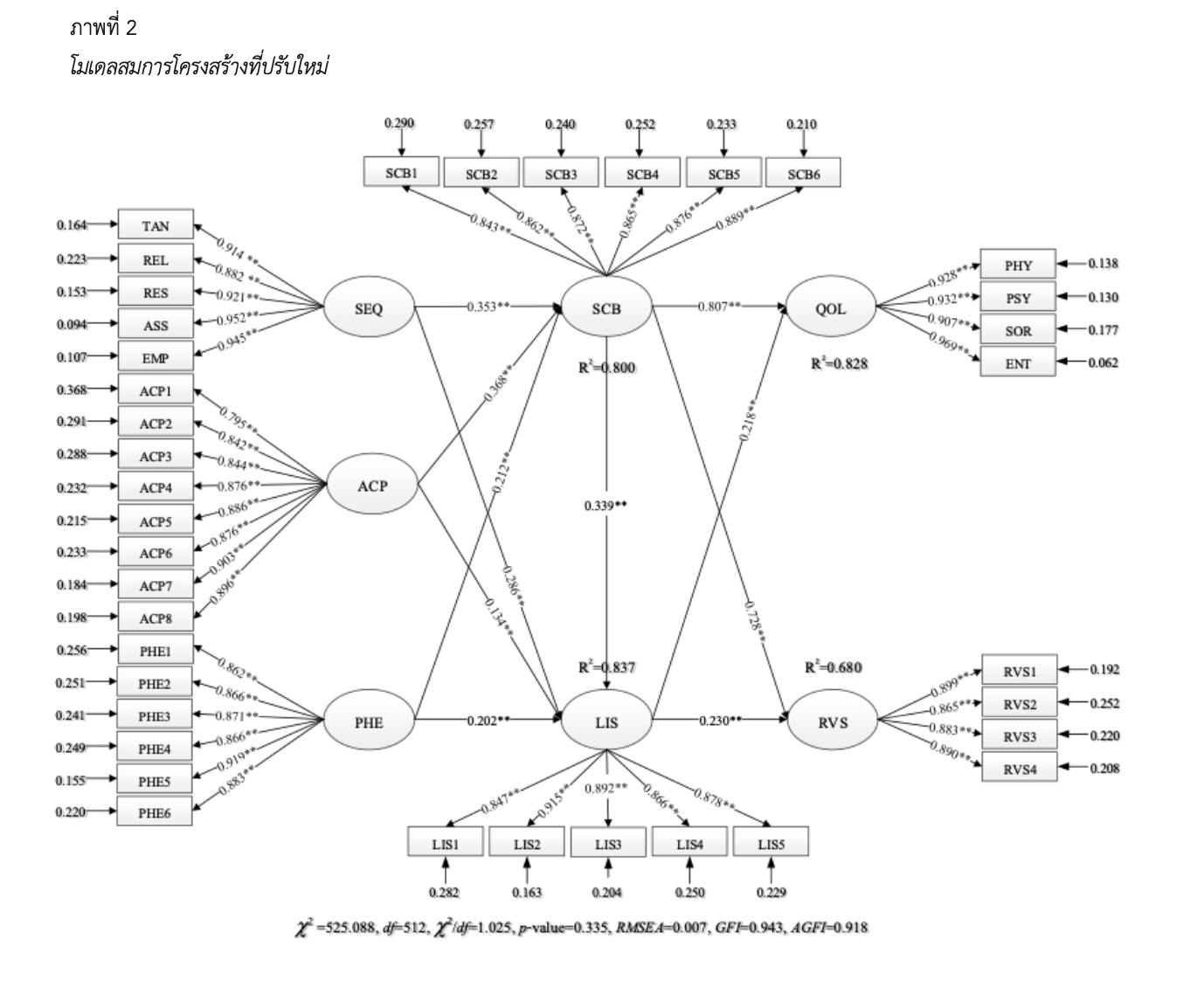
The objectives of this research were, the researcher develops (1) a causal relationship model of the influence of service quality, activities participation, and physical environment affecting the quality of life and revisit intention through self-care health behavior and life satisfaction of the elderly using the elderly care services in Thailand. The researcher examines (2) the congruence of the causal relationship model affecting the quality of life and revisit intention of the elderly under investigation and the empirical data. Findings of the causal relationship model affecting the quality of life and revisit intention showed the following. (1) The service quality, activities participation, and physical environment exhibited positive influence in self-care health behavior. (2) The service quality, activities participation, physical environment, and self-care health behavior exhibited positive influence on life satisfaction. (3) Self-care health behavior and life satisfaction exhibited positive influence on the quality of life. (4) Self-care health behavior and life satisfaction exhibited positive influence on revisit intention. When considering the factors influencing, it was found that the factor with the highest direct influence was self-care health behavior. The factor with the highest indirect influence was the service quality. The factor with the highest total influence was self-care health behavior. The inspection of the congruence of the causal relationship model affecting the quality of life and revisit intention found that the adjusted structural equation model exhibited the congruence with the empirical data at a good level.
Downloads
Article Details

This work is licensed under a Creative Commons Attribution-NonCommercial-NoDerivatives 4.0 International License.
The author(s) is only responsible for data appearing in the submitted manuscript of Interdisciplinary social sciences and communication journal.Besides, this journal encourages and enables you to share data such as statements, contents, figures, etc. that support your research publication where appropriate, and enables you to interlink the data with proper citation.
References
กรมพัฒนาธุรกิจการค้า. (2561). พาณิชย์' เร่งแก้ปัญหาการขาดแคลน และมาตรฐานบุคลากรดูแลผู้สูงอายุ.http://www.dbd.go.th/mobile/news_ view.php?nid=469404775
กรมกิจการผู้สูงอายุ. (2564, 21 มิถุนายน). สังคมผู้สูงอายุในปัจจุบันและเศรษฐกิจในประเทศไทย. https://www.dop.go.th/th/know/15/926
ท็อปเบสท์แบรนด์ (topbestbrand). (2564). 10 บ้านพักคนชราและศูนย์ดูแลผู้สูงอายุ ประสบการณ์ยาวนาน บริการดีเยี่ยม 2021. https://topbestbrand.com/
Ahn, S., Song, R., & Choi, S. W. (2016). Effects of Self-care Health Behaviors on Quality of Life Mediated by Cardiovascular Risk Factors Among Individuals with Coronary Artery Disease: A Structural Equation Modeling Approach. Asian Nursing Research, 10(2), 158-163.
Best, J. W. (1982). Research in education (4 ed.). New Delhi: Prentice Hall.
Brown, Z. S., Oueslati, W., & Silva, J. (2016). Links between urban structure and life satisfaction in a cross-section of OECD metro areas. Ecological economics, 129, 112-121.
Choy, K. L. T., Siu, K. Y. P., Ho, T. S. G., Wu, C., Lam, H. Y., Tang, V., et al. (2018). An intelligent case-based knowledge management system for quality improvement in nursing homes. VINE Journal of Information and Knowledge Management Systems. 48(1), 103-121.
Hair, J. F., Black, W. C., Babin, B. J., & Anderson, R. E. (2018). Multivariate data analysis (8 ed.). Harow,Essex: Pearson.
Hair, J., Black, W., Anderson, R., & Babin, B. (2019). Multivariate Data Analysis (8, ilustra ed.).
Ho, C.-S., & Chang, Y.-M. (2017). Implementation and Usage Evaluation for Self Health Management with App-based Framework. Paper presented at the 2016 International Forum on Mechanical, Control and Automation (IFMCA 2016).
Huang, L., Frijters, P., Dalziel, K., & Clarke, P. (2018). Life satisfaction, QALYs, and the monetary value of health. Social Science & Medicine, 211, 131-136.
Kabadayi, S., Hu, K., Lee, Y., Hanks, L., Walsman, M., & Dobrzykowski, D. (2020). Fostering older adult care experiences to maximize well-being outcomes. Journal of Service Management. 31(5), 953-977.
Kalaja, R., Myshketa, R., & Scalera, F. (2016a). Service Quality Assessment in Health Care Sector: The Case of Durres Public Hospital. Procedia - Social and Behavioral Sciences, 235, 557-565.
Kang, E.-M., & Lee, Y.-C. (2018). Analysis of factors affecting the life satisfaction of elderly users of senior citizen centers: focus on senior citizen centers in Seoul. Journal of Convergence for Information Technology, 8(5), 173-181.
Keller, C., & Fleury, J. (2000). Health promotion for the elderly: Sage.
Kholifah, S. N., Yumni, H., Minarti, & Susanto, T. (2017). Structural model of factors relating to the health promotion behavior of reproductive health among Indonesian adolescents. International Journal of Nursing Sciences, 4(4), 367-373.
Kim, C., & Ko, H. (2018). The impact of self-compassion on mental health, sleep, quality of life and life satisfaction among older adults. Geriatric Nursing, 39(6), 623-628.
Kim, H., Woo, E., & Uysal, M. (2015). Tourism experience and quality of life among elderly tourists. Tourism Management, 46, 465-476.
Kim, H., Woo, E., & Uysal, M. (2015). Tourism experience and quality of life among elderly tourists. Tourism Management, 46, 465-476.
Knapik, W. (2020). Stimulators and inhibitors of the development of social care and support for the elderly in Poland. Journal of Rural Studies, 76, 12-24.
Konuk, F. A. (2019). The influence of perceived food quality, price fairness, perceived value and satisfaction on customers’ revisit and word-of-mouth intentions towards organic food restaurants. Journal of Retailing and Consumer Services, 50, 103-110.
Ladhari, R. (2010). Developing e-service quality scales: A literature review. Journal of Retailing and Consumer Services, 17(6), 464-477.
Lee, M. K., & Oh, J. (2020). Health-related quality of life in older adults: Its association with health literacy, self-efficacy, social support, and health-promoting behavior. Paper presented at the Healthcare.
Lee, S., & Kim, H. (2017). Structural equation modeling on self-care behavior and quality of life in older adults with diabetes using citizen health promotion centers. Journal of Korean Academy of Nursing, 47(4), 514-525.
Leung, M.-y., & Liang, Q. (2019). Developing structural facilities management–quality of life models for the elderly in the common areas of public and subsidized housings. Habitat International, 94, 102067.
Liu, Y., Dijst, M., Faber, J., Geertman, S., & Cui, C. (2017). Healthy urban living: Residential environment and health of older adults in Shanghai. Health & place, 47, 80-89.
Marques, A., Mota, J., Gaspar, T., & de Matos, M. G. (2017). Associations between self-reported fitness and self-rated health, life-satisfaction and health-related quality of life among adolescents. Journal of Exercise Science & Fitness, 15(1), 8-11.
Nella, A., & Christou, E. (2016). Extending tourism marketing: Implications for targeting the senior tourists' segment. Journal of Tourism, Heritage & Services Marketing, 2(1), 36-42.
Olsen, J. R., Nicholls, N., & Mitchell, R. (2019). Are urban landscapes associated with reported life satisfaction and inequalities in life satisfaction at the city level? A cross-sectional study of 66 European cities. Social Science & Medicine, 226, 263-274.
Ozcelik, G., & Becerik-Gerber, B. (2018). Benchmarking thermoception in virtual environments to physical environments for understanding human-building interactions. Advanced Engineering Informatics, 36, 254-263.
Parasuraman, A., Zeithaml, V. A., & Berry, L. L. (1988). Servqual: A multiple-item scale for measuring consumer perc. Journal of retailing, 64(1), 12.
Parsons, M. A., Pender, N. J., & Murdaugh, C. L. (2011). Health promotion in nursing practice: Pearson Higher Ed.
Pender, N. (1996). Health Promotion in nursing practice, II. Appleton and Lange, 115-144.
Pham, T. A. N., Sweeney, J. C., & Soutar, G. N. (2019). Customer value cocreation activities: An exploration of psychological drivers and quality of life outcomes. Journal of Service Theory and Practice, 29(3), 282-308.
Sato, M., Jordan, J. S., & Funk, D. C. (2016). A distance-running event and life satisfaction: The mediating roles of involvement. Sport Management Review, 19(5), 536-549.
Scocco, P., & Nassuato, M. (2017). The role of social relationships among elderly community‐dwelling and nursing‐home residents: findings from a quality of life study. Psychogeriatrics, 17(4), 231-237.
Suriyanrattakorn, S., & Chang, C.-L. (2021). Long-term care (LTC) policy in Thailand on the homebound and bedridden elderly happiness. Health Policy OPEN, 2, 100026.
Swart, K., George, R., Cassar, J., & Sneyd, C. (2018). The 2014 FIFA World Cup™: Tourists’ satisfaction levels and likelihood of repeat visitation to Rio de Janeiro. Journal of Destination Marketing & Management, 8, 102-113.
Turner, R., Mulvenon, S., Thomas, S. P., & Balkin, R. (2002). Computing indices of item congruence for test development validity assessments. Paper presented at the Proceedings of the SAS Users’ Group International Conference.
Vitman Schorr, A., & Khalaila, R. (2018). Aging in place and quality of life among the elderly in Europe: A moderated mediation model. Archives of Gerontology and Geriatrics, 77, 196-204.
Wang, M., & Li, D. (2019). An empirical investigation of the continuance intention using the bullet curtain: Synchronicity vs information overload. Chinese Management Studies, 13(1), 235-254.
Wang, S. (2017). Leisure travel outcomes and life satisfaction: An integrative look. Annals of Tourism Research, 63, 169-182.
Whaley, M. M., & Barber, D. L. (2017). The Aging Process. Occupational Therapy with Elders-eBook: Strategies for the Occupational Therapy Assistant, 30.
Zailani, S., Iranmanesh, M., Masron, T. A., & Chan, T.-H. (2016). Is the intention to use public transport for different travel purposes determined by different factors? Transportation research part D: transport and environment, 49, 18-24.
