
THE INFLUENCE OF FIRM-GENERATED SOCIAL MEDIA BRAND COMMUNICATION AND USER-GENERATED SOCIAL MEDIA BRAND COMMUNICATION ON PERCEIVED PRODUCT QUALITY
Article Sidebar
Main Article Content
Abstract
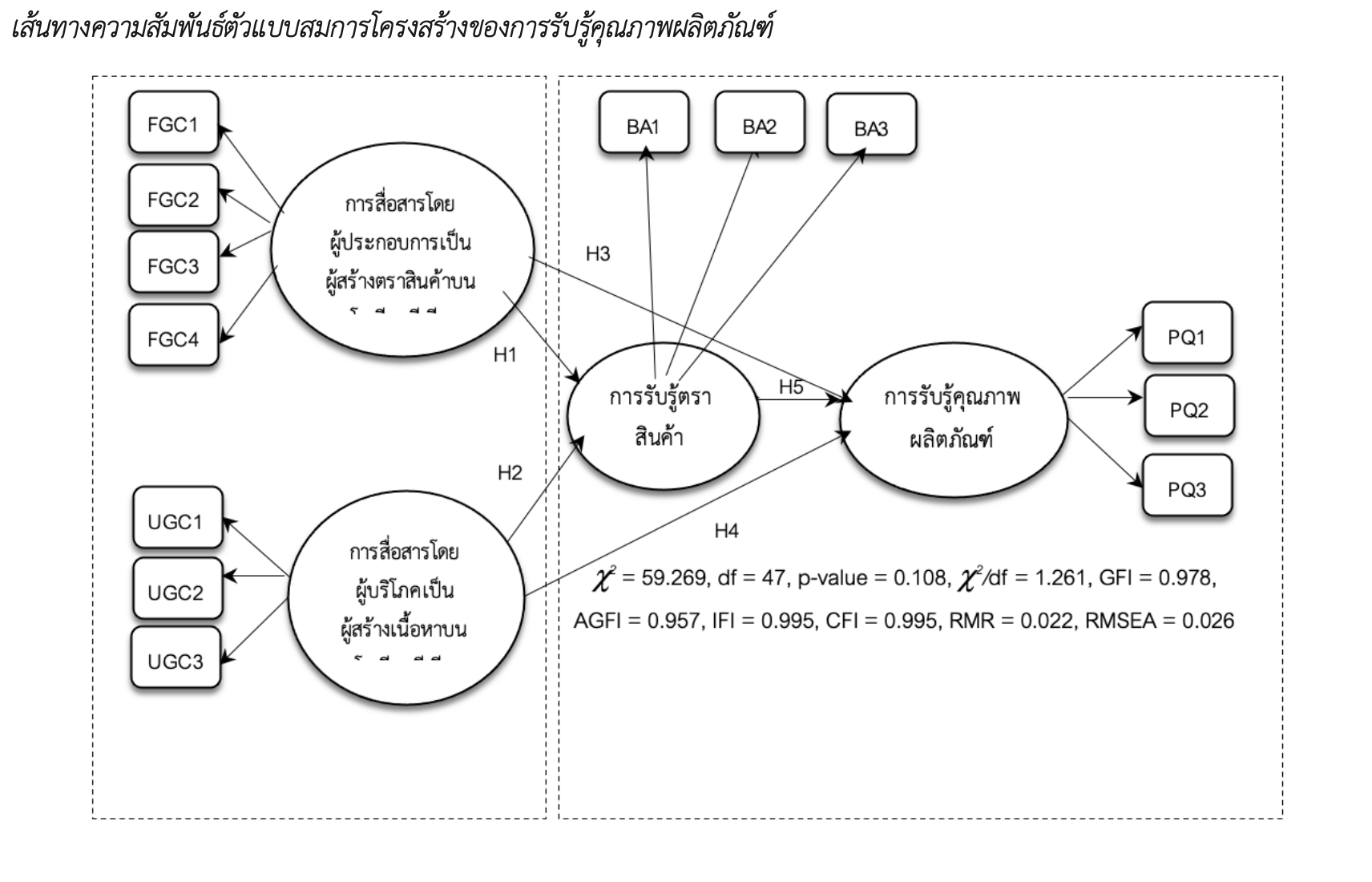
The objective of this research was to examine the model of perceived product quality derived from firm-generated social media brand communication, user-generated social media brand communication, and brand awareness. The 400 subjects were customers buying the products from social media business chosen by snowball sampling. The structural equation model (SEM) was analyzed by AMOS program.The research findings indicated that:firm-generated social media brand communication, user-generated social media brand communication, and brand awareness had a significantly positive influence on perceived product quality (p < .05). As for analyzing factors influencing perceived product quality, it was found that the three factors influencing the perceived product quality were brand awareness (TE=0.691), firm-generated social media brand communication (TE=0.333), and user-generated social media brand communication (TE =0.198), respectively. All factors were predictive of perceived product quality at 52.80 (R2 = 0.528)
Downloads
Article Details

This work is licensed under a Creative Commons Attribution-NonCommercial-NoDerivatives 4.0 International License.
The author(s) is only responsible for data appearing in the submitted manuscript of Interdisciplinary social sciences and communication journal.Besides, this journal encourages and enables you to share data such as statements, contents, figures, etc. that support your research publication where appropriate, and enables you to interlink the data with proper citation.
References
Aaker, D.A. (1996). Measuring brand equity across products and markets. CA Management Review, 38(3):102-120.
Arnold, M.J. and Reynolds, K.E. (2003). Hedonic shopping motivations. Journal of Retailing, 79(2):77-95.
Bruhn, M., Schoenmueller, V., & Schafer, D.B. (2012). Are social media replace traditional media in terms of brand equity creation?. Management Research Review, 35(9).
Bruhn, M., Schnebelen, S., & Schafer, D. (2013). Antecedents and consequences of the quality of e-customer-to-customer interaction in B2B brand communities. Industrial marketing management, 43(1).
Cleary, J. and Bloom, T. (2011). Gatekeeping at the portal: an analysis of local television websites’ user-generated content, Electronic News, Vol.5 (2):93-111.
Cyr, D., Head, M., & Ivanov, A. (2009). Perceived interactivity leading to e-loyalty: Development of model cognitive-affective user response. Interaction Journal of Human-computer studies, 67: 850-869.
Kaplan, A.M. & Haenlein, M. (2010). User of the world, unite! The challenges and opportunities of social media. Business Horizons, 53(1):59-68.
Keller, K.L. (1993). Conceptualizing, measuring, managing customer-based brand equity. Journal of Marketing, 57(1):1-22.
Morra, M. C., Ceruti, F., Chierici, R., & Gregorio, A. D. (2017). Social vs traditional media communication: brand origin associations strike a chord. Journal of Research in interactive marketing, 12(1):2-21.
Oliver, R. (1997). Satisfaction: A Behavioral Perspective on the consumer, McGraw-Hill, New York, NY.
Rao, A.R. & Monroe, K.B. (1989). The effect of price, brand name, and store name on buyers’ perceptions of product quality: an integrative review. Journal of Marketing Research, 36(2):351-358.
Rossiter, J.R., & Percy, L. (1987). Advertising and Promotion Management. McGraw-Hill Book Company, New York.
Santos, M. L. B. (2021). The so-called UGC: an updated definition of user-generated content in the age of social media. Online information review,
Schivininski, B., & Dabrowski, D. (2014). The impact of brand communication on brand equity through Facebook. Journal of Research in Interactivity Marketing, 9(1):31-53.
Seo, E-J., & Park, J-W. (2018). A study on the effects of social media marketing activities on brand equity and customer response in the airline industry. Journal of Air Transport Management, 66: 36-41.
Sethan, B.N., Hazari, S., & Bergiel, B. (2017). Influence of user generated content in online shopping: impact of gender on purchase behavior, trust, and intention to purchase. Int. J. Electronic Marketing and Retailing, 8(4).
Tran, T.P., Lin, C-W., Baalbaki, S., & Guzman, F. (2020). How personalized advertising affects equity of brands advertised on Facebook? A mediation mechanism, 120: 1-15.
Yoo, B. & Donthu, N. (2001). Developing and validating a multidimensional consumer-based brand equity scale. Journal of Business Research, 52(1):1-14.
Yoo, C., Park, J. & MachInnis, D.J. (1998). Effects of store characteristics and in-store emotional experiences on store attitude. Journal of Business Research, 42(3):253-263.
William, R., Madden, T.J., Krimani, A., & Mukherjee, S. (2001). Understanding what’s in a brand rating: a model for assessing brand and attribute effects and their relationship to brand equity. Journal of Marketing Research, 38: 415-429.
