
FACTORS AFFECTING LEADERSHIP EFFECTIVENESS IN GOVERNMENTAL HOSPITALS UNDER THE MINISTRY OF PUBLIC HEALTH
Article Sidebar
Main Article Content
Abstract
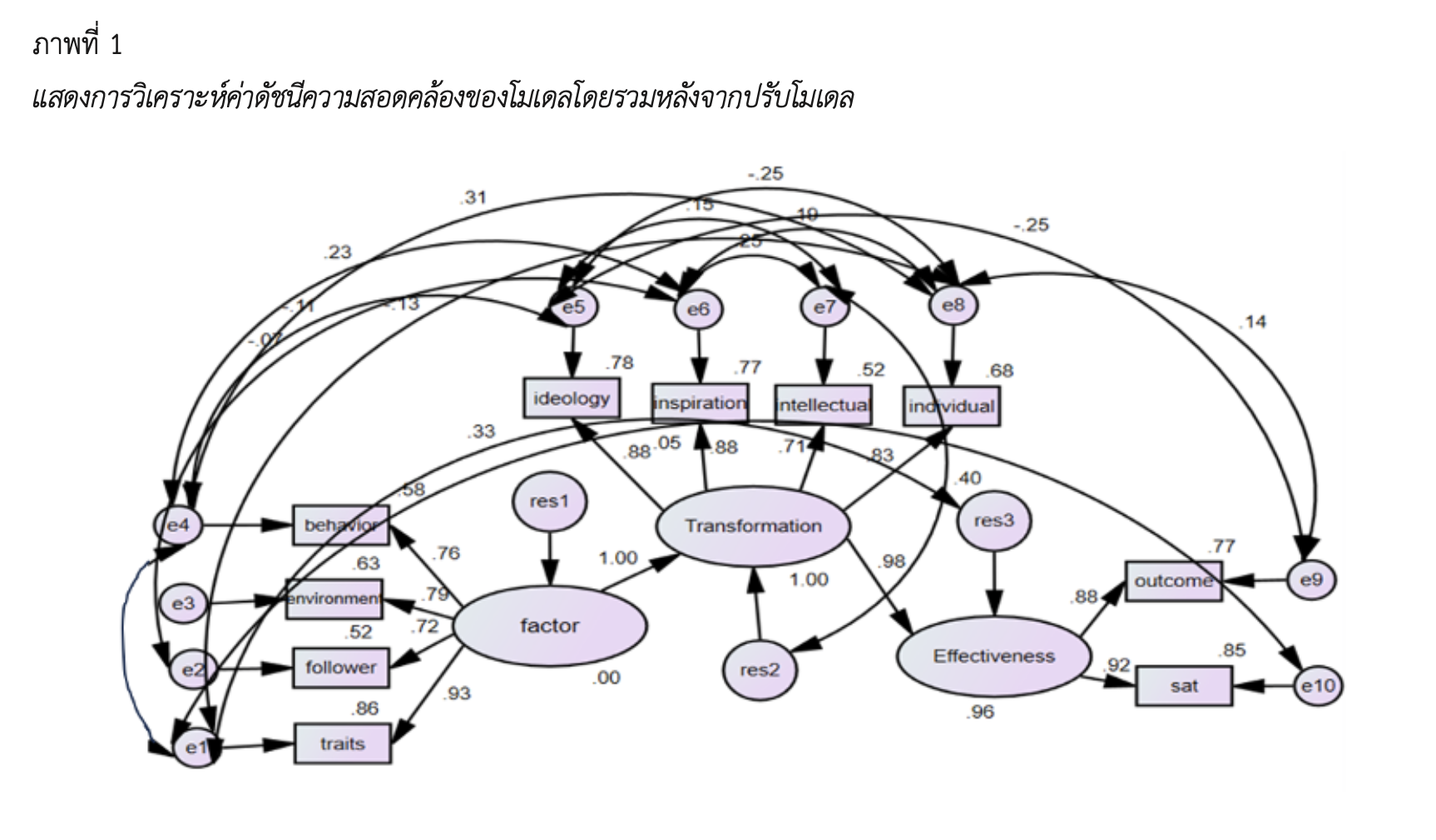
This research is part of the dissertation on Factors Affecting Leadership Effectiveness in Governmental Hospitals under the Ministry of Public Health, the objectives were to (1) test the direct influence between factors affecting leadership effectiveness and leadership effectiveness (2) test the direct influence between factors affecting leadership effectiveness and transformational leadership 3) test the influence and 4) to test the indirect influence between the factors affecting the effectiveness of leadership and the effectiveness of leadership through transformational leadership. The population used in the study was 12,652 personnel of government hospitals in the Ministry of Public Health in Health Service Area 6 of the Ministry of Public Health located in the provinces of Chonburi, Rayong, Chanthaburi, Samutprakan, Chachoengsao, Prachinburi, Sakaeo and Trat, a systematic random sampling method was used 373 people, using questionnaires as a data collection tool, statistics used to analyze the data were frequency, percentage, mean, standard deviation and structural equation.The results showed that: Factors Affecting Leadership Effectiveness in Governmental Hospitals under the Ministry of Public Health in 4 areas, consisting of leader attributes, follower attributes, environment, leadership behavior and transformational leadership style were all averaged at a high level. The overall leadership effectiveness was averaged at a high level. From the analysis of the structural equation, it was found that (1) Factors affecting leadership effectiveness have no direct positive influence on leadership effectiveness. (2) Factors affecting leadership effectiveness have a positive direct influence on transformational leadership; (3) transformational leadership has a positive direct influence on leadership effectiveness; and (4) Factors affecting leadership effectiveness have an indirect influence on leadership effectiveness through transformational leadership.
Downloads
Article Details

This work is licensed under a Creative Commons Attribution-NonCommercial-NoDerivatives 4.0 International License.
The author(s) is only responsible for data appearing in the submitted manuscript of Interdisciplinary social sciences and communication journal.Besides, this journal encourages and enables you to share data such as statements, contents, figures, etc. that support your research publication where appropriate, and enables you to interlink the data with proper citation.
References
ภีรดา ศิลปชัย และณัฐชา ธำรงโชติ. (2561). ความสัมพันธ์ระหว่างปัจจัยจูงใจ และความมีประสิทธิภาพการทำงาน ของบุคลากรภายในหน่วยงานด้านชุมชนสัมพันธ์ของรัฐวิสาหกิจแห่งหนึ่ง. วารสารสหวิทยาการสังคมศาสตร์และการสื่อสาร, 1(2), 217-235.
สุภาภรณ์ ไกรฤกษ์. (2554). รูปแบบภาวะผู้นำของผู้บริหารโรงพยาบาลที่ประสบความสำเร็จ. [วิทยานิพนธ์ปริญญาดุษฎี บัณฑิต ไม่ได้ตีพิมพ์]. มหาวิทยาลัยรามคำแหง.
สำนักงานคณะกรรมการข้าราชการพลเรือน. (2564, 13 ตุลาคม). คู่มือแนวทางการพัฒนาบุคลากรภาครัฐ พ.ศ. 2563-2565.
การพัฒนาบุคลากร. https://www.ocsc.go.th.
อภิรดี เลาหวิเชียร. (2556). คุณลักษณะของนักบริหารกับประสิทธิผลของภาวะผู้นำกรณีเปรียบเทียบระหว่างบริษัทวิทยุการบินแห่งประเทศไทยจำกัด และบริษัทการบินไทยจำกัด (มหาชน). [วิทยานิพนธ์ปริญญาดุษฎีบัณฑิต ไม่ได้ ตีพิมพ์]. มหาวิทยาลัยรามคำแหง.
ฮาลีซาล เจะเลาะ. (2561). ศึกษาแนวทางในการปฏิบัติหน้าที่เพื่อประสิทธิผลของสำนักนโยบายและแผนกลาโหมในประชาคมอาเซียนกรณีศึกษาสำนักนโยบายและแผนกลาโหม. วารสารสหวิทยาการสังคมศาสตร์และการสื่อสาร, 1(2), 113-124.
Bass, B.M., & Avolio, B.J. (1990). The implications of transactional and Transformational leadership for
individual, team, and organization development. Research in Organizational Change and Development, 4(1), 231-272.
Bass, B. M. & Riggio, R.E. (2006). Transformational leadership. (2nded.). Lawrence Erlbaum.
Bauer, T. N., & Green, S. G. (1996). Development of leader–member exchange: A longitudinal
test. Academy of Management Journal, 39(6), 1538–1567. https://doi.org/10.2307/257068
Bradford, D.L., Cohen, A.R. (1984). The post heroic leader. Training & development Journal, 38(1), 40-49.
Burns, J. M. (1978). Leadership. New York: Harper and Row.
Carroll, S. J., & Gillen, D. J. (1987). Are the classical management functions useful in describing managerialwork? The Academy of Management Review, 12(1), 38–51. https://doi.org/10.2307/257992
Caruso, C. M., Gill, D.L., Dzewaltowski D.A. & McElroy, M.A. (1990). Psychological and physiological change in competitive success and failure. Journal of Sport and Exercise Psychology, 12, 6-20.
Cicero, L., Pierro, A. & Van Knippenberg, D. (2010). Leadership and uncertainty: How role ambiguity affect the
relationship between leader group prototypicality and leadership effectiveness, British Journal of Management, 21(2), 411-421.
De Cremer, D. & Van Knippenberg, D. (2004), Leader self-sacrifice and leadership effectiveness: The moderating role of leader self-confidence, Organizational behavior and human decision processes, 95(2), 140-155. https://doi.org/ 10.1016/j.obhdp.2004.04.002
DuBrin, A.J. (2010). Principles of leadership.6th ed. Canada: South-Western, Cengage Learning.
Hair, J. F., Jr., Anderson, R. E., Tatham, R. L. and Black, W. C. (1995) Multivariate Data Analysis. (3rd ed.).Macmillan Publishing Company, New York.
Kanste O., Kääriäinen M., Kyngäs H. (2009). Statistical testing of the full-range leadership theory in nursing. Scandinavian Journal of Caring Science, 23, 775-782.
Kanter, R. M. (1985). Managing the human side of change. Management Review, 52–56.
Madlock, P.E. (2008). The link between leadership style, communicator competence, and employee
satisfaction. Journal of Business Communication, 45(1), 61-78.
Podsakoff, P.M., et.al. (1990). Transformational Leader Behaviors and Their Effects on Followers’ Trust in
Leader, Satisfaction, and Organization Citizenship Behaviors, Leadership Quarterly. 1(2), 107-142.
Saiyadain, M. S. (2003). Organizational behavior. New Delhi: Tata. McGraw-Hill.
Stajkovic, A.D. and Luthans, F. (1998). Self-Efficacy and Work-Related Performance A Meta-Analysis. Psychological Bulletin, 124, 240-261.
Yukl, G. (1998). Leadership in organizations. (4th ed.). Englewood Cliffs, NJ: Prentice Hall.
Yukl, G. (2010). Leadership in organizations. (7thed.). New Jersey: Pearson.
Yammarino, F. J., & Bass, B. M. (1990). Transformational leadership and multiple levels of analysis. Human
Relations, 43(10), 975-995. https://doi.org/10.1177/001872679004301003
Wood, N. (2008, 31 July). Transformational leadership not autocratic leadership needed in health caremanagement. http://www.nubpages. com/hub/healthcare management.
