THE BOOK OF SONGS AND HEALTH CULTURE: INSIGHTS FOR MODERN LIFE
Article Sidebar
Main Article Content
บทคัดย่อ
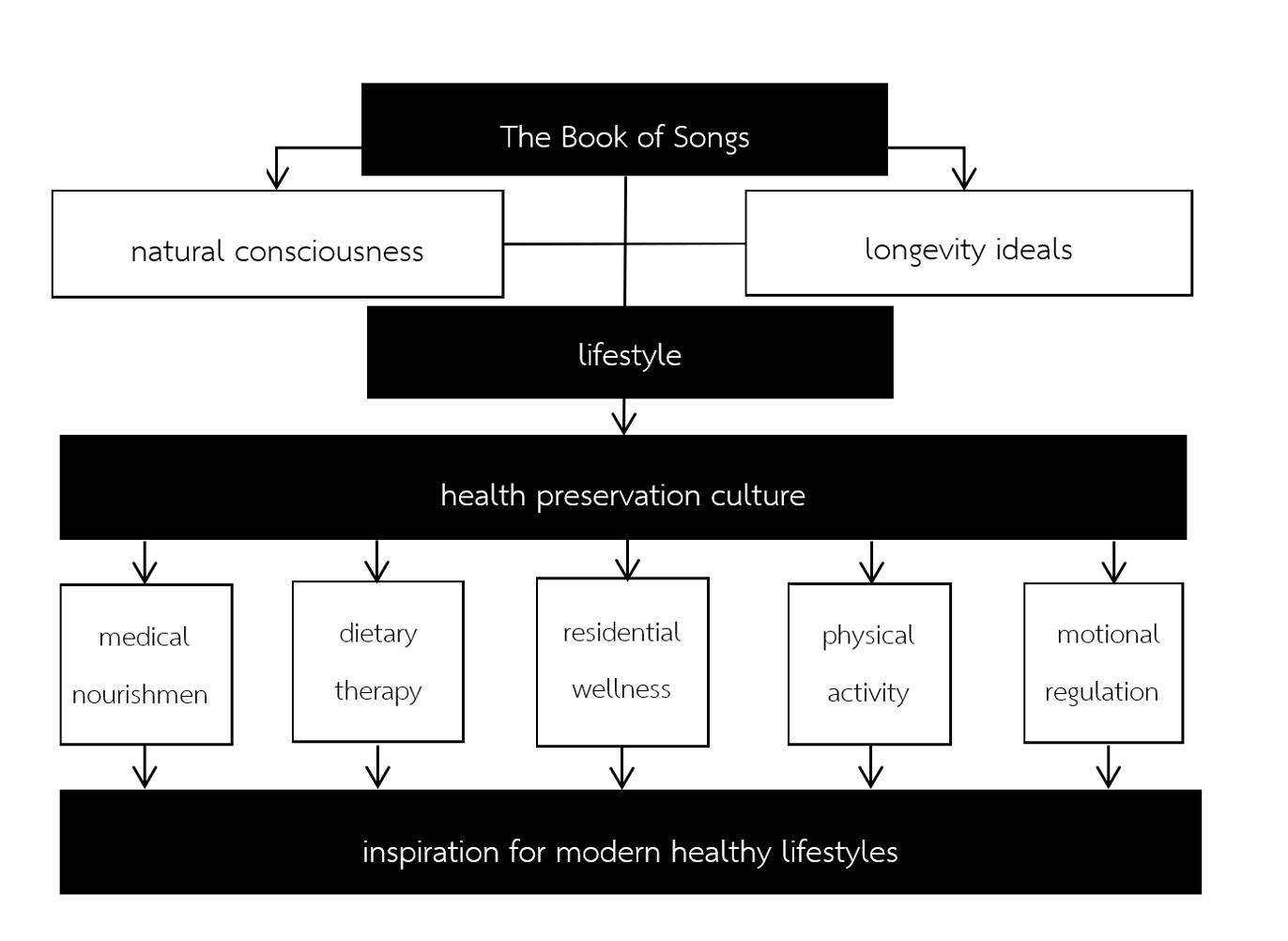
Introduction: Health preservation culture is an important component of traditional Chinese civilization. The Book of Songs, as the earliest anthology of Chinese poetry, records early Chinese views on nature, life, diet, labor, and emotional well-being. However, limited studies have explored its health preservation wisdom from a multidimensional perspective and its relevance to modern life. Objective: This study aims to examine the historical development of The Book of Songs, explore its embedded health preservation wisdom, and investigate its implications for contemporary lifestyles. Method: A qualitative approach was employed using qualitative content analysis. Relevant textual materials, including The Book of Songs and related studies, were analyzed to identify and interpret health-related themes. Results: The findings reveal that The Book of Songs embodies a multidimensional health preservation culture grounded in harmony with nature and longevity ideals. Key dimensions include medical health preservation, dietary therapy, residential wellness, physical activity, and emotional regulation. A Health Preservation Framework from The Book of Songs was proposed to explain these interrelated dimensions. Conclusion: The study suggests that the health wisdom in The Book of Songs remains relevant to modern healthy lifestyles and contributes to the contemporary understanding of traditional Chinese health culture.
Downloads
Article Details

อนุญาตภายใต้เงื่อนไข Creative Commons Attribution-NonCommercial-NoDerivatives 4.0 International License.
** ข้อความ ข้อคิดเห็น หรือข้อค้นพบ ในวารสารสหวิทยาการสังคมศาสตร์และการสื่อสารเป็นของผู้เขียน ซึ่งจะต้องรับผิดชอบต่อผลทางกฎหมายใด ๆ ที่อาจเกิดขึ้นจากบทความและงานวิจัยนั้น ๆ โดยมิใช่ความรับผิดชอบของคณะนิเทศศาสตร์ มหาวิทยาลัยราชภัฏรำไพพรรณี **
เอกสารอ้างอิง
Elo, S., & Kyngäs, H. (2008). The qualitative content analysis process. Journal of Advanced Nursing,62(1), 107–115. https://doi.org/10.1111/j.1365-2648.2007.04569.x
Han, Y. (2021). Plant notes in the Book of Songs (13th ed.). Chemical Industry Press.
Hsieh, H.-F., & Shannon, S. E. (2005). Three approaches to qualitative content analysis. Qualitative Health Research, 15(9), 1277–1288. https://doi.org/10.1177/1049732305276687
Krippendorff, K. (2018). Content analysis: An introduction to its methodology (4th ed.). SAGE Publications.
Li, J. (2007). History of traditional Chinese medicine (9787573003478th ed.). Hainan Publishing House.
Ng, S. M., Wang, C. W., & Wan, A. H. (2024). Chinese Medicine and Yang Sheng. In Encyclopedia of Quality of Life and Well-Being Research (pp. 947-953). Springer International Publishing. https://doi.org/10.1007/978-3-031-17299-1_3579
Song, Y., & Huang, Y. (2010). Concepts of life in the Book of Songs and their implications for physical health preservation. Journal of Guangdong Youth Cadre College, 20(4), 86 - 88.
Wang, Z. (2002). The cultural connection between the Book of Songs and ancient medical customs. Ethnic Art, 3(3), 86-98.
Wen, C. (1991). Medicinal and therapeutic ideas in the Book of Songs. Jiangsu Chinese Medicine,7(4), 38–39.
Xie, X. (2006). A discussion on health preservation thought in the Book of Songs. Proceedings of the 7th International Conference on The Book of Songs, 1(1), 86–88.
Yan, M., Song, X., & Lu, C. (2012). A study of dietary and health culture in the Book of Songs. Agricultural Archaeology, 2(4), 279–282.
Yang, S. (2011). Jiweiju primary school collection of Jinshi studies (5th ed.). Commercial Press.
Zhang, X., Liu, Y., & Wang, Y. (2024). The mediating effect of traditional Chinese medicine health literacy on the relationship between traditional Chinese medicine cultural ambiance and health status. Frontiers in Public Health, 12, Article 1386085. https://doi.org/10.3389/fpubh.2024.1386085
