ANALYSIS OF GRAMMATICAL FEATURES IN THE PUBLIC ENGLISH OF UNDERGRADUATE EXAMINATION (PEUE) FOR JUNIOR HIGHER COLLEGE STUDENTS IN YUNNAN PROVINCE, CHINA
Article Sidebar
Main Article Content
บทคัดย่อ
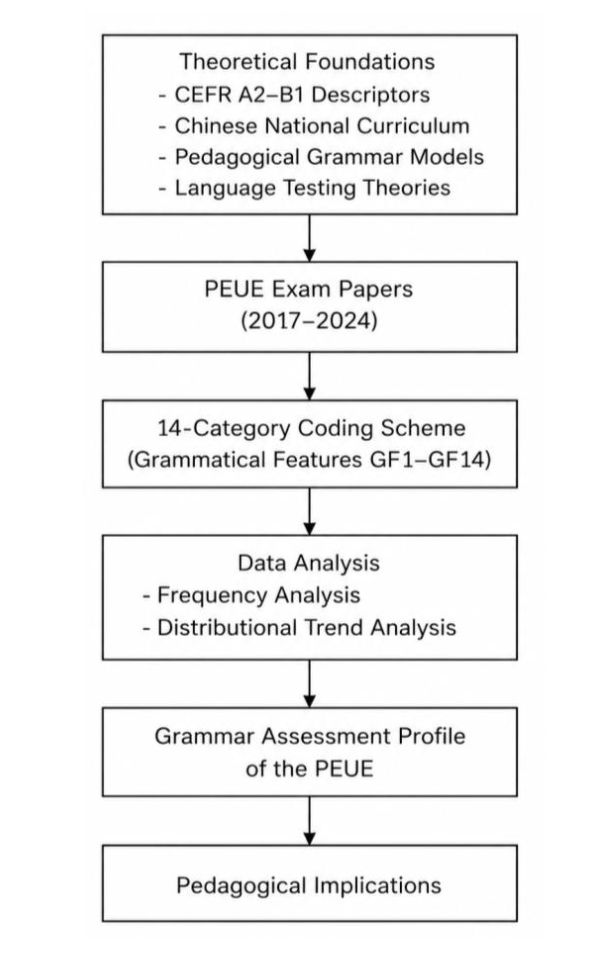
Introduction: Although English proficiency examinations play an important role in vocational English education, limited research has systematically examined the grammatical features assessed in the Public English of Undergraduate Examination (PEUE) in Yunnan Province, China. Objective: This study examined the grammatical features assessed in the Public English of Undergraduate Examination (PEUE) for junior higher college students in Yunnan Province, China, from 2017 to 2024. Methods: A total of 240 grammar-related test items from eight PEUE examination papers were analyzed using the Grammatical Features Analysis Table (GFAT), resulting in 222 coded grammatical feature occurrences. Results: Infinitives and Gerunds (GF13) and Prepositions (GF9) were the most frequently assessed grammatical categories (13.51% each), followed by Conjunctions and Linking Words (GF11) (11.71%) and Noun Phrase Structure (GF4) (9.46%). The findings also revealed a gradual shift from sentence-level grammatical structures toward discourse-oriented features associated with communicative language use. Conclusion: The findings suggest an increasing emphasis on contextualized grammar in the PEUE and provide implications for grammar instruction, curriculum development, and assessment practices in vocational English education.
Downloads
Article Details

อนุญาตภายใต้เงื่อนไข Creative Commons Attribution-NonCommercial-NoDerivatives 4.0 International License.
** ข้อความ ข้อคิดเห็น หรือข้อค้นพบ ในวารสารสหวิทยาการสังคมศาสตร์และการสื่อสารเป็นของผู้เขียน ซึ่งจะต้องรับผิดชอบต่อผลทางกฎหมายใด ๆ ที่อาจเกิดขึ้นจากบทความและงานวิจัยนั้น ๆ โดยมิใช่ความรับผิดชอบของคณะนิเทศศาสตร์ มหาวิทยาลัยราชภัฏรำไพพรรณี **
เอกสารอ้างอิง
Alderson, J. C., Clapham, C., & Wall, D. (1995). Language Test Construction and Evaluation.Cambridge University Press.
Bachman, L. F., & Palmer, A. S. (1996). Language testing in practice: Designing and developing useful language tests. Oxford University Press.
Brown, H. D. (2007). Principles of language learning and teaching (5th ed.). Pearson Education.
Brown, H. D., & Abeywickrama, P. (2010). Language assessment: Principles and classroom practices (2nd ed.). Pearson Education.
Celce-Murcia, M., & Larsen-Freeman, D. (1999). The grammar book: An ESL/EFL teacher’s course (2nd ed.). Heinle & Heinle.
Chunmei, Y. (2023). Research on the reform and innovation of English teaching in vocational colleges. Journal of Education and Educational Research, 6(3), 118–120.https://doi.org/10.54097/jeer.v6i3.14387
Council of Europe. (2020). Common European Framework of Reference for Languages:Learning, teaching, assessment Companion volume. Council of Europe Publishing.
Ellis, R. (2006). The study of second language acquisition (2nd ed.). Oxford University Press.
Halliday, M. A. K., & Matthiessen, C. M. I. M. (2014). Halliday’s introduction to functional grammar (4th ed.). Routledge.
Hartwell, P. (1985). Grammar, grammars, and the teaching of grammar. College English, 47(2),105–127. https://doi.org/10.2307/377341
Hu, G. (2002). Potential cultural resistance to pedagogical imports: The case of communicative language teaching in China. Language, Culture and Curriculum, 15(2), 93–105.https://doi.org/10.1080/07908310208666636
Hyland, K. (2006). English for academic purposes: An advanced resource book. Routledge.
Ministry of Education of the People's Republic of China. (2018). English Curriculum Standards for General Senior High Schools (2017 Edition). People's Education Press.
Purpura, J. E. (2004). Assessing grammar. Cambridge University Press. https://doi.org/10.1017/CBO9780511733086
Quirk, R., Greenbaum, S., Leech, G., & Svartvik, J. (1985). A comprehensive grammar of the English language. Longman.
Saengboon, S., Panyaatisin, K., & Toomaneejinda, A. (2022). The roles of grammar in English language teaching: Local viewpoints. PASAA
Schmidt, R. (1990). The role of consciousness in second language learning. Applied Linguistics, 11(2), 129–158.
Swain, M. (1985). Communicative competence: Some roles of comprehensible input and comprehensible output in its development. In S. Gass & C. Madden (Eds.), Input in second language acquisition (pp. 235–253). Newbury House.
Yang, W. (2018). The development of English curriculum standards in China. English Today, 34(4), 2–8. https://doi.org/10.1017/S0266078418000367
Zhou, Z. (2017). The investigation of the English grammar learning strategy of high school students in China. Theory and Practice in Language Studies, 7(12), 1243–1248.https://doi.org/10.17507/tpls.0712.11
