CONSTRUCTING GUITBOOK BY THE APPLYING KODÁLY’S TEACHING METHODS FOR TEACHING WESTERN MUSIC NOTATION SINGING FOR 3RD - YEAR STUDENTS AT CHAOYANG NORMAL COLLEGE, CHAOYANG CITY, LIAONING PROVINCE
Article Sidebar
Main Article Content
บทคัดย่อ
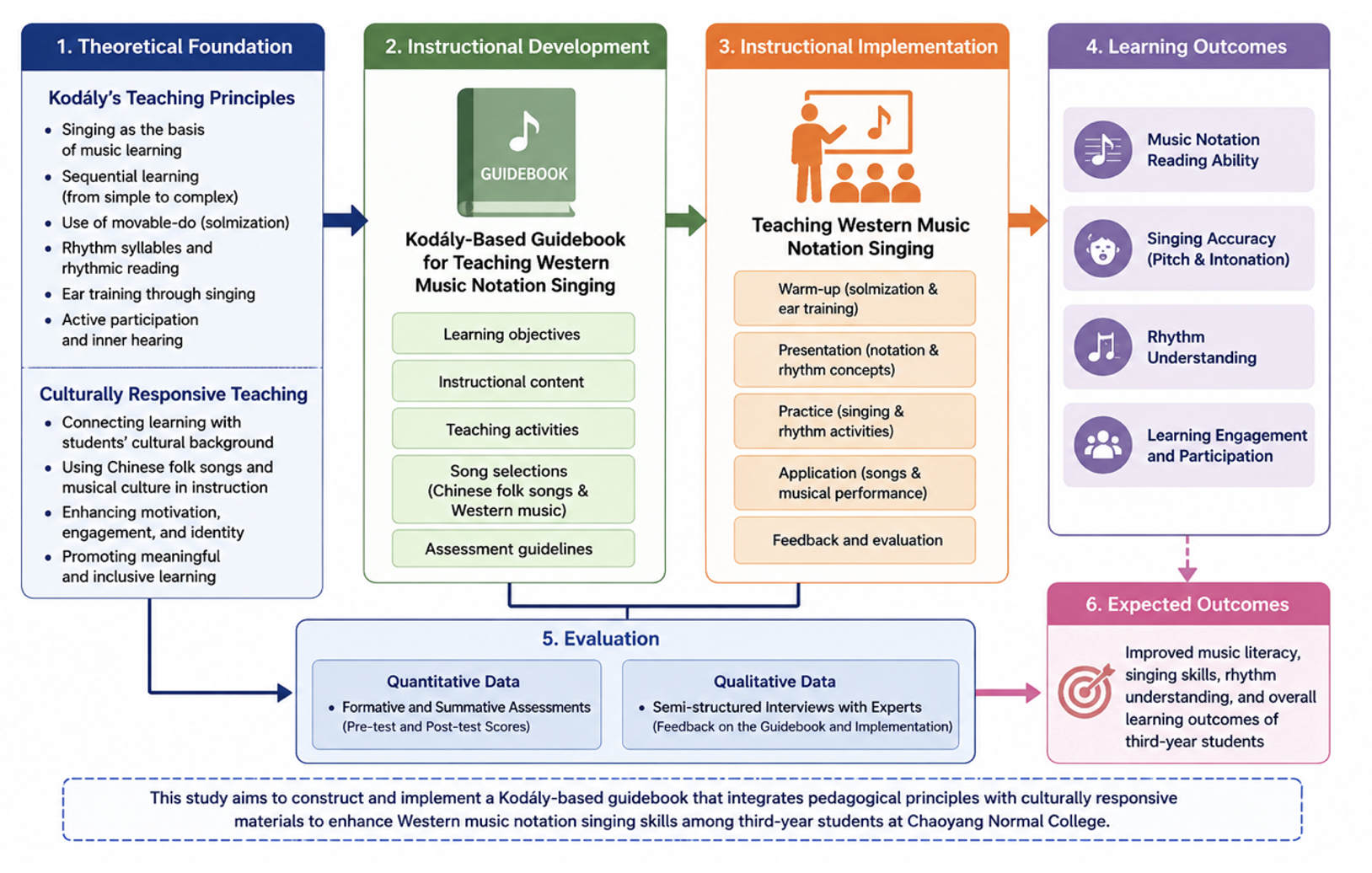
Introduction: Developing music literacy and singing skills remains a major challenge in higher education, particularly in learning Western music notation. Traditional instructional approaches often emphasize theoretical knowledge rather than active musical practice, resulting in limited student engagement and insufficient development of practical music skills. Kodály's teaching method, which emphasizes singing, sequential learning, and culturally relevant musical materials, has been recognized as an effective pedagogical approach for improving music learning. Objective: This study aimed to (1) examine the application of Kodály's teaching methods, (2) construct a guidebook based on Kodály's pedagogical principles, (3) implement the guidebook in teaching third-year students at Chaoyang Normal College, and (4) evaluate the learning outcomes of the instructional implementation. Method: A mixed-methods approach was employed. Qualitative data were collected through semi-structured interviews with three experts in music education to support the development of the instructional guidebook. Quantitative data were obtained from formative and summative assessments conducted during a teaching experiment involving ten third-year students. Results: Students' mean scores increased from 61.80 in the formative assessment to 90.50 in the summative assessment, indicating an improvement of 28.70 points after the implementation of the Kodály-based instructional guidebook. Expert feedback also supported the appropriateness of the guidebook in terms of instructional content, learning sequence, and classroom applicability. Students demonstrated improvements in music notation reading, singing performance, and rhythm understanding. Conclusion: The findings suggest that applying Kodály's teaching methods through a structured instructional guidebook can effectively support the teaching of Western music notation singing in higher education. The developed guidebook may serve as a practical instructional resource for music educators who seek to integrate sequential learning and culturally responsive teaching into music instruction.
Downloads
Article Details

อนุญาตภายใต้เงื่อนไข Creative Commons Attribution-NonCommercial-NoDerivatives 4.0 International License.
** ข้อความ ข้อคิดเห็น หรือข้อค้นพบ ในวารสารสหวิทยาการสังคมศาสตร์และการสื่อสารเป็นของผู้เขียน ซึ่งจะต้องรับผิดชอบต่อผลทางกฎหมายใด ๆ ที่อาจเกิดขึ้นจากบทความและงานวิจัยนั้น ๆ โดยมิใช่ความรับผิดชอบของคณะนิเทศศาสตร์ มหาวิทยาลัยราชภัฏรำไพพรรณี **
เอกสารอ้างอิง
Choksy, L. (1999). The Kodály method I: Comprehensive music education (3rd ed.). Prentice Hall.
Gallina, J. (2006). A study of Kodály-based instruction in studio music teaching. Australian Journal of Music Education, 5(2), 23–35.
Goopy, J. (2013). The Kodály method. In G. E. McPherson & G. F. Welch (Eds.), The Oxford handbook of music education (pp. 337–354). Oxford University Press.
Hallam, S. (2010). The power of music: Its impact on the intellectual, social and personal development of children and young people. International Journal of Music Education, 28(3), 269–289. https://doi.org/10.1177/0255761410370658
Houlahan, M., & Tacka, P. (2008). Kodály today: A cognitive approach to elementary music education. Oxford University Press.
Kodály, Z. (1974). Selected writings of Zoltán Kodály. Boosey & Hawkes.
Liu, S. (2023). Exploration of culturally responsive teaching in music education. Journal of Music Education Research, 45(2), 112–120.
Türkmen, U., & Özal Göncü, İ. (2018). Adaptation of Kodály method in different cultural contexts. International Journal of Music Education, 36(2), 214–226.
