จุดแข็ง จุดอ่อน โอกาส และอุปสรรค ของปัญญาประดิษฐ์แบบรู้สร้าง ในการศึกษาระดับอุดมศึกษา: การวิเคราะห์สภาวะแวดล้อม (SWOT Analysis)
DOI:
https://doi.org/10.14456/educu.2024.46คำสำคัญ:
ปัญญาประดิษฐ์แบบรู้สร้าง, เอไอแบบรู้สร้าง, ปัญญาประดิษฐ์ในการศึกษา, การวิเคราะห์สภาวะแวดล้อม, อุดมศึกษาบทคัดย่อ
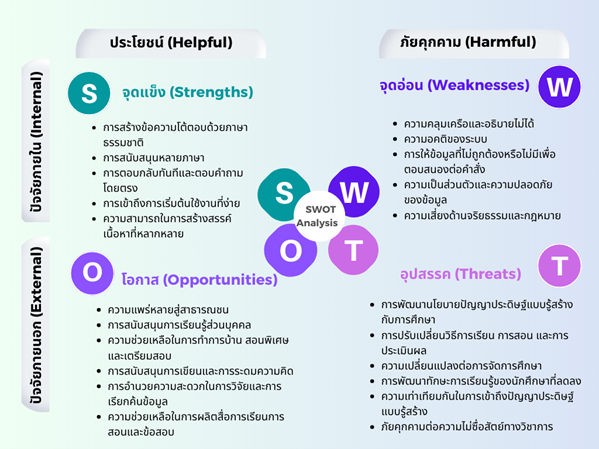
ปัญญาประดิษฐ์แบบรู้สร้าง (Generative Artificial Intelligence) ได้แพร่หลายเข้าสู่สาธารณชนอย่างรวดเร็วไปทั่วโลก เข้าถึงผู้ใช้ในอุตสาหกรรมด้านต่าง ๆ รวมทั้งการศึกษา ปัญญาประดิษฐ์แบบรู้สร้างในการศึกษาเป็นความท้าทายที่มีทั้งประโยชน์และความเสี่ยงในการนำมาใช้อันส่งผลกระทบต่อการศึกษาในระดับอุดมศึกษา ดังนั้นความรู้ความเข้าใจและข้อมูลเชิงประจักษ์ของปัญญาประดิษฐ์แบบรู้สร้างกับการศึกษาจึงเป็นเรื่องสำคัญ การศึกษานี้จึงได้ทำขึ้นโดยใช้กรอบแนวคิดการวิเคราะห์สภาวะแวดล้อม (SWOT analysis) โดยการค้นหารวบรวมและศึกษาวรรณกรรมที่เกี่ยวข้องเพื่อนำมาวิเคราะห์หาจุดแข็ง จุดอ่อน โอกาส และอุปสรรคของปัญญาประดิษฐ์แบบรู้สร้างในการศึกษาระดับอุดมศึกษา ผลลัพธ์เชิงบวกที่ได้ คือ (1) จุดแข็ง ได้แก่ การสร้างข้อความโต้ตอบด้วยภาษาธรรมชาติ การสนับสนุนหลายภาษา การตอบกลับทันทีและตอบคำถามโดยตรง การเข้าถึงการเริ่มต้นใช้งานที่ง่าย ความสามารถในการสร้างสรรค์เนื้อหาที่หลากหลาย (2) โอกาส ได้แก่ ความแพร่หลายสู่สาธารณชน การสนับสนุนการเรียนรู้ส่วนบุคคล ความช่วยเหลือในการทำการบ้าน สอนพิเศษและเตรียมสอบ การสนับสนุนการเขียนและการระดมความคิด การอำนวยความสะดวกในการวิจัยและ
การเรียกค้นข้อมูลความช่วยเหลือในการผลิตสื่อการเรียนการสอนและข้อสอบ ส่วนผลลัพธ์เชิงลบที่ได้ คือ (1) จุดอ่อน ได้แก่ ความคลุมเครือและอธิบายไม่ได้ ความอคติของระบบ การให้ข้อมูลที่ไม่ถูกต้องหรือไม่มีเพื่อตอบสนองต่อคำสั่ง ความเป็นส่วนตัวและความปลอดภัยของข้อมูล ความเสี่ยงด้านจริยธรรมและกฎหมาย (2) อุปสรรค ได้แก่ การพัฒนานโยบายปัญญาประดิษฐ์แบบรู้สร้างกับการศึกษา การปรับเปลี่ยนวิธีการเรียนการสอนและการประเมินผล ความเปลี่ยนแปลงต่อการจัดการศึกษา การพัฒนาทักษะการเรียนรู้ของนักศึกษาที่ลดลง ความเท่าเทียมกันในการเข้าถึงปัญญาประดิษฐ์แบบรู้สร้าง และภัยคุกคามต่อความไม่ซื่อสัตย์ทางวิชาการ ซึ่งผลลัพธ์ที่ได้นี้ จะเป็นประโยชน์ต่อนักศึกษา ครูผู้สอน นักการศึกษา ผู้เชี่ยวชาญเทคโนโลยีการศึกษา และผู้กำหนดนโยบาย ในการได้รับผลการศึกษาวิเคราะห์ทั้งประโยชน์และภัยคุกคามของปัญญาประดิษฐ์แบบรู้สร้างในการศึกษาที่อาจเผชิญในอนาคต และนำผลการศึกษาที่ได้ไปใช้ในการพัฒนากลยุทธ์ในการบูรณาการปัญญาประดิษฐ์แบบรู้สร้างในการศึกษาระดับอุดมศึกษาต่อไป
เอกสารอ้างอิง
Alasadi, E. A., & Baiz, C. R. (2023). Generative AI in Education and Research: Opportunities, Concerns, and Solutions. Journal of Chemical Education, 100(8), 2965–2971. https://doi.org/10.1021/acs.jchemed.3c00323
Ali, K., Barhom, N., Tamimi, F., & Monty, D. (2023). ChatGPT—A double-edged sword for healthcare education? Implications for assessments of dental students. European Journal of Dental Education, 28(1), 206-211. https://doi.org/10.1111/eje.12937
Allam, H., Dempere, J., Akre, V., Parakash, D., Mazher, N., & Ahamed, J. (2023). Artificial Intelligence in Education: An Argument of Chat-GPT Use in Education. 2023 9th International Conference on Information Technology Trends (ITT). https://doi.org/10.1109/ITT59889.2023.10184267
Arcaute, G. M., Watson, L., Reviriego, P., Hern’andez, J. A., Juarez, M., and Sarkar, R. (2023). Combining generative Artificial Intelligence (AI) and the Internet: Heading towards Evolution or Degradation? arXiv [Preprint]. doi: 10.48550/arxiv.2303.01255
Bahroun, Z., Anane, C., Ahmed, V., & Zacca, A. (2023). Transforming Education: A Comprehensive Review of Generative Artificial Intelligence in Educational Settings through Bibliometric and Content Analysis. Sustainability, 15(17), 12983. https://doi.org/10.3390/su151712983
Braun, V., & Clarke, V. (2012). Thematic analysis. In H. Cooper, P. M. Camic, D. L. Long, A. T. Panter, D. Rindskopf, & K. J. Sher (Eds.), APA handbook of research methods in psychology, Vol. 2. Research designs: Quantitative, qualitative, neuropsychological, and biological (pp. 57–71). American Psychological Association. https://doi.org/10.1037/13620-004
Capon, C. (2003). Understanding organisational context: Inside and outside organisations (2nd ed.). London: Financial Times/Prentice Hall.
Chan, C. K. Y. (2023). A comprehensive AI policy education framework for university teaching and learning. International Journal of Educational Technology in Higher Education, 20(1). https://doi.org/10.1186/s41239-023-00408-3
Chan, C. K. Y., & Hu, W. (2023). Students’ voices on generative AI: perceptions, benefits, and challenges in higher education. International Journal of Educational Technology in Higher Education, 20(1), 1–18. https://doi.org/10.1186/s41239-023-00411-8
Dai, Y., Liu, A., & Lim, C. P. (2023). Reconceptualizing ChatGPT and generative AI as a student-driven innovation in higher education. Procedia CIRP, 119, 84–90. https://doi.org/10.1016/j.procir.2023.05.002
Ellis, A. R., & Slade, E. (2023). A New Era of Learning: Considerations for ChatGPT as a Tool to Enhance Statistics and Data Science Education. Journal of Statistics and Data Science Education, 31(2), 128–133. https://doi.org/10.1080/26939169.2023.2223609
Emenike, M. E., & Emenike, B. U. (2023). Was This Title Generated by ChatGPT? Considerations for Artificial Intelligence Text-Generation Software Programs for Chemists and Chemistry Educators. Journal of Chemical Education, 100(4), 1413-1418. https://doi.org/10.1021/acs.jchemed.3c00063.
French, F., Levi, D., Maczo, C., Simonaityte, A., Triantafyllidis, S., Varda, G. (2023). Creative Use of OpenAI in Education: Case Studies from Game Development. Multimodal Technologies and Interaction, 7(8). https://doi.org/10.3390/mti7080081
Hsu, Y. C., & Ching, Y. H. (2023). Generative Artificial Intelligence in Education, Part One: the Dynamic Frontier. TechTrends, 67, 603–607. https://doi.org/10.1007/s11528-023-00863-9
Jeon, J., & Lee, S. (2023). Large language models in education: A focus on the complementary relationship between human teachers and ChatGPT. Education and Information Technologies, 28, 15873–15892. https://doi.org/10.1007/s10639-023-11834-1
Karabacak, M, O., Burak B., Margetis, K., Wintermark, M., & Bisdas, S. (2023). The Advent of Generative Language Models in Medical Education. JMIR medical education, 9, e48163. https://doi.org/10.2196/48163
Kelly, A., Sullivan, M., & Strampel, K. (2023). Generative artificial intelligence: University student awareness, experience, and confidence in use across disciplines. Journal of University Teaching & Learning Practice, 20(6). https://doi.org/10.53761/1.20.6.12
Kohnke, L., Moorhouse, B. L., & Zou, D. (2023). ChatGPT for Language Teaching and Learning. RELC Journal, 54(2), 537–550. https://doi.org/10.1177/00336882231162868
Kohnke, L., Moorhouse, B. L., & Zou, D. (2023). Exploring generative artificial intelligence preparedness among university language instructors: A case study. Computers and Education: Artificial Intelligence, 5, 100156. https://doi.org/10.1016/j.caeai.2023.100156
Leigh, D. (2010). SWOT Analysis. In R. Watkins & D. Leigh (Eds), Handbook of Improving Performance in the Workplace: Selecting and Implementing Performance Interventions. (pp. 115–140).
Mishra, P., Warr, M., & Islam, R. (2023). TPACK in the age of ChatGPT and Generative AI. Journal of Digital Learning in Teacher Education, 39(4), 1–17. https://doi.org/10.1080/21532974.2023.2247480
Nikolic, S., Daniel, S., Haque, R., Belkina, M., Hassan, G. M., Grundy, S., Lyden, S., Neal, P., & Sandison, C. (2023). ChatGPT versus engineering education assessment: a multidisciplinary and multi-institutional benchmarking and analysis of this generative artificial intelligence tool to investigate assessment integrity. European Journal of Engineering Education, 48(4), 1–56. https://doi.org/10.1080/03043797.2023.2213169
Ratten, V., & Jones, P. (2023). Generative artificial intelligence (ChatGPT): Implications for management educators. The International Journal of Management Education, 21(3), 100857. https://doi.org/10.1016/j.ijme.2023.100857
Ray, P. P. (2023). ChatGPT: a Comprehensive Review on background, applications, Key challenges, bias, ethics, Limitations and Future Scope. Internet of Things and Cyber-Physical Systems, 3(1), 121–154. https://doi.org/10.1016/j.iotcps.2023.04.003
Ruiz-Rojas, L. I., Acosta-Vargas, P., De-Moreta-Llovet, J., Gonzalez-Rodriguez, M. (2023). Empowering Education with Generative Artificial Intelligence Tools: Approach with an Instructional Design Matrix. Sustainability, 15(15), 11524. https://doi.org/10.3390/su151511524
Sullivan, M., Kelly, A., & McLaughlan, P. (2023). ChatGPT in higher education: Considerations for academic integrity and student learning. Journal of Applied Learning & Teaching, 6(1). https://doi.org/10.37074/jalt.2023.6.1.17
United Nations Educational, Scientific and Cultural Organization. (2023). Guidance for generative AI in education and research. UNESCO. https://doi.org/10.54675/EWZM9535
Van Slyke, C., Johnson, R. D., & Sarabadani, J. (2023). Generative Artificial Intelligence in Information Systems Education: Challenges, Consequences, and Responses. Communications of the Association for Information Systems, 53(1), 1–21. https://doi.org/10.17705/1CAIS.05301
Walczak, K., & Cellary, W. (2023). Challenges for higher education in the era of widespread access to generative AI. The Poznań University of Economics Review, 9(2). https://doi.org/10.18559/ebr.2023.2.743
Yilmaz, R., & Yilmaz, F. G. K. (2023). Augmented intelligence in programming learning: Examining student views on the use of ChatGPT for programming learning. Computers in Human Behavior: Artificial Humans, 1(2), 100005. https://doi.org/10.1016/j.chbah.2023.100005
Yu, H., & Guo, Y. (2023). Generative artificial intelligence empowers educational reform: current status, issues, and prospects. Frontiers in Education, 8, 1183162 https://doi.org/10.3389/feduc.2023.1183162
ดาวน์โหลด
เผยแพร่แล้ว
รูปแบบการอ้างอิง
ฉบับ
ประเภทบทความ
สัญญาอนุญาต

อนุญาตภายใต้เงื่อนไข Creative Commons Attribution-NonCommercial-NoDerivatives 4.0 International License.