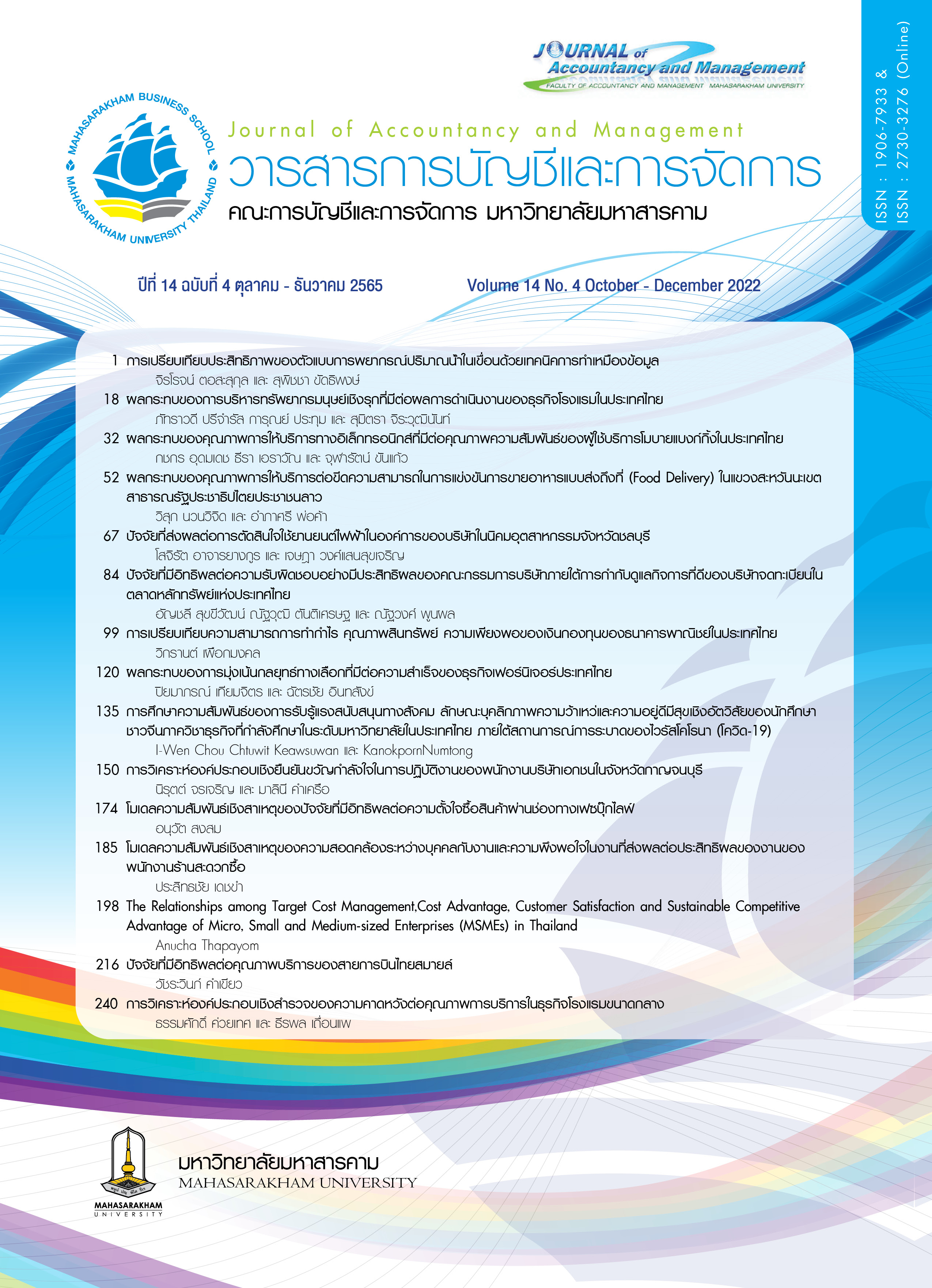
ผลกระทบของคุณภาพการให้บริการทางอิเล็กทรอนิกส์ที่มีต่อคุณภาพความสัมพันธ์ของผู้ใช้บริการโมบายแบงก์กิ้งในประเทศไทย
คำสำคัญ:
คุณภาพการให้บริการทางอิเล็กทรอนิกส์, คุณภาพความสัมพันธ์, โมบายแบงก์กิ้ง, ประเทศไทยบทคัดย่อ
การวิจัยนี้มีวัตถุประสงค์เพื่อศึกษาความสัมพันธ์และผลกระทบของคุณภาพการให้บริการทางอิเล็กทรอนิกส์ที่มีต่อคุณภาพความสัมพันธ์ของผู้ใช้บริการโมบายแบงก์กิ้งในประเทศไทย โดยใช้แบบสอบถามเป็นเครื่องมือในการเก็บรวบรวมข้อมูลจากกลุ่มตัวอย่างซึ่งเป็นผู้ใช้บริการโมบายแบงก์กิ้งในประเทศไทย จำนวน 400 คน การวิเคราะห์ข้อมูลโดยใช้สถิติเชิงพรรณนา การวิเคราะห์สหสัมพันธ์พหุคูณและการวิเคราะห์ความถดถอยพหุคูณ ผลการวิจัยพบว่า คุณภาพการให้บริการทางอิเล็กทรอนิกส์ ด้านประสิทธิภาพของการบริการ ด้านความพร้อมของระบบ ด้านความเป็นส่วนตัวและด้านความปลอดภัย รวมถึงด้านการตอบสนองต่อความต้องการ มีความสัมพันธ์และมีผลกระทบเชิงบวกต่อคุณภาพความสัมพันธ์ของผู้ใช้บริการโมบายแบงก์กิ้งในประเทศไทย งานวิจัยนี้เป็นงานวิจัยแรกที่สร้างคุณค่าทางวิชาการให้กับการศึกษาเกี่ยวกับคุณภาพการให้บริการทางอิเล็กทรอนิกส์ โดยศึกษาความสัมพันธ์ระหว่างคุณภาพการให้บริการทางอิเล็กทรอนิกส์กับคุณภาพความสัมพันธ์ในบริบทของโมบายแบงก์กิ้งในประเทศไทย
Downloads
เอกสารอ้างอิง
กรุงเทพธุรกิจ. (2563). เศรษฐกิจไร้เงินสด: พฤติกรรมผู้บริโภค โอกาสธุรกิจไทยช่วงโควิด. ค้นเมื่อ 3 กันยายน 2563, จาก https://www.bangkokbiznews.com/blog/detail/650718.
ฉันธะ จันทะเสนา. (2562). ตัวแปรที่มาก่อนของการตั้งใจซื้อซ้ำในพาณิชย์อิเล็กทรอนิกส์ไทย, วารสารการพัฒนาทรัพยากรมนุษย์และองค์การ สถาบันบัณฑิตพัฒนบริหารศาสตร์, 11(2), 1–31.
ฐานเศรษฐกิจ. (2562). การพัฒนาของธุรกิจ ธนาคารในโลกดิจิทัล. ค้นเมื่อ 3 กันยายน 2563, จาก https://www.bot.or.th/
ณัฐนันท์ พฤฒิจิระวงศ์. (2557). การรับรู้คุณภาพบริการ และความพึงพอใจในการบริการที่ส่งผลต่อความภักดีในการใช้บริการ กรณีศึกษานักท่องเที่ยวในสวนสัตว์เชียงใหม่. วิทยานิพนธ์ปริญญามหาบัณฑิต มหาวิทยาลัยราชมงคลอีสาน.
ธนาคารแห่งประเทศไทย. (2563). จำนวนบัญชีลูกค้าที่ใช้บริการ. ค้นเมื่อ 14 กันยายน 2563, จาก https://www.bot.or.th/App/BTWS
ธนาคารแห่งประเทศไทย. (2563). ธุรกรรมการชำระเงินผ่านบริการ Mobile Banking. ค้นเมื่อ 14 กันยายน 2563, จาก https://www.bot.or.th/App/BTWS
นันทนาฏ อุพงค์ บุญฑวรรณ วิงวอน และพิชาภพ พันธุ์แพ. (2564). การจัดการลูกค้าสัมพันธ์ทางอิเล็กทรอนิกส์ที่ส่งผลต่อความภักดีผ่านบทบาทเชื่อมโยงของคุณภาพความสัมพันธ์และประสบการณ์ลูกค้าในธุรกิจธนาคารพาณิชย์. วารสารวิชาการบริหารธุรกิจ: สมาคมสถาบันอุดมศึกษาแห่งประเทศไทย มหาวิทยาลัยวงษ์ชวลิตกุล, 10(1), 123-141.
บุญชม ศรีสะอาด. (2545). การวิจัยเบื้องต้น (พิมพ์ครั้งที่ 7). กรุงเทพฯ : สุวีริยาสาส์น.
ปทิตตา ภูวัฒนศิลป์ และวสุธิดา นุริตมนต์. (2560). การตลาดเชิงประสบการณ์และคุณภาพความสัมพันธ์ที่มีอิทธิพลต่อความภักดีของลูกค้าเบเกอรี่ร้านเอสแอนด์พีในเขตกรุงเทพมหานครและปริมณฑล. วารสารสุทธิปริทัศน์ มหาวิทยาลัยธุรกิจบัณฑิตย์, 100(31), 1–14.
ประสิทธิชัย นรากรณ์. (2561). คุณภาพความสัมพันธ์และแรงสนับสนุนทางสังคมในฐานะตัวแปรเชื่อมโยงระหว่างโซเชียลคอมเมิร์ซกับความตั้งใจซื้ออย่างต่อเนื่อง. วารสารวิทยาการจัดการ มหาวิทยาลัยราชภัฏเชียงราย, 13(1), 44–69.
ภาวิณี ทองแย้ม. (2560). ความสำคัญของคุณภาพการบริการต่อความสำเร็จของธุรกิจ. วารสารเกษมบัณฑิต มหาวิทยาลัยเกษมบัณฑิต, 18(1), 219–232.
สมบัติ ท้ายเรือคํา. (2552). ระเบียบวิธีการวิจัยสำหรับมนุษยศาสตร์และสังคมศาสตร์ (พิมพ์ครั้งที่ 3). มหาสารคาม : คณะศึกษาศาสตร์ มหาวิทยาลัยมหาสารคาม.
สุวิมล ติรกานันท์. (2551). การสร้างเครื่องมือวัดตัวแปรในการวิจัยทางสังคมศาสตร์: แนวทางสู่การปฏิบัติ. กรุงเทพฯ : โรงพิมพ์แห่งจุฬาลงกรณ์มหาวิทยาลัย.
สำนักงานพัฒนาธุรกรรมทางอิเล็กทรอนิกส์. (2563). รายงานผลการสำรวจพฤติกรรมผู้ใช้อินเทอร์เน็ตในประเทศไทยปี 2562. ค้นเมื่อ 2 กันยายน 2563, จาก https://www.etda.or.th/th/newsevents/pr-news/ETDA/ETDA-เผย-ปี-62-คนไทยใช้อินเทอร์เน็ตเพิ่มขึ้นเฉลี่ย-10-ชั่วโมง-2.aspx?feed=590fb9ad-c550-4bc5-9a56-459ad4891d74
หนึ่งนุช ธีระรุจินนท์ และวิโรจน์ เจษฎาลักษณ์. (2560). การให้บริการธุรกรรมอิเล็กทรอนิกส์ธนาคารกรุงไทย สาขาเอ็มไพร์ทาวเวอร์ กรุงเทพมหานคร. Veridian E-Journal, Silpakorn University, 10(1), 1523–1537.
Al‐Hawari, S. I. S., & Al‐Smeran, W. F. (2017). Impact of electronic service quality on customers satisfaction of Islamic Banks in Jordan. International Journal of Academic Research in Accounting, Finance and Management Sciences, 7(1), 170-188.
Al‐Hawari, M. A. (2011). Automated service quality as a predictor of customers' commitment. Asia Pacific Journal of Marketing and Logistics, 23(3), 346-366.
Alrubaiee, L. & Alnazer, N. (2010). Investigate the Impact of relationship marketing orientation on customer loyalty : The Customer's Perspective. International Journal of Marketing Studies, 2(1), 155-174.
Arcand, M., Promtep, S., Brun, I., & Rajaobelina, L. (2016). Mobile banking service quality and customer relationships. International Journal of Bank Marketing, 35(7), 1068-1089.
Ayo, C. K., Oni, A. A., Adewoye, O. J., & Eweoya, I. O. (2016). E-banking users’ behavior : e-service quality, Attitude and customer satisfaction. International Journal of Bank Marketing, 34(3), 347-367.
Black, K. (2006). Business statistics: for contemporary decision Making. 4th Edition. USA : John Wiley & Sons.
Brun, I., Rajaobelina, L., Ricard, L., & Fortin, A. (2017). Impact of website characteristics on relationship quality: a comparison of banks financial cooperatives. Journal of Financial Services Marketing, 22(4). 141-149.
Chek, Y. L. & Ho, J. S. Y. (2016). Consumer electronics E-retailing: why the alliance of vendors’ E-service quality, trust and trustworthiness matters. Procedia - Social and Behavioral Sciences, 219, 804-811.
Cho, J. E. & Hu, H. (2009). The effect of service quality on trust and commitment varying across generations. International Journal of Consumer Studies, 33, 468-476.
Chu, Z., Wang, Q., & Lado, A. A. (2016), Customer orientation, relationship quality, and performance: The third-party logistics provider’s perspective. The International Journal of Logistics Management, 27(3), 738-754.
Fauzi, A. (2018) Electronic service quality on mobile application of online transportation services. Journal Manajemen Indonesia, 18(1), 13-27.
Giovanis, A. N. & Athanasopoulou, P. (2014). Gaining customer loyalty in the e-tailing marketplace: the role of e-service quality, e-satisfaction and e-trust. Int. J. Technology Marketing, 9(3), 288-304.
Hwang, J. H. (2018). Structural relationship among Customer Orientation, Relationship Quality, and Relationship Performance of Fitness Facilities. Korean Journal of Sports Science, 27(1), 563-574, Javed, S., Rashidin, S., & Li, B. (2018). Assessing The E-service of the banking Sector by using E-serqual Model: a comparative study of local commercial banks and foreign banks in Pakistan. Journal of Internet Banking and Commerce, 23(1), 1-12.
Jiang, L., Jun, M., & Yang, Z. (2015). Customer-perceived value and loyalty: how do key service quality dimensions matter in the context of B2C e-commerce?. Service Business, 10(2), 1-17.
Kiew, L. M. (2017). Relationship quality, service quality on internet advertising effectiveness: knowledge management as a moderator. Doctor of Business Administration, University Utara Malaysia.
Kim, J. & Kim, C. (2010). E‐service quality perceptions: a cross‐cultural comparison of American and Korean consumers. Journal of Research in Interactive Marketing, 4(3), 257–275.
Kim, J., Jin, B., & Swinney, J. L. (2009). The role of etail quality, e-satisfaction and e-trust in online loyalty development process. Journal of Retailing and Consumer Services, 16, 239–247.
Kotler, P. & Keller, K. L. (2006). Marketing management (12th ed.). Upper Saddle River, NJ : Prentice-Hall.
Kundu, S. & Datta, S. K. (2015). Customer loyalty towards internet banking: Some survey evidence for banks in India. The IUP Journal of Bank Management, 8(4), 37-50.
Leonnard (2019). Exploring the relationship among E-service Quality, E-trust, E-satisfaction and loyalty at higher education institutions, Journal on Efficiency and Responsibility in Education and Science, 12(4), 103-110.
Liu, G. & Nam, S. (2020).The influence of relationship marketing activities on relationship quality and selection behavioral intention in Chinese medical beauty service institution : Focused on Moderating Effect of Medical Beauty Service Quality. Journal of China Studies, 23(2), 85-110.
Mendoza, M. C. O., Santos, R. R. C., & Magdaraog, J. E. H. (2020). Assessment of E-service quality dimensions and Its influence on customer satisfaction: A study on the online banking services in the Philippines. IEEE 7th International Conference on Industrial Engineering and Applications, 1076-1081.
Moliner, M. A., Sánchez, J., Rodríguez, R. M., & Callarisa, L. (2007). Relationship quality with a travel agency: The influence of the post-purchase perceived value of a tourism package, Tourism and Hospitality Research, 7(3-4), 194-211.
Monteiro, N. F. D. P. S. (2013). E-CRM and relationship quality: Exploratory research in the portuguese banking sector. (Master Degree). Lisbon school of economics and management.
Parasuraman, A., Zeithaml, V. A., & Malhotra, A. (2005). A multiple-item scale for assessing electronic service quality. Journal of Service Research, 3(7), 213-233.
Pepur, M., Mihanovic, Z., & Pepur, S. (2013). The impact of psychological contract on relationship quality in financial services market. Croatian Operational Research Review, 4(1), 89-98.
Pourazad, N. & Pare, V. (2015). Investigating the impact of social media marketing activities on adelaide festival's brand relationship quality. Proceedings of Sydney International Business Research Conference, 363-386.
Purnamasari, D. (2018). The roles of E-service quality, E-trust, and E-satisfaction on online retail loyalty. 9th industrial research workshop and national seminar, 634-641.
Rahahleh, A., Al-Nsour, S., Moflih, M. A., & Alabaddi, Z. (2020). The influence of electronic service quality on relationship quality: Evidence from tourism industry. Management Science Letters, 10(12), 2759-2758.
Rahi, S. & Ghani, M. A. (2019). Investigating the role of UTAUT and e-service quality in internet banking adoption setting. Journal of Accounting, 31(3), 491-506.
Rita, P., Oliveira, T., & Farisa, A. (2016). The impact of e-service quality and customer satisfaction on customer behavior in online shopping. Journal Heliyon, 5(10), 1-14.
Saodin, S., Arifin, Z., & Sunarti, S. (2019). The influence of E-service quality toward E-satisfaction, E-trust, E-word of mounth and online repurchase intention: A study on the consumers of the three-star hotels in Lampung. Russian Journal of Agricultural and Socio-Economic Sciences, 93(9), 27-38.
Sari, N. A. M., Azlina, N. Humaidi, N., & Nordin, A. (2019). The relationship between E-service quality and user satisfaction regarding the use of mobile banking in The Banking Industry. International Journal of Academic Research in Business and Social Sciences, 8(12), 1663–1676.
Seo, Y. S. & Jo, D. H. (2020). The effect of supply chain partners’ Relationship marketing on relationship quality and relationship performance. Journal of Korea Service Management Society, 21(4), 286-301.
Shin, J. & Lee, J. (2018). The effects of relationship marketing of land operator on relationship quality and repurchase intention. Journal of Tourism Management Research, 22(7), 419-437.
Singh, S. (2019). Measuring E-service quality and customer satisfaction with internet Banking in India. Theoretical Economics Letters, 9(2), 308-326.
Suharyono, S. H., Fauzi, A., & Suyadi, I. (2015). The effects of service quality on customer satisfaction, customer delight, trust, repurchase intention, and word of mouth. International Institute for Science, Technology and Education (IISTE): E-Journals, 7(12), 36-48.
Theodosiou, M., Katsikea, E., Samiee, S., & Makri, K. (2019). A comparison of formative versus reflective approaches for the measurement of electronic service quality. Journal of Interactive Marketing, 19(47), 53-57.
Ting, O. S., Ariff, M. S. B. M., Zakuan, N., & Sulaiman, Z. (2016). E-Service quality, E-satisfaction and E-loyalty of online shoppers in business to consumer market; Evidence form Malaysia. IOP Conference Series Materials Science and Engineering, 131(1), 1-10.
Tran, V. D. & Vu, Q. H. (2019). Inspecting the relationship among E-service quality, E-trust, E-customer satisfaction and behavioral intentions of online shopping customers. Global Business Finance Review, 24(3), 29-42.
Wang, Y. & Hajli, M. N. (2014). Co-creation in branding through social commerce: The role of social support, relationship quality and privacy concerns. Twentieth Americas Conference on Information Systems, Savannah, 1-16.
Wu, X. (2018). The impact of ecommerce service quality of B2C E-commerce on customer loyalty in China. Degree of Master of Master of Business Administration. The University of the Thai Chamber of Commerce, 1-78.
Zavareh, F. B., Ariff, M. S. M., Jusoh, A., Zakuan, N., Bahari, A. Z., & Ashourian, M. (2012). E-service quality dimensions and their effects on E-customer satisfaction in internet banking services. Procedia - Social and Behavioral Sciences, 40.
ดาวน์โหลด
เผยแพร่แล้ว
รูปแบบการอ้างอิง
ฉบับ
ประเภทบทความ
สัญญาอนุญาต
ลิขสิทธิ์ (c) 2021 วารสารการบัญชีและการจัดการ

อนุญาตภายใต้เงื่อนไข Creative Commons Attribution-NonCommercial-NoDerivatives 4.0 International License.
บทความที่ได้รับการตีพิมพ์เป็นลิขสิทธิ์ของวารสารการบัญชีและการจัดการ
ข้อความที่ปรากฏในบทความแต่ละเรื่องในวารสารวิชาการเล่มนี้เป็นความคิดเห็นส่วนตัวของผู้เขียนแต่ละท่านไม่เกี่ยวข้องกับมหาวิทยาลัยมหาสารคาม และคณาจารย์ท่านอื่นๆในมหาวิทยาลัยฯ แต่อย่างใด ความรับผิดชอบองค์ประกอบทั้งหมดของบทความแต่ละเรื่องเป็นของผู้เขียนแต่ละท่าน หากมีความผิดพลาดใดๆ ผู้เขียนแต่ละท่านจะรับผิดชอบบทความของตนเองแต่ผู้เดียว