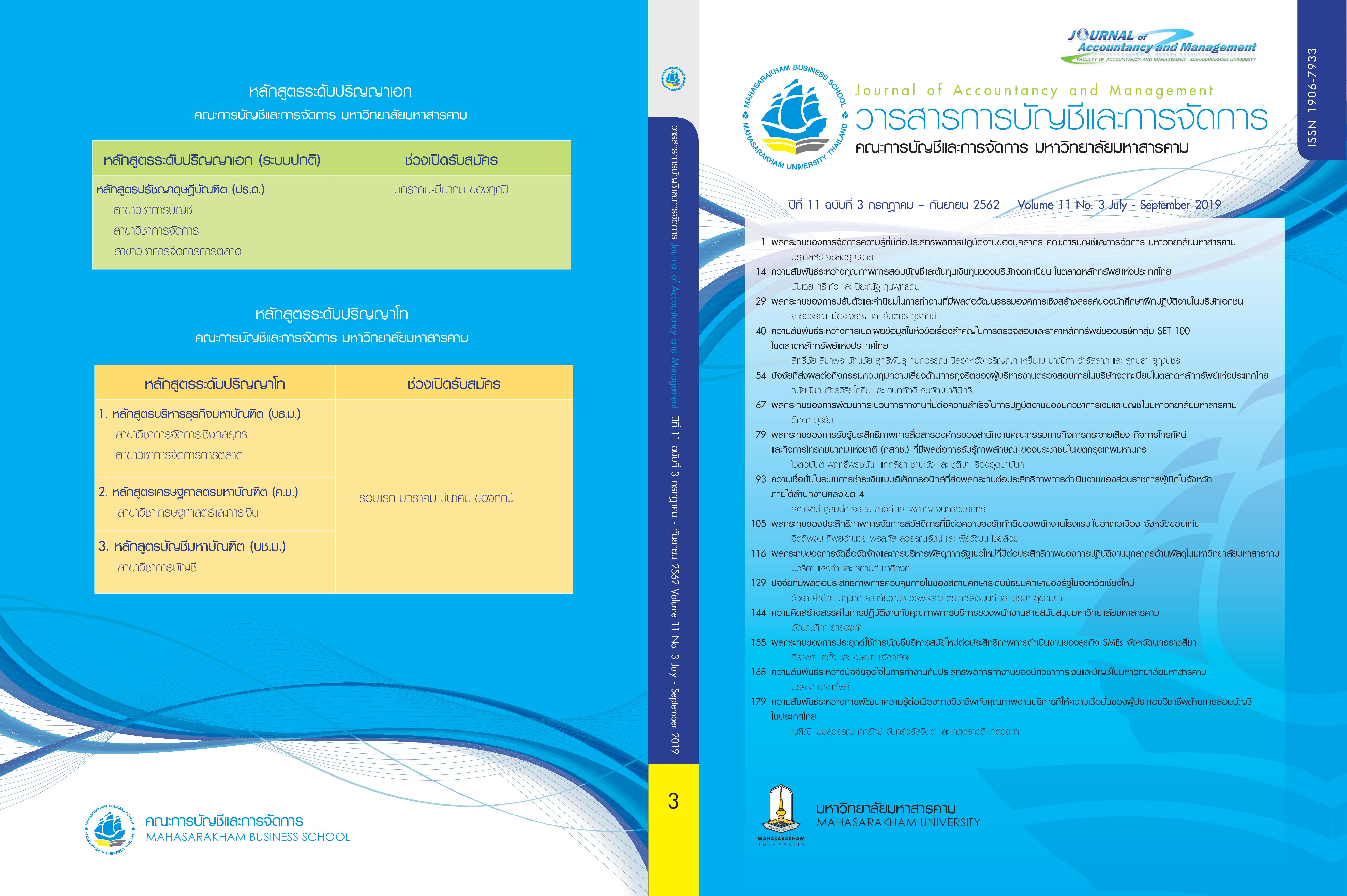
ผลกระทบของการปรับตัวและค่านิยมในการทำงานที่มีผลต่อ วัฒนธรรมองค์การเชิงสร้างสรรค์ของนักศึกษาฝึกปฏิบัติงานในบริษัทเอกชน
คำสำคัญ:
การปรับตัวในการทำงาน, ค่านิยมในการทำงาน, วัฒนธรรมองค์การเชิงสร้างสรรค์บทคัดย่อ
การวิจัยครั้งนี้มีวัตถุประสงค์เพื่อศึกษาผลกระทบการปรับตัวและค่านิยมในการทำงานที่มีผลต่อวัฒนธรรมองค์การเชิงสร้างสรรค์ของนักศึกษาฝึกปฏิบัติงานในบริษัทเอกชน โดยศึกษากลุ่มตัวอย่าง 400 คน ใช้แบบสอบถามเป็นเครื่องมือที่ใช้ในการเก็บรวบรวมข้อมูล พร้อมทั้งสถิติที่ใช้ในการวิเคราะห์ ได้แก่ ค่าร้อยละ ค่าเฉลี่ย ค่าความเบี่ยงเบนมาตรฐาน การวิเคราะห์ความสัมพันธ์ระหว่างตัวแปรอิสระโดยใช้ค่าสหสัมพันธ์เพียร์สันและวิเคราะห์การถดถอยพหุคูณ ผลการวิจัยพบว่า การปรับตัวในการทำงาน ได้แก่ ความสามารถในการเรียนรู้งานความสามารถในการติดต่อสัมพันธ์กับบุคคลอื่น ความสามารถในการปรับตัวให้เข้ากับวัฒนธรรมองค์การ และความสามารถในการแก้ไขปัญหาอย่างสร้างสรรค์ และค่านิยมในการทำงาน ได้แก่ การปรับตัวต่อการเปลี่ยนแปลง การอนุรักษ์ การพัฒนาตนเอง และการเข้าใจผู้อื่น ส่งผลต่อวัฒนธรรมองค์การเชิงสร้างสรรค์ ได้แก่ มิติมุ่งความสำเร็จ มิติมุ่งสัจการแห่งตน มิติมุ่งบุคคล และมิติมุ่งไมตรีสัมพันธ์ อย่างมีนัยสำคัญทางสถิติที่ระดับ 0.05 พร้อมทั้งได้มีการสรุปผลและข้อเสนอแนะจากการวิจัยมาเป็นแนวทางกำหนดนโยบายเพื่อนำมาประยุกต์ใช้กับองค์การได้ตามบรรลุเป้าหมายต่อไป
Downloads
เอกสารอ้างอิง
กล้าหาญ ณ น่าน. (2557). อิทธิพลของคุณลักษณะบุคลิกภาพ และความพึงพอใจที่มีต่อการปรับตัวในการทำงานของผู้เข้าสู่ตลาดบัณฑิตใหม่. วารสารวิทยาการจัดการ, 31(1), 39-67.
สถาบันการจัดการปัญญาภิวัฒน์. (2561). สถาบันอุดมศึกษาโดย CP All. ค้นหาวันที่ 27 กรกฎาคม 2561, จาก https://www.pim.ac.th/en/pages/cpall.
Abessolo, M., Hirschi, A., & Rossier, J. (2017). Work values underlying protean and boundaryless career orientations. Career Development International, 22(3), 241-259.
Bolman, L. G. & Deal, T. E. (2003). Reframing organizations: Artistry, Choice, and Leadership. San Francisco: Jossey-Bass.
Cochran, W.G. (1977). Sample Techniques. 3nd Edition. Singapore: John Wiley & Sons, Inc.
Cooke, R. A. & Lafferty, J. C. (1994). Organizational culture inventory. Plymouth, MI: Human Synergistics International.
Cronbach, J. L. (1990). Essentials of psychological testing (5th ed.). New York, NY: Harper and Row.
Dawis, R. B. & Lofquist, L. (1984). A Psychological theory of work adjustment: An individual difference model and its application. Minneapolis: University of Minnesota.
Greenberg, J. & Baron, R. A. (2008). Behavior in Organizations (9th ed.). Upper Saddle River, N.J.: Prentice Hall.
Harrison, T. & Bazzy, J. D. (2017) Aligning organizational culture and strategic human resource management. Journal of Management Development, 36(10), 1260-1269.
Hinkle, D.E, William, W., & Stephen, G. J. (1998). Applied statistics for the behavior sciences (4th ed.). New York, NY: Houghton Mifflin.
Kreitner, R., & Kinicki, A. (2010). Organizational Behavior. New York: McGraw-Hill.
Likert, R. (1961). New patterns of management. New York, NY: McGraw-Hill.
Lyons, S. & Kuron, L. (2014). Generational differences in the workplace: A review of the evidence and directions for future research. Journal of Organizational Behavior, 35, 139-157.
Plamondon, K. E. (2000). Adaptability in the workplace: Development of a taxonomy of adaptive performance. Journal of Applied Psychology, 85(4), 612-624.
Raghuram, S. Garud, R., Wiesenfeld, B., & Gupta V. (2001). Factors contributing to virtual work adjustment. Journal of Management, 27(3), 383-405.
Robbin, P.S. & Jundge, T.A. (2007). Organizational Behavior (12 th ed.) New Jersey, NJ: Pearson Education.
Rovinelli, R. J., & Hambleton, R. K. (1977). On the use of content specialists in the assessment of criterion-referenced test item validity. Dutch Journal of Educational Research, 2, 49-60.
Savovic, S. (2017). Organizational culture differences and post-acquisition performance: The mediating role of employee attitudes. Leadership & Organization Development Journal, 38(5), 719-741.
Schein, E. H. (2004). Organizational Culture and Leadership (3rd ed.) Sanfanciso, CA: Jossey-Bas.
Schwartz, S. H. (2012). An overview of the Schwartz theory of basic values. Online Readings in Psychology and Culture, 2(1), 11.
Stevens, J. (1992). Applied multivariate statistics for the social science (2nd ed.). New York, NY: Harper and Row.
Wang, X. & Pierre, J. S. (2005). Work adjustment and job satisfaction of Filipino immigrant employees in Canada. Canadian Journal of Administrative Sciences, 22(3), 243-254.
ดาวน์โหลด
เผยแพร่แล้ว
รูปแบบการอ้างอิง
ฉบับ
ประเภทบทความ
สัญญาอนุญาต
บทความที่ได้รับการตีพิมพ์เป็นลิขสิทธิ์ของวารสารการบัญชีและการจัดการ
ข้อความที่ปรากฏในบทความแต่ละเรื่องในวารสารวิชาการเล่มนี้เป็นความคิดเห็นส่วนตัวของผู้เขียนแต่ละท่านไม่เกี่ยวข้องกับมหาวิทยาลัยมหาสารคาม และคณาจารย์ท่านอื่นๆในมหาวิทยาลัยฯ แต่อย่างใด ความรับผิดชอบองค์ประกอบทั้งหมดของบทความแต่ละเรื่องเป็นของผู้เขียนแต่ละท่าน หากมีความผิดพลาดใดๆ ผู้เขียนแต่ละท่านจะรับผิดชอบบทความของตนเองแต่ผู้เดียว