
Design Guidelines for Shophouse Renovation to Enhance Well-Being and Safety for Older Adults
Article Sidebar
Main Article Content
Abstract
This study investigates the living conditions of older adults in shophouse buildings, where mixed commercial–residential use may no longer support ageing-related needs for safety and well-being. The research aims to identify key design factors affecting quality of life and to propose adaptive design guidelines.
Data were collected through semi-structured interviews with 13 households (20 participants) and field surveys. The selected cases were categorized into two typologies: (1) ground-floor commercial use with upper-level residential spaces, and (2) mixed-use configurations combining retail, storage, and residential functions. The analysis focuses on two dimensions: well-being design (including spatial use, constraints, social space, lighting, and ventilation) and universal design (emphasizing safety, accessibility, and usability).
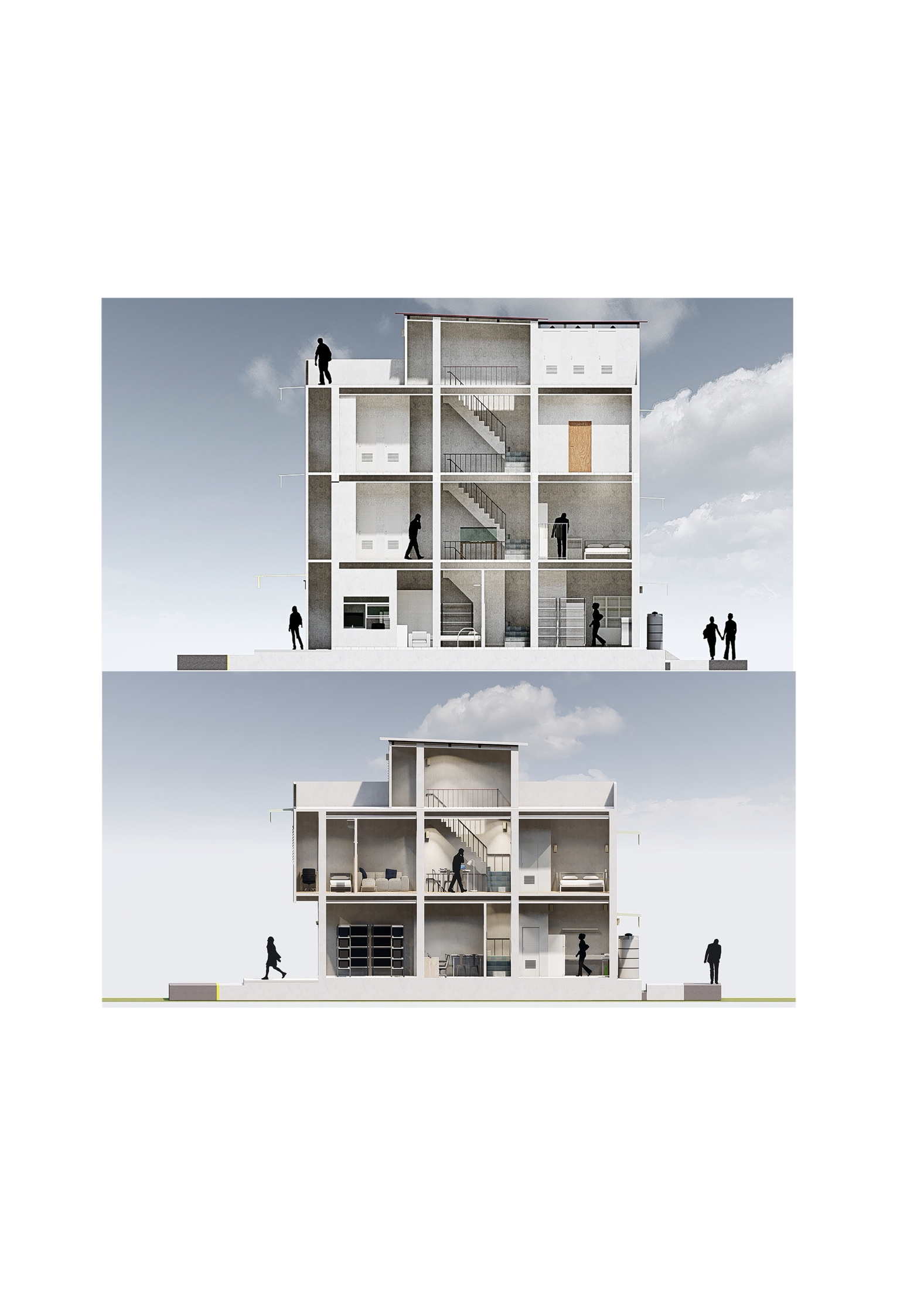
The findings reveal that slip-resistant materials, assistive installations, and layouts supporting independent use significantly enhance safety and reduce the risk of falls. Additionally, flexible social spaces, appropriate lighting, and adequate ventilation contribute to improved well-being and family interaction. The results are synthesized through plans, sections, and three-dimensional representations to demonstrate practical design interventions.
This study provides evidence-based guidelines for adapting shophouse environments to support ageing in place, promoting both safety and well-being in a sustainable manner.
Article Details

This work is licensed under a Creative Commons Attribution-NonCommercial-NoDerivatives 4.0 International License.
References
Arkarapotiwong, P., Chindapol, S., Jarutat, T., Sawangcharoen, C., Hosuthisima, K., & Tanmongkon, S. (2022). Health-environmental adaptation for Thai elderly across Thailand (Research report), Thailand Research Fund.
Center for Universal Design. (1997). The principles of universal design, version 2.0. North Carolina State University. https://design.ncsu.edu/research/center-for-universal-design/
Center for Universal Design. (2020). CHULA Home Modification Checklist for Older Persons. Chulalongkorn University. https://section09.thaihealth.or.th/wp-content/uploads /sites/26/2022/12/650922-CHULA-Modification-Checklist.pdf
Centers for Disease Control and Prevention. (2024). Vision and older adults. U.S. Department of Health and Human Services. https://www.cdc.gov/vision-health/about/older-adults.html
Cha, S.-M. (2025). A systematic review of home modifications for aging in place in older adults. Healthcare, 13(7), 752. https://doi.org/10.3390/healthcare13070752
Chindapol, S. (2023). Reducing the risk of falls in houses for older adults in Thailand. Kasetsart Journal - Social Sciences, 44(4), 1155–1166. https://doi.org/10.34044/-j.kjss.2023.44.4.20
Department of Health. (2020). Manual for driving the action plan for health promotion among older persons. Ministry of Public Health. https://mwi.anamai.moph.go.th /th/elderly -group/download/?did =209463 &id=91 754&reload=&preview=1
Divandari, N., Bird, M. L., Vakili, M., & Jaberzadeh, S. (2023). The association between cognitive domains and postural balance among healthy older adults: A systematic review of literature and meta-analysis. Current Neurology and Neuroscience Reports, 23(11), 681–693. https://doi.org/10.1007/s11910-023-01305-y
Klimczuk, A., & Tomczyk, Ł. (2015). Intergenerational relations: Contemporary theories, studies, and policies. Springer. https://doi.org/10.1007/978-3-658-05984-4
Kopec, D. (2012). Environmental psychology for design (2nd ed.). Fairchild Books.
Kraisin, C. (2014). Physical housing factors affecting the health of older adults: A case study of Bangkok. Journal of Public Health, 44(2), 145–156. https://doi.org/10.14456 /jph.2014.15
Li, P., Dahlan, N. D., Jaafar, J. M., & Zhu, N. (2025). A systematic review of indoor environmental quality in age-friendly housing. Buildings, 15(22), 4148. https://doi.org /10.3390/buildings15224148
Lord, S. R., Sherrington, C., Menz, H. B., & Close, J. C. T. (2007). Falls in older people: Risk factors and strategies for prevention (2nd ed.). Cambridge University Press. https://doi.org/10.1017/CBO9780511722233
Ministry of Interior. (1994). Ministerial Regulation No. 39 (B.E. 2537) issued under the Building Control Act B.E. 2522 (1979). Royal Thai Government Gazette, 111(23 Kor). https://odl. parliament.go.th/handle/20.500.13072/285972
Ng, B. P., Lu, J., Tiu, G. F., Thiamwong, L., & Zhong, Y. Y. (2021). Bathroom modifications among community-dwelling older adults who experience falls in the United States: A cross-sectional study. Health & Social Care in the Community, 30(1), 253–263. https://doi.org/10.1111/hsc.13398
Nimmol, K., Pongthana, P., Prasirtsuk, P., & Uratanamanee, S. (2025). Guidelines for physical environment and facilities to serve elderly tourists in riverside bungalows: A case study of Samut Songkhram Province. Journal of Architectural/Planning Research and Studies, 22(2), Article 273627. https://doi.org/10.56261/jars.v22.273627
Wolffsohn, J. S., & Davies, L. N. (2019). Presbyopia: Effectiveness of correction strategies. Progress in Retinal and Eye Research, 68, 124–143. https://doi.org/10.1016/j.preteyeres. 2018.09.004
World Health Organization. (2021). Decade of healthy ageing: Baseline report. https://www. who.int/publications/i/item/9789240017900
Yu, J., Ma, G., & Jiang, X. (2017). Impact of the built environment and care services within rural nursing homes in China on quality of life for elderly residents. Engineering, Construction and Architectural Management, 24(6), 1170–1183. https://doi.org/10.1108 /ECAM-08-2016-0187
