
Designing and Renovating Lanna Landscape Learning Space for the Conservation and Sustainable Transmission of Lanna Wisdom: A Case Study of Lanna Wisdoms School, Chiang Mai
Article Sidebar
Main Article Content
Abstract
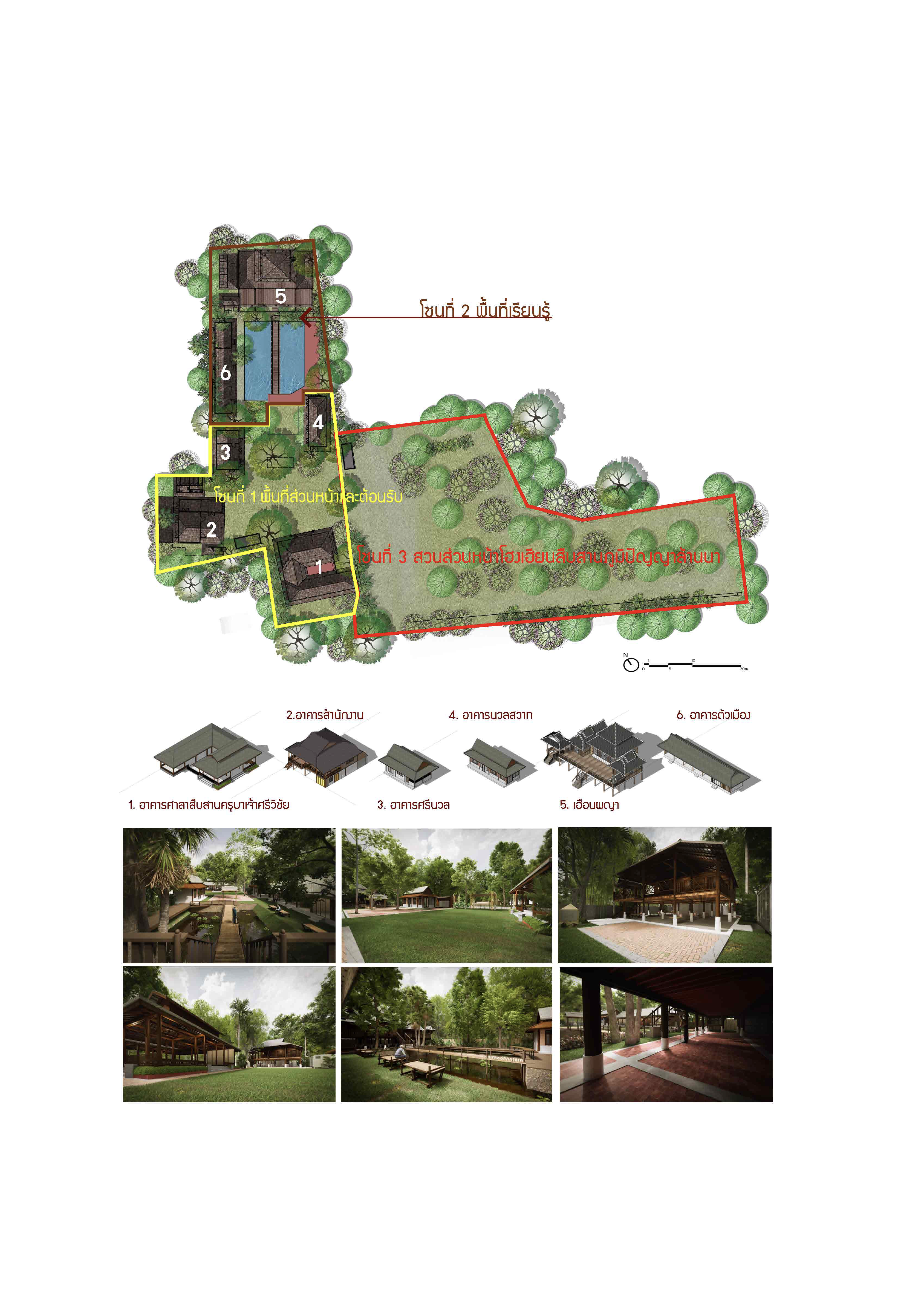
This study investigated the guidelines for designing and and renovating the physical environment improvement of learning spaces, focusing on the case of " Lanna Wisdoms School” which is a central hub connecting networks of Lanna wisdom teachers across generations, nurturing the youth, and preserving Lanna traditions, functioning as a "third place" for transmitting urban Lanna wisdom over a 30-year period (1996–2026). The process of participatory action research approached the collection data, survey, and extract lessons learned from cultural preservation revealed that despite sustained interest in the growth of teacher network and intergenerational learning, physical space development has been continuously disrupted include surrounding urban expansion, flood disasters, and the chronological deterioration of vernacular architecture. Therefore, it rendered current activities incompatible with the needs of contemporary learners and tourists. Furthermore, the participatory workshop are involved by the Lanna wisdom teacher network, architects, and students from Faculty of Fine Arts and Architecture, Rajamangala University of Technology Lanna, found the currently physical conditions, spatial utilization for learning space, and various activities, in order to develop guidelines for designing and renovating their area under the concept of "Lanna Landscape". These guidelines will encompass the environmental planning and architectural renovation, which aimed to optimizing inclusivity for all users, reflecting spatial functionality for disseminating Lanna art and culture, and establishing a social capital asset. Ultimately, this serves as a third place that anchors cultural networks, fosters self-reliance, and promotes sustainable development.
Article Details

This work is licensed under a Creative Commons Attribution-NonCommercial-NoDerivatives 4.0 International License.
References
Amloy, A., Ruangwitthayanusorn, S., Wonglangka, W., Ounchanum, P., Siriphon, A. & Oranratmanee, R. (2022). Karn suksa phumitouch phunthin Lanna nai boribot chumchon kong nakwichakarn Thai nai prathedthai chuwng por-sor 2545-2564 (In Thai) [The study of Lanna vernacular landscape in the community context of Thai scholars in Thailand during 2002–2021]. Landscape Architecture Journal, 4(1), 62–81. https://doi.org/10 .14456/laj.2022.4
Chotporn, K. (2020). Attalak khong sathanthi lae kan mi suan ruam khong chumchon nai kan phatthana mueang (In Thai) [Place identity and community participation in urban development]. Journal of Social Sciences, Chiang Mai University, 26(2), 45–67.
Goffman, E. (1959). The presentation of self in everyday life. Anchor Books.
Jeffres, L. W., Bracken, C. C., Jian, G., & Casey, M. F. (2009). The Impact of Third Places onCommunity Quality of Life. Applied Research in Quality of Life, 4(4), 333–345.
Office of Natural Resources and Environmental Policy and Planning. (2018). Khu Mue Sathapataya kam thongthin changwat Chiang Mai lae changwat Lamphun (In Thai) [Local architecture manual of Chiang Mai and Lamphun provinces]. E-Book in Thai, S. Offset Graphic Design Limited Partnership.
Oldenburg, R. (1989). The great good place: cafes, coffee shops, community centers, beauty parlors, general stores, bars, hangouts, and how they get you through the day. Paragon House.
Phakdisukcharoen, K. (2011). Ong prakop thi chueam yong kan thang hok prakan khong phuen thi satharana baep Thai (In Thai) [The six interrelated components of Thai public space]. Silpakorn University.
Proshansky, H. M., Fabian, A. K., & Kaminoff, R. (1983). Place-identity: physical world socialization of the self. Journal of Environmental Psychology, 3(1), 57–83, https://doi.org/10.1016/ S0272-4944(83)80021-8
Punyathong, S. & Baengthid, P. (2025). The evolution and development of public spaces in Mueang Chiang Mai, Thailand. International Journal of Building Urban Interior and Landscape Technology (BUILT), 23(1), https://doi.org/10.56261/built.v23.259022
Thongdeelert, C. (1998). Withi Lanna withi phumpanya (In Thai). Lanna Wisdoms School.
Thongdeelert, C. (1999). Subsarn Lanna subtor lomhayjai phandin (In Thai). [Preserving Lanna heritage, continuing the breath of the land]. Lanna Wisdoms School.
Thong-suk, W. (2019). Khuang ban kap phuen thi satharana Lanna (In Thai) [Khuang Ban and Lanna public space]. Master’s thesis, Chiang Mai University.
Tuan, Y. F. (1977). Space and place: the perspective of experience. University of Minnesota Press.
