
The renovation of the Jed Yod cafeteria at Rajamangala University of Technology Lanna for the exhibition hall under the green building concept
Article Sidebar
Main Article Content
Abstract
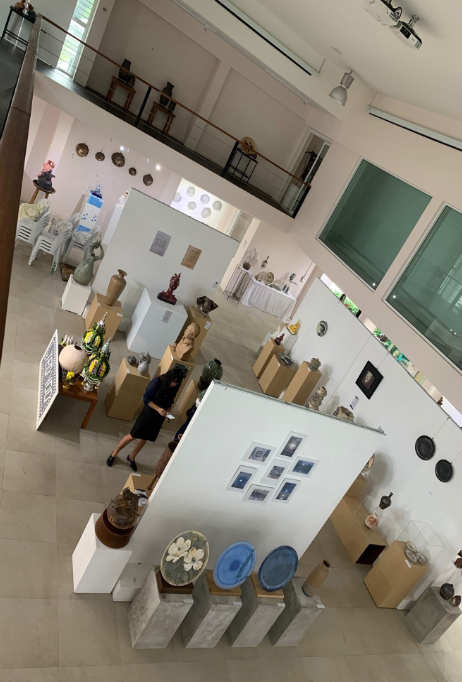
The transformation of utilization is the design approach which addresses the environmental issues by integrating natural elements such as material selection and construction processes with consideration of environmental impacts. To support the sustainable building efficiency, contributing to the mitigation of which is part of mitigating global warming, this study aims to propose the renovation approach for the existing Jed Yod cafeteria into the exhibition hall to accommodate the students, faculty members, artists, and designers for their exhibition for of works and creative ideas to the public under the concept of green building design. The study methodology includes the assess meet of the building and its interior environment to gather data and to identify areas for improvement with consideation of the green building design criteria and sustainable design theories, and the evaluation of user satisfaction. The result found the importance of reusing the existing structures to reduce construction waste, enhancing natural lighting, utilizing local materials, and integrating flexible design elements to accommodate various users to maximize benefits and suitability for the public building space.
Article Details

This work is licensed under a Creative Commons Attribution-NonCommercial-NoDerivatives 4.0 International License.
References
Alfuraty, A.B. (2020). Sustainable environment in interior design: design by choosing sustainable materials. IOP Conference Series: Materials Science and Engineering, 881, doi: 10.1088/1757-899x/881/1/012035
AVL Design. (2021). Ruchak kap “green architecure” karn okbaep doi chai prayot chak thammachat. (In Thai) [Get to know “green architecture” a design that derives benefits from nature]. Retrieved July 15, 2023, from https://avl.co.th/blogs/get-to-know-green-architecture-the-design-of-using-nature/
Celadyn, M. (2018). Environmental activation of inner space components in sustainable interior design. Sustainability, 10(6), 19-45.
Department of Public Works and Town & Country Planning. (2019). Khumue karn okbaep prapprung akhan phak rat thi miyu doem hai pen akhan khiao phak rat, version 1.0. (In Thai) [Green government office design guidelines for major renovation, version 1.0]. Bangkok: Consultant Office of Technology Limited.
Disri, E. (2021). Mattrathan akhan khiao kap ngan okbaep phainai hong prachum. (In Thai) [Green building standards and interior design for conference rooms]. Retrieved April, 10, 2023, from https://avl.co.th/blogs/interior-design-green-building-standards/
Guo, Y. (2019). Architectural analysis and design of urban planning exhibition hall based on four design elements. IOP Conference Series: Earth and Environmental Science, 242, doi.org/10.1088/1755-1315/242/6/062015
Homsetthi, O. & Ananprayoon, W. (2019). Karn okbaep toktaeng phainai phuea setthakit choeng niwet korani sueksa thruesadi unchit niwet setthakit (In Thai) [Interior design for environmental-economic sustainability: case study, theory, and environmental-economic efficiency. The 6th BTAC Proceeding of Environmental Technology and Energy (pp. 63-71). Khon Kaen: Faculty of Architecture, Khon Kaen University.
Li, L.X. (2017) Discussion on the role of urban planning in urban development. Research on Urban Construction Theory, 35, 43–44.
National Innovation Agency. (2022). “ESG” naeokhit khwam yangyuen thi ongkon khuan chai pen khrueangmue. (In Thai) [“ESG” sustainable concepts that organizations should use as tools or just follow trends]. Retrieved June, 1, 2023, from https://www.nia.or.th/ESG-sustainability-concepts-or-trends
Panitchavalit, N. & Patankittipong, P. (2009). Pra chittipap niwet setthakit phuea karn phattana yangyuen. (In Thai) [Environmental-economic efficiency for sustainable development]. Retrieved Apirl, 1, 2023, from http://www2.mtec.or.th/website/article_list.aspx?id =116&cate=28.
Pitchayapanya, N. (2018). Karn sueksa karn chatkarn khaya chak set watsadu kosang nai khrongkan “Miyake Seki”. (In Thai) [Study of waste management from scraps construction materials in Miyake Seki factory project]. SSRU Journal of Public Administration, 1(3), 35-48.
Puthipairot, P. (2019). Khumue ken karn pramoen akhan khiao phak rat (korani akhan doem). (In Thai) [Guidelines for designing new government buildings to be green government buildings]. Retrieved Apirl, 15, 2023, from http://www.pcd.go.th/publication/5505
Puthipiroj, P., Sreeparsert, P. & Phimpraphan, M.M. (2020). Ken karn okbaep lae prapprung akhan phak rat hai pen akhan khiao. (In Thai) [Green building design and major renovation guidelines for government offices]. NAJUA: History of Architecture and Thai Architecture, 17(2), 8-40.
Rotsirikamon, P. (2021). Watsadu toktaeng phainai thi pen mit kap singwaetlom. (In Thai) [Interior decoration materials that are environmentally friendly]. Retrieved Apirl, 15, 2023, from https//:content.collacreate.com/2021/09/23/วัสดุตกแต่งใน/
Sisaat, B. (2010). Karn wichai bueangton. (In Thai) [Preliminary research]. Bangkok: Suwiriyasan.
Songwannawutthirojana, M. (2021). Lik neung mum maung kwang sustainable design. (In Thai) [Another perspective of sustainable design]. Retrieved Apirl, 5, 2023, from https://www.nipponpaintdecor.com/get_idea/another-ankle-of-sustainable-design/
Thongngam, P. (2019). Naeothang karn prapprung akhan rian kao su phuen thi thamngan ruam karn khong naksueksa sakha sathapattayakam, mahawitthayalai Theknoloyi Ratchamongkhon Lanna. (In Thai) [The guideline for old education building renovation toward collaboration space in Department of Architecture Rajamangala University of Technology Lanna]. Asian Creative Architecture, Art and Design: ACAAD, 28(1), 65-80.
Tulavanthana, P. (2019). Thammai phanang hosin tong pen sikhao? prawattisat khong amnat thi thuk mong kham nai lok sinlapa. (In Thai) [Why do museum walls have to be white? The history of suppressed authority]. Retrieved Apirl, 12, 2023, from https://waymagazine.org/with-cube-of-art-museum/
Yang, S. (2019). Research on the design of characteristic space in exhibition architecture. IOP Conference Series: Earth and Environmental Science, 310(2), doi:10.1088/1755-1315/310/2/022062
