
การปรับปรุงอาคารตึกแถว เพื่อสุขภาวะที่ดีและความปลอดภัยของผู้สูงอายุ
Article Sidebar
Main Article Content
บทคัดย่อ
การวิจัยนี้มุ่งศึกษาลักษณะการอยู่อาศัยของผู้สูงอายุในอาคารตึกแถว ซึ่งมีการใช้พื้นที่เชิงพาณิชย์ร่วมกับที่อยู่อาศัย อันอาจไม่สอดคล้องกับความต้องการด้านความปลอดภัยและสุขภาวะในปัจจุบัน โดยมีเป้าหมายเพื่อวิเคราะห์ปัจจัยด้านการออกแบบที่ส่งผลต่อคุณภาพชีวิต และเสนอแนวทางการปรับปรุงอาคารให้เหมาะสมกับผู้สูงอายุ การวิจัยใช้วิธีการเก็บข้อมูลด้วยแบบสอบถามกึ่งสัมภาษณ์ใน 13 ครัวเรือน รวมผู้ให้ข้อมูล 20 คน ร่วมกับการสำรวจภาคสนาม เพื่อนำข้อมูลมาวิเคราะห์ทั้งเชิงกายภาพและการใช้งานจริงของอาคารตึกแถว โดยแบ่งประเภทอาคารออกเป็น 2 ลักษณะ ได้แก่ อาคารที่ใช้ชั้นล่างเป็นพื้นที่ร้านค้าและชั้นบนเป็นที่อยู่อาศัย และอาคารที่มีการใช้งานพื้นที่ร้านค้า โกดัง และที่อยู่อาศัยปะปนกัน การวิเคราะห์ครอบคลุม 2 ประเด็นหลัก คือ ด้านสุขภาวะ (Well-being Design: WD) ซึ่งพิจารณาเงื่อนไขการใช้งาน ปัญหา ข้อจำกัด รวมถึงการจัดพื้นที่ทางสังคม แสงสว่าง และการระบายอากาศ และด้านการออกแบบเพื่อทุกคน (Universal Design: UD) ซึ่งเน้นความปลอดภัย การเข้าถึง และความสะดวกในการใช้งานของผู้สูงอายุ ผลการศึกษาพบว่า ในด้านความปลอดภัย การเลือกใช้วัสดุที่ช่วยลดความเสี่ยงต่อการหกล้ม การติดตั้งอุปกรณ์เสริมเพื่อความปลอดภัย และการออกแบบพื้นที่ที่เอื้อต่อการใช้งานด้วยตนเอง มีส่วนช่วยเพิ่มความมั่นใจและลดโอกาสเกิดอุบัติเหตุ ขณะที่ด้านสุขภาวะพบว่าการจัดพื้นที่ทางสังคมที่รองรับกิจกรรมหลากหลายสามารถส่งเสริมปฏิสัมพันธ์ภายในครอบครัวได้อย่างมีประสิทธิภาพ อีกทั้งการจัดแสงสว่างที่เหมาะสมกับการใช้งานในแต่ละพื้นที่ และการระบายอากาศที่ดี ล้วนส่งผลต่อคุณภาพชีวิตของผู้สูงอายุ
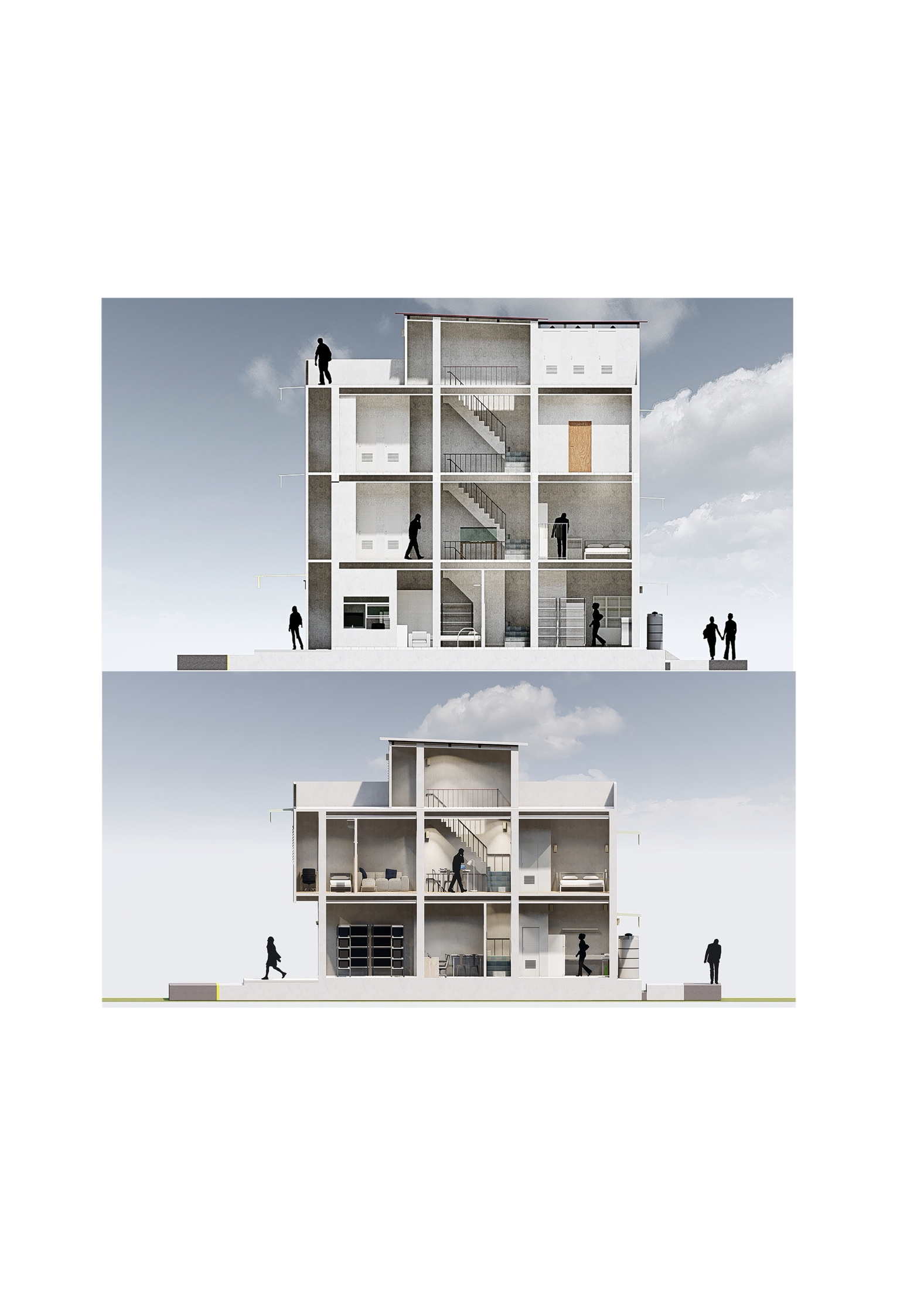
โดยผลการวิเคราะห์ถูกนำเสนอผ่านผัง (plan) รูปตัด (section) และภาพจำลองสามมิติ เพื่อแสดงแนวทางการปรับปรุงอาคารอย่างเป็นรูปธรรม และสามารถนำไปประยุกต์ใช้เป็นแนวทางในการออกแบบหรือปรับปรุงอาคารตึกแถวให้เหมาะสมกับการอยู่อาศัยของผู้สูงอายุได้อย่างมีประสิทธิภาพและยั่งยืนต่อไป
โดยผลการวิเคราะห์ถูกนำเสนอผ่านผัง (plan) รูปตัด (section) และภาพจำลองสามมิติ เพื่อแสดงแนวทางการปรับปรุงอาคารอย่างเป็นรูปธรรม และสามารถนำไปประยุกต์ใช้เป็นแนวทางในการออกแบบหรือปรับปรุงอาคารตึกแถวให้เหมาะสมกับการอยู่อาศัยของผู้สูงอายุได้อย่างมีประสิทธิภาพและยั่งยืนต่อไป
Article Details

อนุญาตภายใต้เงื่อนไข Creative Commons Attribution-NonCommercial-NoDerivatives 4.0 International License.
เอกสารอ้างอิง
Arkarapotiwong, P., Chindapol, S., Jarutat, T., Sawangcharoen, C., Hosuthisima, K., & Tanmongkon, S. (2022). Health-environmental adaptation for Thai elderly across Thailand (Research report), Thailand Research Fund.
Center for Universal Design. (1997). The principles of universal design, version 2.0. North Carolina State University. https://design.ncsu.edu/research/center-for-universal-design/
Center for Universal Design. (2020). CHULA Home Modification Checklist for Older Persons. Chulalongkorn University. https://section09.thaihealth.or.th/wp-content/uploads /sites/26/2022/12/650922-CHULA-Modification-Checklist.pdf
Centers for Disease Control and Prevention. (2024). Vision and older adults. U.S. Department of Health and Human Services. https://www.cdc.gov/vision-health/about/older-adults.html
Cha, S.-M. (2025). A systematic review of home modifications for aging in place in older adults. Healthcare, 13(7), 752. https://doi.org/10.3390/healthcare13070752
Chindapol, S. (2023). Reducing the risk of falls in houses for older adults in Thailand. Kasetsart Journal - Social Sciences, 44(4), 1155–1166. https://doi.org/10.34044/-j.kjss.2023.44.4.20
Department of Health. (2020). Manual for driving the action plan for health promotion among older persons. Ministry of Public Health. https://mwi.anamai.moph.go.th /th/elderly -group/download/?did =209463 &id=91 754&reload=&preview=1
Divandari, N., Bird, M. L., Vakili, M., & Jaberzadeh, S. (2023). The association between cognitive domains and postural balance among healthy older adults: A systematic review of literature and meta-analysis. Current Neurology and Neuroscience Reports, 23(11), 681–693. https://doi.org/10.1007/s11910-023-01305-y
Klimczuk, A., & Tomczyk, Ł. (2015). Intergenerational relations: Contemporary theories, studies, and policies. Springer. https://doi.org/10.1007/978-3-658-05984-4
Kopec, D. (2012). Environmental psychology for design (2nd ed.). Fairchild Books.
Kraisin, C. (2014). Physical housing factors affecting the health of older adults: A case study of Bangkok. Journal of Public Health, 44(2), 145–156. https://doi.org/10.14456 /jph.2014.15
Li, P., Dahlan, N. D., Jaafar, J. M., & Zhu, N. (2025). A systematic review of indoor environmental quality in age-friendly housing. Buildings, 15(22), 4148. https://doi.org /10.3390/buildings15224148
Lord, S. R., Sherrington, C., Menz, H. B., & Close, J. C. T. (2007). Falls in older people: Risk factors and strategies for prevention (2nd ed.). Cambridge University Press. https://doi.org/10.1017/CBO9780511722233
Ministry of Interior. (1994). Ministerial Regulation No. 39 (B.E. 2537) issued under the Building Control Act B.E. 2522 (1979). Royal Thai Government Gazette, 111(23 Kor). https://odl. parliament.go.th/handle/20.500.13072/285972
Ng, B. P., Lu, J., Tiu, G. F., Thiamwong, L., & Zhong, Y. Y. (2021). Bathroom modifications among community-dwelling older adults who experience falls in the United States: A cross-sectional study. Health & Social Care in the Community, 30(1), 253–263. https://doi.org/10.1111/hsc.13398
Nimmol, K., Pongthana, P., Prasirtsuk, P., & Uratanamanee, S. (2025). Guidelines for physical environment and facilities to serve elderly tourists in riverside bungalows: A case study of Samut Songkhram Province. Journal of Architectural/Planning Research and Studies, 22(2), Article 273627. https://doi.org/10.56261/jars.v22.273627
Wolffsohn, J. S., & Davies, L. N. (2019). Presbyopia: Effectiveness of correction strategies. Progress in Retinal and Eye Research, 68, 124–143. https://doi.org/10.1016/j.preteyeres. 2018.09.004
World Health Organization. (2021). Decade of healthy ageing: Baseline report. https://www. who.int/publications/i/item/9789240017900
Yu, J., Ma, G., & Jiang, X. (2017). Impact of the built environment and care services within rural nursing homes in China on quality of life for elderly residents. Engineering, Construction and Architectural Management, 24(6), 1170–1183. https://doi.org/10.1108 /ECAM-08-2016-0187
