
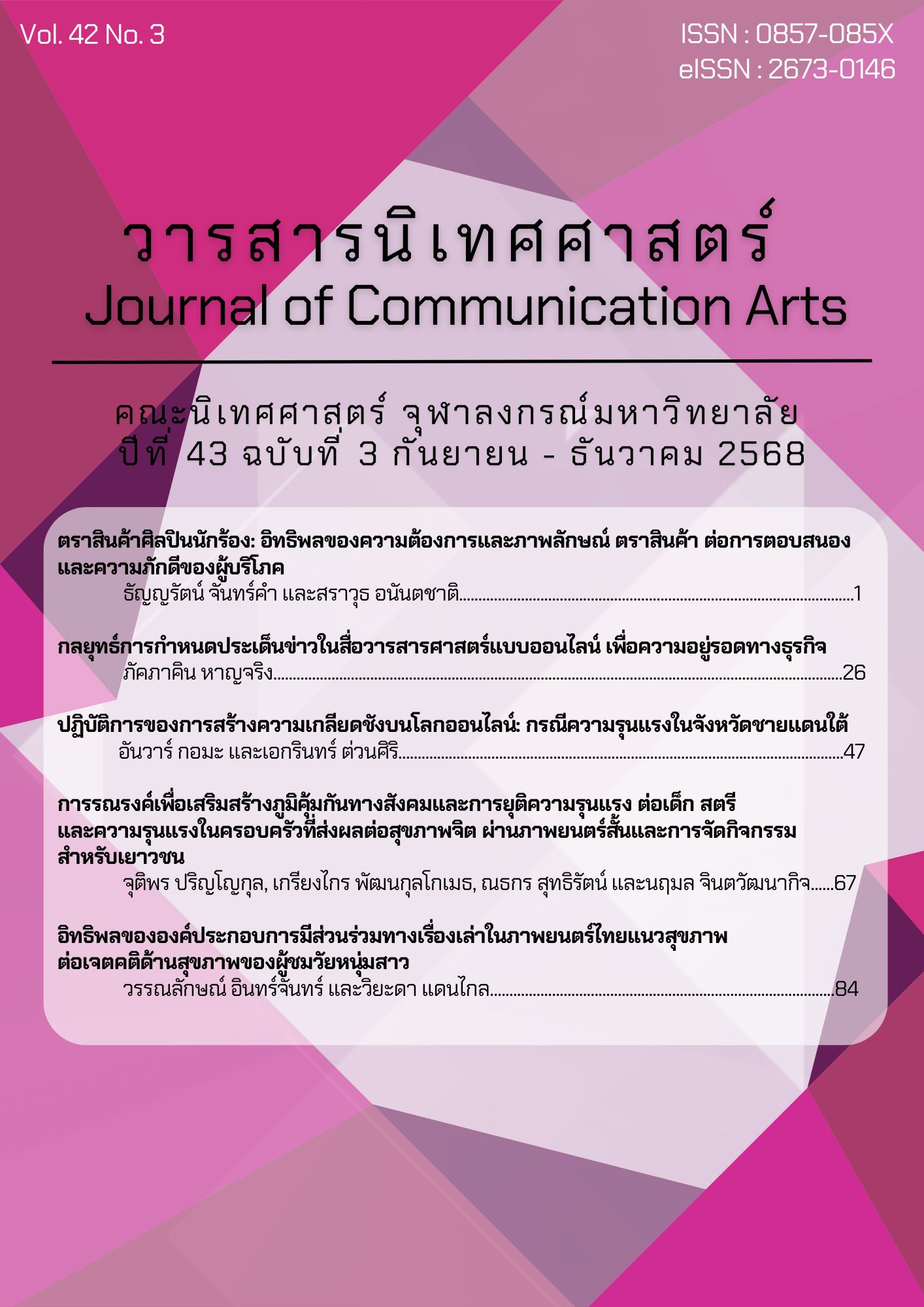
ตราสินค้าศิลปินนักร้อง: อิทธิพลของความต้องการและภาพลักษณ์ ตราสินค้า ต่อการตอบสนองและความภักดีของผู้บริโภค
Article Sidebar
Main Article Content
บทคัดย่อ
การวิจัยเชิงสำรวจในครั้งนี้มีวัตถุประสงค์เพื่อศึกษา 1) ความต้องการของผู้บริโภค ภาพลักษณ์ตราสินค้าศิลปินนักร้อง การตอบสนองของผู้บริโภค (ได้แก่ ความผูกพัน ความพึงพอใจ ความไว้วางใจ ความมุ่งมั่น และความตั้งใจซื้อ) และความภักดีต่อตราสินค้าศิลปินนักร้องของผู้บริโภค 2) อิทธิพลของความต้องการของผู้บริโภคและภาพลักษณ์ตราสินค้าศิลปินนักร้อง ต่อการตอบสนองของผู้บริโภค และ 3) อิทธิพลของการตอบสนองของผู้บริโภค ต่อความภักดีต่อตราสินค้าศิลปินนักร้องของผู้บริโภค โดยเป็นการวิจัยเชิงปริมาณ ใช้วิธีวิจัยเชิงสํารวจ มีแบบสอบถามเป็นเครื่องมือในการเก็บรวบรวมข้อมูลผ่านช่องทางออนไลน์ จากกลุ่มตัวอย่างที่มีอายุระหว่าง 18 - 34 ปี จำนวน 435 คน ที่ติดตามศิลปิน ATLAS หรือศิลปิน PROXIE บนช่องทางโซเชียลมีเดียต่าง ๆ ของศิลปิน ผลการวิจัยพบว่า ความต้องการของผู้บริโภค ในมิติบรรทัดฐานของเพื่อน มีอิทธิพลต่อการตอบสนองของผู้บริโภคมากที่สุด และภาพลักษณ์ตราสินค้าศิลปินนักร้อง ในมิติการออกแบบ และความสามารถรอบด้าน มีอิทธิพลต่อการตอบสนองของผู้บริโภคมากที่สุด นอกจากนี้ ผลการวิจัยยังพบว่า การตอบสนองของผู้บริโภค ในด้านความผูกพัน และความตั้งใจซื้อ มีอิทธิพลต่อความภักดีต่อตราสินค้าศิลปินนักร้องของผู้บริโภค
Article Details

อนุญาตภายใต้เงื่อนไข Creative Commons Attribution-NonCommercial-NoDerivatives 4.0 International License.
เอกสารอ้างอิง
Marketing Oops. (2565, 20 พฤษภาคม). อินไซต์ “แฟนด้อม” ในอาเซียน “คนไทยเปย์มากสุด-อัพสกิลภาษา” พร้อมจับเทรนด์ธุรกิจใหม่ คว้าโอกาสเจาะแฟนด้อม. https://www.marketingoops.com/reports/hill-asean-into-the-fandom-research/
Marketeer. (2566, 28 มิถุนายน). Sony Music เลือกไทยเป็นศูนย์กลางธุรกิจเพลง SEA ศิลปินไทยครีเอตสูง รูปลักษณ์ได้ ตลาดใหญ่ระดับเอเชีย. https://marketeeronline.co/archives/312806
Mindshare. (2566). มายด์แชร์เจาะกระแส Short Video และโอกาสของแบรนด์กับ T-Pop. https://www.focal-th.online/features/mindshare/t-pop/
Aaker, D. A. (1991). Managing brand equity: Capitalizing on the value of a brand name. Free Press.
Alvarez del Blanco, R. (2010). Personal brands: Managing your life with talent and turn it into a unique experience. Palgrave Macmillan.
Assael, H. (2004). Consumer behavior: A strategic approach. Houghton Mifflin.
Bowlby, J. (1982). Attachment and loss (2nd ed.). Basic Book.
Chuang, S. J., & Ding, C. G. (2013). Measuring celebrity singer image. International Journal of Market Research, 55(1), 149-172.
Deci, E. L., & Ryan, R. M. (2000). Self-determination theory and the facilitation of intrinsic motivation, social development, and well-being. American Psychologist, 55(1), 68-78.
Deci, E. L., & Ryan, R. M. (2002). Overview of self-determination theory: An organismic dialectical perspective. Handbook of Self-determination Research, 2, 3-33.
Deci, E. L., & Ryan, R. M. (2015). Self-determination theory. International Encyclopedia of the Social & Behavioral Sciences, 11, 486-491.
Delgado-Ballester, E., Munuera-Aleman, J. L., & Yague-Guillen, M. J. (2003). Development and validation of a brand trust scale. International Journal of Market Research, 45(1), 35-54.
Delgado‐Ballester, E., & Luis Munuera‐Alemán, J. (2005). Does brand trust matter to brand equity?. Journal of Product & Brand Management, 14(3), 187-196.
Huang, Y. A., Lin, C., & Phau, I. (2015). Idol attachment and human brand loyalty. European Journal of Marketing, 49(7/8), 1234-1255.
Kahn, B. E. (1995). Consumer variety-seeking among goods and services: An integrative review. Journal of Retailing and Consumer Services, 2(3), 139-148.
Keller, K. L., & Swaminathan, V. (2020). Strategic brand management: Building, measuring, and managing brand equity (5th ed.). Pearson.
Kotler, P., Armstrong, G., & Balasubramanian, S. (2024). Principles of marketing (19th ed.). Pearson.
Kotler, P., Keller, K. L., & Chernev, A. (2023). Marketing management (16th ed.). Pearson.
Lee, S. H., Choi, S., & Kim, H. W. (2021). Unveiling the success factors of BTS: A mixed-
methods approach. Internet Research, 31(5), 1518-1540.
Liu, C., Zhang, Y., & Zhang, J. (2020). The impact of self-congruity and virtual interactivity on online celebrity brand equity and fans’ purchase intention. Journal of Product & Brand Management, 29(6), 783-801.
Loroz, P. S., & Braig, B. M. (2015). Consumer attachments to human brands: The “Oprah effect.” Psychology & Marketing, 32(7), 751-763.
MacInnis D. J., Pieters, R., Hoyer, W. D., & Close-Scheinbaum, A. (2024). Consumer behavior (8th ed.). Cengage.
Mayer, R. C., Davis, J. H., & Schoorman, F. D. (1995). An integrative model of organizational trust. Academy of management review, 20(3), 709-734.
McNally, D., & Speak, K. D. (2011). Be your own brand : Achieve more of what you want by being more of who you are (2nd ed.). Berrett-Koehler.
Montoya, P., & Vandehey, T. (2009). The brand called you: Create a personal brand that wins attention and grows your business. McGraw-Hill.
Mothersbaugh, D. L., Kleiser, S. B., & Hawkins, D. I. (2024). Consumer behavior: Building marketing strategy (15th ed.). McGraw-Hill.
Oliver, R. L. (1999). Whence consumer loyalty?. Journal of Marketing, 63(4_suppl1), 33-44.
Peters, T. (1997). The brand called you. https://www.fastcompany.com/28905/brand-called-you
Rampersad, H. K. (2009). Authentic personal branding: A new blueprint for building and aligning a powerful leadership brand. Information Age Publishing.
Schiffman, L. G., & Wisenblit, J. (2019). Consumer behavior (12th ed., Global ed.). Pearson.
Shepherd, I. D. (2005). From cattle and Coke to Charlie: Meeting the challenge of self marketing and personal branding, Journal of Marketing Management, 21(5-6), 589-606.
Smith, A. (2024). Consumer behaviour and analytics (2nd ed.). Routledge.
Solomon, M. R., & Russell, C. A. (2024). Consumer behavior: Buying, having, and being (14th ed.). Pearson.
Spotify (2023). 2023 WRAPPED The top songs, artists, podcasts, and listening trends of 2023 revealed. https://newsroom.spotify.com/2023-11-29/top-songs-artists-podcasts-albums-trends-2023/
Thomson, M. (2006). Human brands: Investigating antecedents to consumers’ strong attachments to celebrities. Journal of Marketing, 70(3), 104-119.
Thomson, M., MacInnis, D. J., & Park, C. W. (2005). The ties that bind: Measuring the strength of consumers’ emotional attachments to brands. Journal of Consumer Psychology, 15(1), 77-91.
van Lange, P. A., Rusbult, C. E., Drigotas, S. M., Arriaga, X. B., Witcher, B. S., & Cox, C. L. (1997). Willingness to sacrifice in close relationships. Journal of Personality and Social Psychology, 72(6), 1373-1395.
