
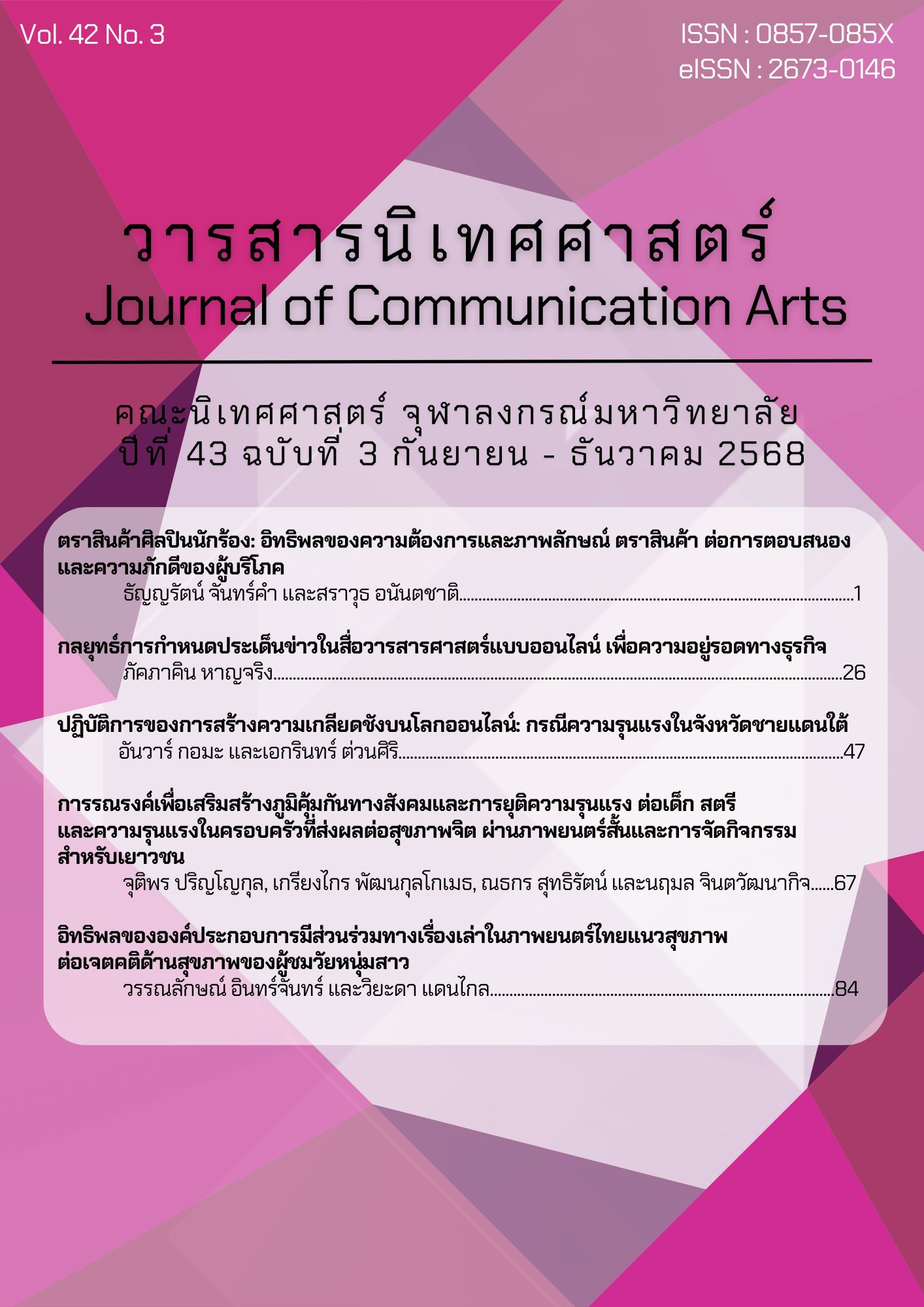
กลยุทธ์การกำหนดประเด็นข่าวในสื่อวารสารศาสตร์แบบออนไลน์ เพื่อความอยู่รอดทางธุรกิจ
Article Sidebar
Main Article Content
บทคัดย่อ
บทความวิชาการนี้มีวัตถุประสงค์เพื่ออธิบายและวิเคราะห์กลยุทธ์การกำหนดประเด็นข่าวในสื่อวารสารศาสตร์แบบออนไลน์ ในฐานะกระบวนการเชิงกลยุทธ์ที่เชื่อมโยงบทบาทเชิงสาธารณะของสื่อเข้ากับความอยู่รอดและความยั่งยืนทางธุรกิจขององค์กรสื่อในยุคดิจิทัล โดยผู้เขียนเสนอกรอบแนวคิดกระบวนการ “มอง–จับ–กำหนด” เพื่อใช้เป็นเครื่องมืออธิบายและวิเคราะห์การเลือก จัดลำดับ และจัดกรอบประเด็นข่าวภายใต้เงื่อนไขของการแข่งขันด้านความสนใจ อัลกอริทึมของแพลตฟอร์ม และพฤติกรรมผู้รับสาร การศึกษานี้อาศัยการทบทวนวรรณกรรม โดยบูรณาการทฤษฎีการกำหนดวาระข่าว ทฤษฎีการจัดกรอบข่าว แนวคิดคุณค่าข่าวและความคุ้มค่าต่อการรายงาน รวมถึงแนวคิดการกำหนดวาระข่าวเชิงเครือข่าย เพื่ออธิบายพลวัตของการกำหนดประเด็นข่าวในบริบทสื่อออนไลน์ที่เน้นความเร็ว ความเฉพาะกลุ่ม และศักยภาพในการแปรรูปเนื้อหาให้เป็นรายได้
นอกจากนี้ บทความยังนำเสนอการวิเคราะห์เชิงเปรียบเทียบจากกรณีศึกษาขององค์กรสื่อต่างประเทศ ได้แก่ The New York Times ซึ่งพัฒนาการกำหนดประเด็นข่าวเชิงลึกไปสู่การออกแบบชุดเนื้อหาแบบบูรณาการ และโมเดลการสมัครสมาชิกแบบรวมหลายผลิตภัณฑ์ The Guardian ซึ่งต่อยอดประเด็นข่าวสิ่งแวดล้อมสู่การระดมทุนผ่านระบบสมาชิกและการบริจาค และ VICE Media ซึ่งใช้การกำหนดประเด็นข่าวย่อยและการจัดกรอบเฉพาะกลุ่มเพื่อสร้างความแตกต่างในตลาดสื่อระดับโลก กรณีศึกษาเหล่านี้สะท้อนให้เห็นว่า การกำหนดประเด็นข่าวอย่างมีกลยุทธ์ไม่ได้จำกัดอยู่เพียงการชี้ว่าเรื่องใดควรได้รับความสนใจ แต่ยังเป็นรากฐานของการออกแบบ “ผลิตภัณฑ์ข่าว” ที่เชื่อมโยงผู้รับสาร ทั้งในฐานะพลเมืองและลูกค้าเข้ากับโมเดลรายได้ขององค์กรสื่ออย่างเป็นรูปธรรม
Article Details

อนุญาตภายใต้เงื่อนไข Creative Commons Attribution-NonCommercial-NoDerivatives 4.0 International License.
เอกสารอ้างอิง
Anderson, C. W., Bell, E., & Shirky, C. (2014). Post-industrial journalism: Adapting to the present. Tow Center for Digital Journalism.
Bednarek, M., & Caple, H. (2012). News discourse. Bloomsbury Publishing.
Carlson, M. (2015). When news sites go native: Redefining the advertising–editorial divide in response to native advertising. Journalism, 16(7), 849–865. https://doi.org/10.1177/14648849145454
de Vreese, C. H. (2005). News framing: Theory and typology. Information Design Journal + Document Design, 13(1), 51–62. https://doi.org/10.1075/idjdd.13.1.06vre
Entman, R. M. (1993). Framing: Toward clarification of a fractured paradigm. Journal of Communication, 43(4), 51–58. https://doi.org/10.1111/j.1460-2466.1993.tb01304.x
Galtung, J., & Ruge, M. H. (1965). The structure of foreign news: The presentation of the Congo, Cuba and Cyprus crises in four Norwegian newspapers. Journal of Peace Research, 2(1), 64–91. https://doi.org/10.1177/002234336500200104
Guo, L. (2012). The application of social network analysis in agenda setting research: A methodological exploration. Journal of Broadcasting & Electronic Media, 56(4), 616–631. https://doi.org/10.1080/08838151.2012.732148
Guo, L. (2013). Toward the third level of agenda setting theory: A network agenda setting model. In T. J. Johnson (Ed.), Agenda setting in a 2.0 world: New agendas in communication (pp. 112–133). Routledge.
Guo, L., & McCombs, M. (2011, May). Network agenda setting: A third level of media effects [Paper presentation]. Annual Conference of the International Communication Association, Boston, MA, United States. https://www.leiguo.net/publications/guo_nas_2011_ica.pdf
Henriksson, T. (2024, August 13). How The Guardian’s commitment to the environment is building reader loyalty and additional revenue. WAN-IFRA. https://wan-ifra.org/2024/08/how-the-guardians-commitment-to-the-environment-is-building-reader-loyalty-and-additional-revenue/
Howard, E. (2015, May 7). Keep it in the Ground divestment campaign attracts 200,000 supporters. The Guardian. https://www.theguardian.com/environment/2015/may/07/keep-it-in-the-ground-divestment-campaign-attracts-200000-supporters
Küng, L. (2017). Strategic management in the media: Theory to practice. Sage.
Marshall, S. (2012, August 20). From fanzine to HBO: How Vice became a video success story. Journalism.co.uk. https://www.journalism.co.uk/news/how-vice-became-a-video-success-story/s2/a550133/
McCombs, M. (2004). Setting the agenda: The mass media and public opinion. Polity Press.
McCombs, M., & Shaw, D. L. (1972). The agenda-setting function of mass media. Public Opinion Quarterly, 36(2), 176–187. https://doi.org/10.1086/267990
Napoli, P. M. (2011). Audience evolution: New technologies and the transformation of media audiences. Columbia University Press.
Newman, N., Fletcher, R., Robertson, C. T., Eddy, K., & Nielsen, R. K. (2024). Reuters Institute Digital News Report 2024. Oxford: Reuters Institute.
NPR Staff. (2014, September 24). Media group evolves from covering Vice to war zones. NPR. https://www.npr.org/2014/09/24/351074951/vice-media-group-moves-into-television
Peterson-Salahuddin, C., & Diakopoulos, N. (2020). Negotiated Autonomy: The Role of Social Media Algorithms in Editorial Decision Making. Media and Communication, 8(3), 27-38. https://doi.org/10.17645/mac.v8i3.3001
Tandoc, E. C. (2014). Journalism is twerking? How web analytics is changing the process of gatekeeping. New Media & Society, 16(4), 559–575. https://doi.org/10.1177/1461444814530541
van Dijck, J., Poell, T., & de Waal, M. (2018). The platform society: Public values in a connective world. Oxford University Press.
Vu, H. T., Guo, L., & McCombs, M. (2014). Exploring “the world outside and the pictures in our heads”: A network agenda-setting study. Journalism & Mass Communication Quarterly, 91(4), 669–686. https://doi.org/10.1177/1077699014550090
Webster, J. G. (2014). The marketplace of attention: How audiences take shape in a digital age. The MIT Press.
Westlund, O., & Lewis, S. C. (2014). Agents of media innovations: Actors, actants, and audiences. The Journal of Media Innovations, 1(2), 10–35. https://doi.org/10.5617/jmi.v1i2.856
Wiedeman, R. (2018, June 10). Shane Smith grew Vice on “greater fool theory.” Now the market may have wised up. New York Magazine-Intelligencer. https://nymag.com/intelligencer/2018/06/inside-vice-media-shane-smith.html
Zacks Equity Research. (2025, February 6). The New York Times Q4 earnings top, subscription revenues up 8.4% Y/Y. Nasdaq. https://www.nasdaq.com/articles/new-york-times-q4-earnings-top-subscription-revenues-84-y-y
