
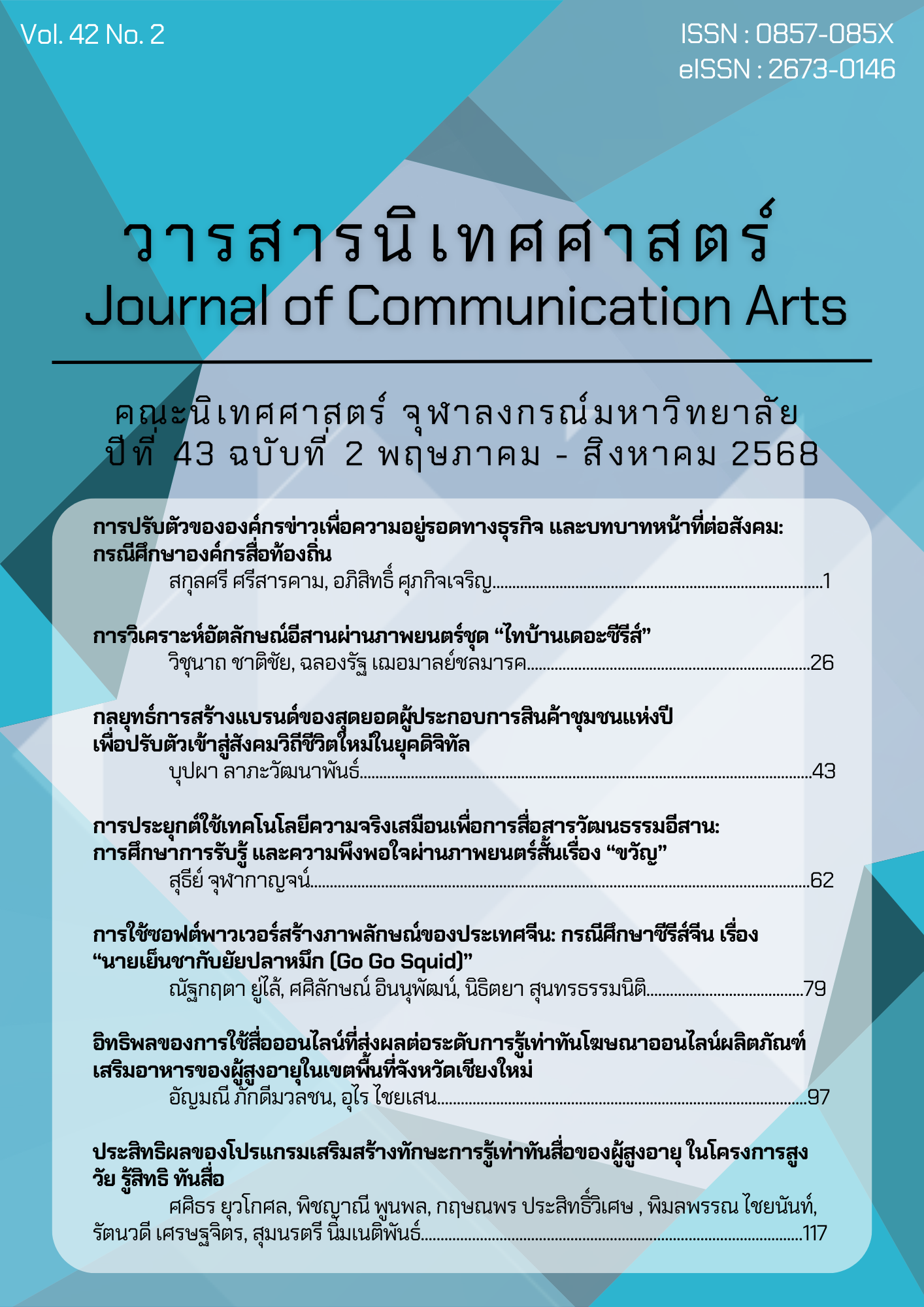
การประยุกต์ใช้เทคโนโลยีความจริงเสมือนเพื่อการสื่อสารวัฒนธรรมอีสาน: การศึกษาการรับรู้ และความพึงพอใจผ่านภาพยนตร์สั้นเรื่อง “ขวัญ”
Article Sidebar
Main Article Content
บทคัดย่อ
การวิจัยนี้มีวัตถุประสงค์เพื่อประเมินประสิทธิภาพของภาพยนตร์สั้นความจริงเสมือน ศึกษาการรับรู้เนื้อหาทุนวัฒนธรรมอีสาน และวัดความพึงพอใจของผู้ชม การวิจัยใช้วิธีแบบผสมผสานในการเก็บข้อมูลจากผู้ชมภาพยนตร์จำนวน 180 คน จากประชากรผู้สนใจเข้าชมภาพยนตร์ที่ลงทะเบียนจำนวน 240 คน โดยการสร้างสรรค์ภาพยนตร์ได้ประยุกต์ใช้แนวคิดละครสภาพแวดล้อมในการออกแบบการเล่าเรื่องแบบ 360 องศา ผลการวิจัยพบว่า ด้านการออกแบบภาพยนตร์ การแสดงของตัวละครได้รับความพึงพอใจสูงสุด (x̅ = 4.44, SD = 0.63) รองลงมาคือฉากและสถานที่ถ่ายทำ (x̅ = 4.40, SD = 0.68) ด้านประสบการณ์การรับชม คุณภาพของมุมมอง 360 องศาได้รับความพึงพอใจสูงสุด (x̅ = 4.48, SD = 0.63) และผู้ชมแสดงความคาดหวังสูงที่จะรับชมภาพยนตร์ความจริงเสมือนเรื่องอื่น ๆ (x̅ = 4.34, SD = 0.69) การศึกษาการรับรู้พบว่า ผู้ชมสามารถเข้าใจแนวคิดหลักเกี่ยวกับความเชื่อเรื่อง “ขวัญ” และพิธีกรรมที่เกี่ยวข้องได้ดี แม้จะมีความเข้าใจแตกต่างกันในรายละเอียด ผู้ชมส่วนใหญ่มีทัศนคติเชิงบวก โดยมองว่าเทคโนโลยีความจริงเสมือนเป็นวิธีที่มีประสิทธิภาพในการนำเสนอและอนุรักษ์วัฒนธรรมท้องถิ่น ผลการวิจัยแสดงให้เห็นศักยภาพของภาพยนตร์ความจริงเสมือนในการสื่อสารและสืบสานทุนวัฒนธรรมอีสานสู่คนรุ่นใหม่ รวมถึงการสร้างประสบการณ์การเรียนรู้ที่มีประสิทธิภาพผ่านการมีส่วนร่วมและปฏิสัมพันธ์กับเนื้อหาวัฒนธรรม
Article Details

อนุญาตภายใต้เงื่อนไข Creative Commons Attribution-NonCommercial-NoDerivatives 4.0 International License.
เอกสารอ้างอิง
ชาญชัย ฮวดศรี และสุริพงษ์ สวัสดิ์ทา. (2562). นโยบายภาครัฐ: การเปลี่ยนแปลงและการคงอยู่ของวัฒนธรรมอีสาน. มหาวิทยาลัยมหาจุฬาลงกรณราชวิทยาลัย.
ไซนิล สมบูรณ์, มาโนช ชุ่มเมืองปัก. (2565). อีสานแมส/อีสานใหม่: กระแสนิยมของภาพยนตร์อีสาน และการประกอบสร้างความเป็นอีสานตั้งแต่ทศวรรษ 2550. วารสารนิเทศศาสตร์ธุรกิจบัณฑิตย์, 16(2), 185-213.
มะยุรี วงศ์กวานกลม. (2561). ภูมิปัญญาพื้นบ้านในการดูแลสุขภาพจิตของผู้สูงอายุในสังคมวัฒนธรรมอีสาน. วารสารมหาวิทยาลัยนครพนม, (ฉบับพิเศษการประชุมพยาบาลครั้งที่ 25).
ยุบล เบ็ญจรงค์กิจ. (2542). การวิเคราะห์ผู้รับสาร. ที.พี.พริ้นท์.
ศุภกรณ์ สิริธนทัต. (2546). ความงามและสุนทรียะของวิถีชีวิตในอีสาน [รายงานวิจัย]. จุฬาลงกรณ์มหาวิทยาลัย.
Allcoat, D., & von Mühlenen, A. (2018). Learning in virtual reality: Effects on performance, emotion and engagement. Research in Learning Technology, 26, Article 2140. https://doi.org/10.25304/rlt.v26.2140
Bailenson, J. N. (2018). Experience on demand: What virtual reality is, how it works, and what it can do. W.W. Norton & Company.
Bekele, M. K., Pierdicca, R., Frontoni, E., Malinverni, E. S., & Gain, J. (2018). A survey of augmented, virtual, and mixed reality for cultural heritage. Journal on Computing and Cultural Heritage, 11(2), 1-36.
Bolter, J. D., & Grusin, R. (2000). Remediation: Understanding new media. MIT Press.
Bowman, D. A., Kruijff, E., LaViola Jr, J. J., & Poupyrev, I. (2004). 3D user interfaces: Theory and practice. Addison-Wesley Professional.
Brown, J. (2017). 360-degree video: A beginner's guide to capturing immersive experiences. Digital Media Press.
Charlton, J. M., & Moar, M. (2018). VR and the dramatic theatre: Are they fellow creatures? International Journal of Performance Arts and Digital Media, 14(2), 187-198. https://doi.org/10.1080/14794713.2018.1511137
Fowler, C. (2015). Virtual reality and learning: Where is the pedagogy? British Journal of Educational Technology, 46(2), 412-422.
Gibson, J. J. (1966). The senses considered as perceptual systems. Houghton Mifflin.
Henrikson, R., Araujo, B., Chevalier, F., Singh, K., & Balakrishnan, R. (2016). Multi-device storyboards for cinematic narratives in VR. In Proceedings of the 29th Annual Symposium on User Interface Software and Technology (pp. 787-796). Association for Computing Machinery. https://doi.org/10.1145/2984511.2984539
Hume, D. (2007). An enquiry concerning human understanding. Oxford University Press.
Jaller, C., & Serafin, S. (2020). Transitioning into states of immersion: Transition design of mixed reality performances and cinematic virtual reality. Digital Creativity, 31(3), 213–222. https://doi.org/10.1080/14626268.2020.1779091
Jenkins, H. (2006). Convergence culture: Where old and new media collide. NYU Press.
Katz, E., Blumler, J. G., & Gurevitch, M. (1974). Utilization of mass communication by the individual. In J. G. Blumler & E. Katz (Eds.), The uses of mass communications: Current perspectives on gratifications research (pp. 19-32). Sage Publications.
Kolb, D. A. (1984). Experiential learning: Experience as the source of learning and development. Prentice-Hall.
Krejcie, R. V., & Morgan, D. W. (1970). Determining sample size for research activities. Educational and Psychological Measurement, 30(3), 607-610. https://doi.org/10.1177/001316447003000308
Krokos, E., Plaisant, C., & Varshney, A. (2019). Virtual memory palaces: Immersion aids recall. Virtual Reality, 23(1), 1-15. https://doi.org/10.1007/s10055-018-0346-3
Locke, J. (1975). An essay concerning human understanding. Oxford University Press.
Markowitz, D. M., Laha, R., Perone, B. P., Pea, R. D., & Bailenson, J. N. (2018). Immersive virtual reality field trips facilitate learning about climate change. Frontiers in Psychology, 9,2364. https://doi.org/10.3389/fpsyg.2018.02364
Manovich, L. (2001). The language of new media. MIT Press.
McCombs, M., & Becker, L. B. (1979). Uses and gratifications: A theoretical perspective. In J. G. Blumler & E. Katz (Eds.), The uses of mass communications: Current perspectives on gratifications research (pp. 51-52). Sage Publications.
McQuail, D., Blumler, J. G., & Brown, J. R. (1972). The television audience: A revised perspective. In J. G. Blumler & E. Katz (Eds.), The uses of mass communications: Current perspectives on gratifications research (pp. 135-155). Sage Publications.
McQuail, D. (2010). McQuail's mass communication theory (6th ed.). Sage Publications.
Meyer, S. R. (2016). Right, left, high, low narrative strategies for non-linear storytelling. In F. Nack & A. Gordon (Eds.), Interactive Storytelling: 9th International Conference on Interactive Digital Storytelling (pp. 306-317). Springer. https://doi.org/10.1007/978-3-319-48279-8_27
Parong, J., & Mayer, R. E. (2020). Learning science in immersive virtual reality. Journal of Educational Psychology, 112(1), 41-55. https://doi.org/10.1037/edu0000389
Paterson, M. (2007). Haptic geographies: Ethnography, haptic knowledges and sensuous dispositions. Progress in Human Geography, 33(6), 766–788. https://doi.org/10.1177/0309132509103155
Pope, V., Dawes, R., Schweiger, F., & Sheikh, A. (2017). The geometry of storytelling: Theatrical use of space for 360-degree videos and Virtual Reality. In Proceedings of the 2017 CHI Conference on Human Factors in Computing Systems (pp. 4468-4479). Association for Computing Machinery. https://doi.org/10.1145/3025453.3025581
Rheingold, H. (1991). Virtual reality: Exploring the brave new technologies of artificial experience and interactive worlds from cyberspace to teledildonics. Simon & Schuster.
Roussou, M. (2002). Virtual heritage: From the research lab to the broad public. Bar International Series, 1075, 93-100.
Ruggiero, T. E. (2000). Uses and gratifications theory in the 21st century. Mass Communication & Society, 3(1), 3–37. https://doi.org/10.1207/S15327825MCS0301_02
Schechner, R. (1973). Environmental theater. Hawthorn Books.
Sherman, W. R., & Craig, A. B. (2018). Understanding virtual reality: Interface, application, and design. Morgan Kaufmann.
Slater, M. (2009). Place illusion and plausibility illusion in virtual environments. Frontiers in Psychology, 3, 549.
Slater, M., & Sanchez-Vives, M. V. (2016). Enhancing our lives with immersive virtual reality. Frontiers in Robotics and AI, 3, 74.
Sundar, S. S., & Limperos, A. M. (2013). Uses and grats 2.0: New gratifications for new media. Journal of Broadcasting & Electronic Media, 57(4), 504-525. https://doi.org/10.1080/08838151.2013.845827
