
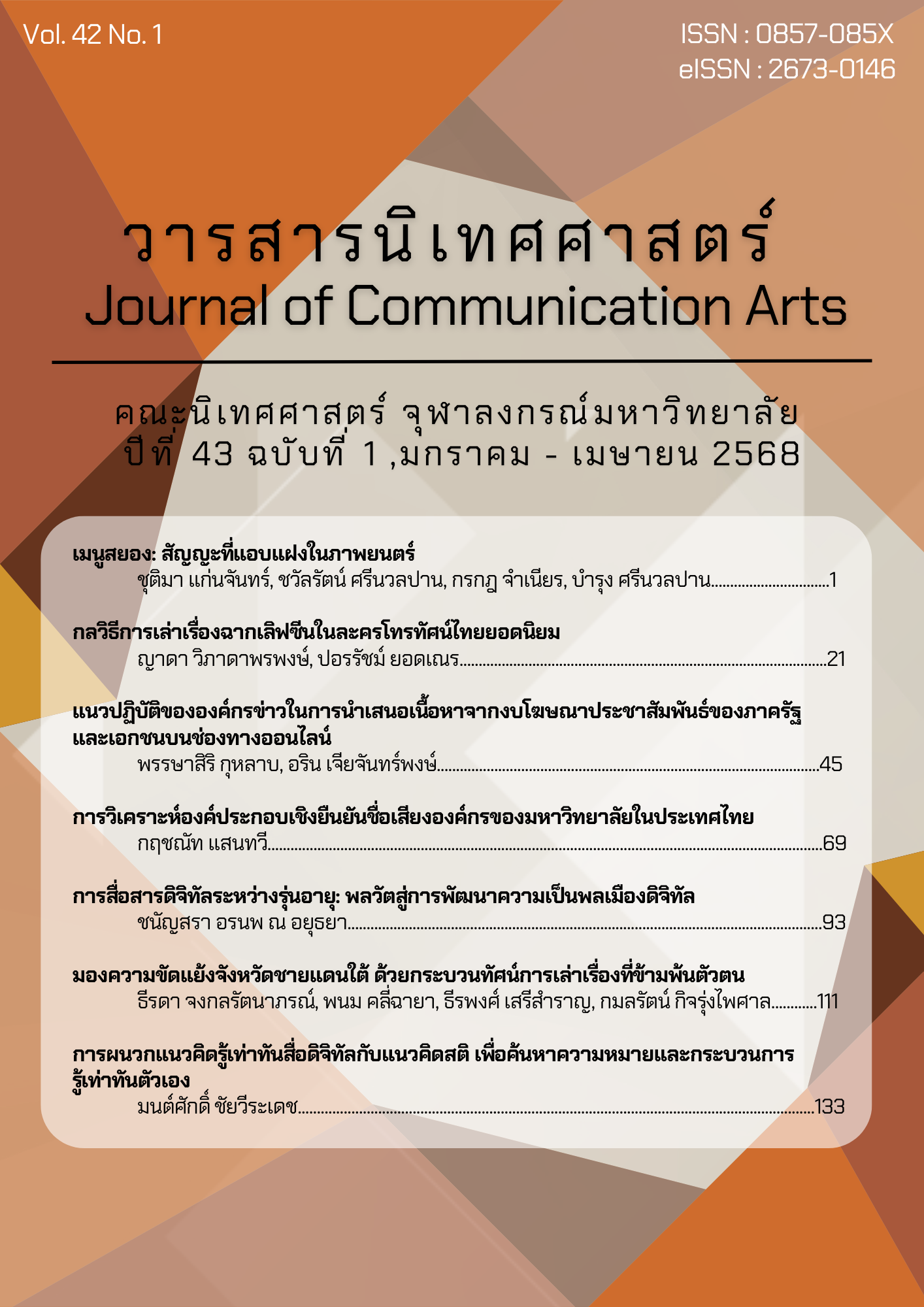
การผนวกแนวคิดรู้เท่าทันสื่อดิจิทัลกับแนวคิดสติ เพื่อค้นหาความหมายและกระบวนการรู้เท่าทันตัวเอง
Article Sidebar
Main Article Content
บทคัดย่อ
บทความวิชาการนี้ได้สรุปใจความสำคัญบางส่วนจากวิทยานิพนธ์เรื่อง Bridging digital media literacy with the Thai context of ‘Sati’ (mindfulness) โดยมีวัตถุประสงค์เพื่อขยายภาพให้เห็นกระบวนการศึกษาวิจัย และรูปแบบการออกแบบระเบียบวิธีวิจัย เพื่อผนวกแนวคิดรู้เท่าทันสื่อดิจิทัลกับแนวคิด ‘สติ’ โดยเฉพาะการรู้เท่าทันตัวเอง (self-literacy) รวมไปถึงการถกอภิปรายจากข้อค้นพบเพื่อส่งเสริมให้กลุ่มผู้มีส่วนได้ส่วนเสียต่าง ๆ ในสังคมได้พิจารณาแนวทางการขับเคลื่อนประเด็นการรู้เท่าทันสื่อดิจิทัลร่วมกัน เป็นเสรีภาพที่จะกล้าตั้งคำถามต่อแนวคิดรู้เท่าทันสื่อที่เรารับมาจากแนวคิดตะวันตกเพื่อตั้งคำถามว่าแนวคิดดังกล่าวมีความสอดคล้องและเหมาะสมกับบริบททางวัฒนธรรมของชุมชนหรือสังคมเราหรือไม่ เพื่อสนับสนุนให้กลุ่มต่าง ๆ ในสังคมได้เป็นผู้กำหนดแก่นหลักของแนวคิดที่สามารถปรับประยุกต์ใช้ให้สอดคล้องกับบริบทในแต่ละสังคมของตนเอง โดยใช้ “แนวทางที่หลากหลาย (diverse approaches)” เพื่อสร้างแรงขับเคลื่อนสำคัญในการสร้างพลเมืองเชิงรุกในประเทศไทยในแบบฉบับของตนเอง
Article Details

อนุญาตภายใต้เงื่อนไข Creative Commons Attribution-NonCommercial-NoDerivatives 4.0 International License.
เอกสารอ้างอิง
พระธรรมปิฎก (ป.อ.ปยุตโต). (2545). พุทธรรม (ฉบับเดิม). กรุงเทพฯ: สำนักพิมพ์ธรรมสภา.
พระธรรมโฆษาจารย์ (ป.อ.ปยุตโต). (2560). พุทธรรม (ฉบับปรับขยาย). กรุงเทพฯ: สำนักพิมพ์ผลิธัมม์.
มนต์ศักดิ์ ชัยวีระเดช. (2562). เส้นทางการทบทวนวรรณกรรมสู่ความเข้าใจแนวคิดสติและแนวคิดรู้เท่าทันสื่อผ่านมุมมองและแนวคิดตะวันตก. วารสารศาสตร์, 12(12), 11-39.
Bawden, D. & Robinson, L. (2020). Information overload: an overview. Oxford Encyclopedia of Political Decision Making [online]. Oxford: Oxford University Press.
Bell, D. (2001). Introduction to cybercultures. London and New York: Routledge.
Berger, G., (2019). Whither MIL: thoughts for the road ahead. In: Carlsson, U., ed. Understanding media and information literacy (MIL) in the digital age: a question of democracy. Gothenburg: Department of Journalism, Media and Communication (JMC), University of Gothenburg, 25-36.
Center of Media Literacy. (2020). Five key questions form foundation for media inquiry [online]. Retrieved 19 September 2022 from: https://www.medialit.org/reading-room/five-key-questions-form-foundation-media-inquiry
Chaiveeradech, M. (2022). Bridging digital media literacy with the Thai context of ‘Sati’ (mindfulness). Doctoral Thesis (Doctoral). Bournemouth University.
Craig, D. V. (2009). Action Research essentials. San Francisco: Jossey-Bass.
De Abreu, B. S. and Mihailidis, P. (2014). Introduction. In De Abreu B. S. and Mihailidis, P. (Eds). Media literacy education in action: theoretical and pedagogical perspectives. New York: Routledge, p.xxiii-xxx.
Hobbs, R. (2010). Digital media literacy: a plan of action [online]. Washington: The Aspen Institute.
Keiny, S and Orland-Barak, L. (2009). Educational action research as a paradigm for change. In: Noffke, S. and Somekh, B., eds. The SAGE handbook of educational action research. London: SAGE, 166-177.
Keller, D. and Share, J. (2019). The critical media literacy guide: engaging media and transforming education. Leiden: BRILL | SENSE.
Kemp, S. (2024). Digital 2022: Thailand [online]. Singapore: DATAREPORTAL.
McAteer, M. (2013). Action research in Education. London: SAGE.
McDougall, J. (2014). Media literacy: an incomplete project. In De Abreu B. S. and Mihailidis, P. (Eds). Media literacy education in action: theoretical and pedagogical perspectives. New York: Routledge, p.3-10.
McDougall, J. (2020). Unbending the springs of action. In: Bennett, P., McDougall, J. and Potter, J., eds. The uses of media literacy. Oxon: Routledge, 66-84.
McNiff, J. (2013). Action research: principles and practice. Oxon: Routledge.
Mihailidis, P. (2014). Media literacy and the emerging citizen: youth, engagement and participation in digital culture. New York: Peter Lang.
Milan, S. (2016). Liberated technology: inside emancipatory communication activism. In: Gordon, E. and Mihailidis, P., eds. Civic media: technology / design / practice. Cambridge, MA: MIT Press, 107-124.
Nussbaum, M. (2011). Creating capabilities: the human development approach. Massachusette: The Belknap Press of Harvard University Press.
Petranker, J. (2017). The mindful self in space and time. In: Purser, R. E., Forbes, D. and Burke, A., eds. Handbook of mindfulness: culture, context, and social engagement. Switzerland: Springer, 95 – 106.
Ramasubramanian, S. & Darzabi, R. C. (2020). Civic engagement, social justice, and media literacy. In: Christ, W. G. and De Abreu, B. S., eds. Media literacy in a disruptive media environment. New York: Routledge.
Rheingold, H. (1998). A slide of life in my virtual community, MIT press [online], Retrieved 9 October 2020 from: https://www.cs.indiana.edu/docproject/bdgtti/bdgtti_18.html
Sen, A. (1993). Capability and well-being. In: Nussbaum, M. C. and Sen, A., eds. The quality of life. Oxford: Oxford University Press, 30-53.
Sen, A. (2009). The idea of justice. London: Penguin Books.
UNESCO. (2013). Global media and information literacy (MIL) assessment framework: country readiness and competencies [online]. Paris: UNESCO.
UNESCO, (2017). Reading the past, writing the future: fifty years of promoting literacy [online]. Paris: UNESCO.
Walker, M. & Unterhalter, E. (2007). The capability approach: its potential for work in education. In: Walker, M. and Unterhalter, E., eds. Amartya Sen’s capability approach and social justice in education. New York: Palgrave Macmillan, 1-18.
Walker, M. (2009). Capabilities, flourishing and the normative purposes of action research. In: Noffke, S. and Somekh, B., eds. The SAGE handbook of educational action research. London: SAGE, 301-312.
Whitehead, J. & McNiff, J. (2006). Action research: living theory. London: SAGE.
Winter, R. (2009). Developing relationships, developing the self: Buddhism and action research. In: Noffke, S. and Somekh, B., eds. The SAGE handbook of educational action research. London: SAGE, 336-346.
