
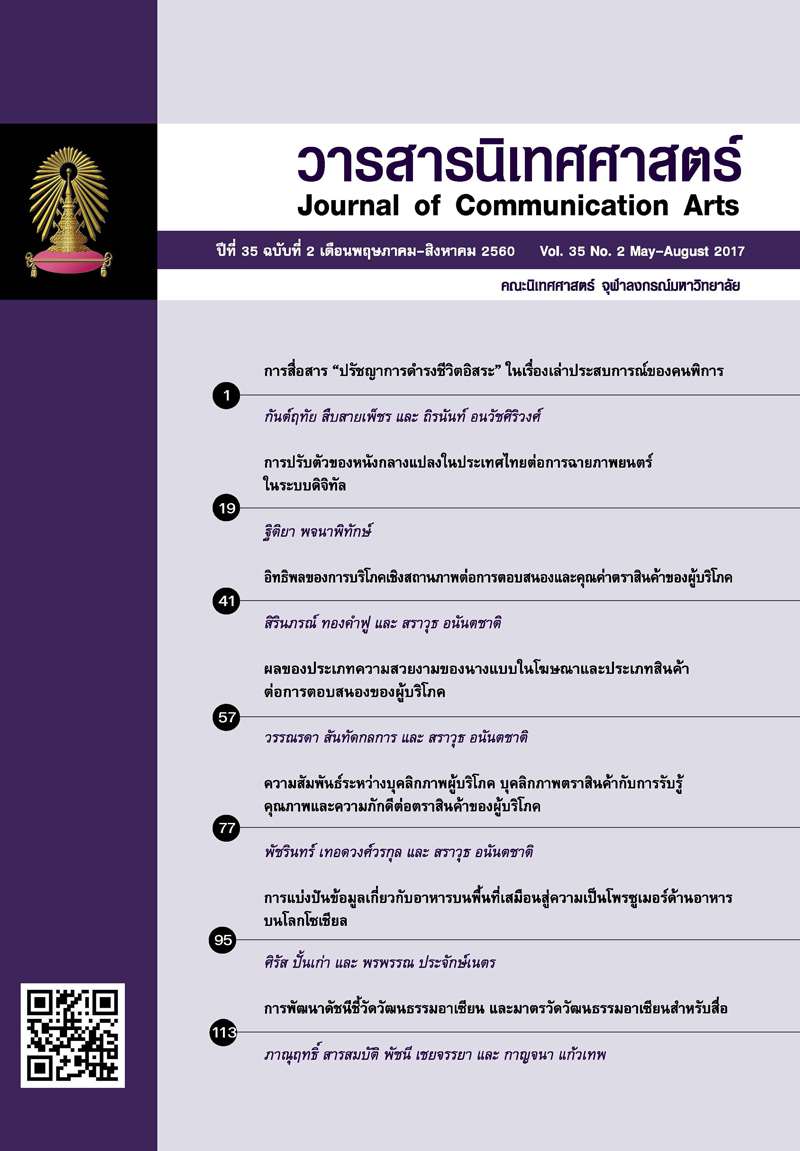
ความสัมพันธ์ระหว่างบุคลิกภาพผู้บริโภค บุคลิกภาพตราสินค้ากับการรับรู้คุณภาพและความภักดีต่อตราสินค้าของผู้บริโภค
Article Sidebar
Main Article Content
บทคัดย่อ
การวิจัยครั้งนี้เป็นการวิจัยเชิงสำรวจ โดยมีวัตถุประสงค์เพื่อศึกษา 1) ความสัมพันธ์ของบุคลิกภาพผู้บริโภคกับบุคลิกภาพตราสินค้า และ 2) ความสัมพันธ์ของบุคลิกภาพตราสินค้ากับการรับรู้คุณภาพและความภักดีต่อตราสินค้าของผู้บริโภค โดยผู้วิจัยได้ใช้แบบสอบถามที่ให้ผู้ตอบเป็นผู้กรอกข้อมูลด้วยตนเองในการเก็บข้อมูลจากกลุ่มตัวอย่างที่เป็นประชากรในกรุงเทพมหานครทั้งเพศชายและหญิง ซึ่งมีอายุระหว่าง 20-40 ปี เป็นผู้ใช้คอมพิวเตอร์โน้ตบุ๊กตรา Acer หรือ Apple และเป็นผู้ทำการตัดสินใจซื้อคอมพิวเตอร์โน้ตบุ๊กตรา Acer หรือ Apple ด้วยตนเอง จำนวน 400 คน ซึ่งผลการวิจัยพบว่า บุคลิกภาพผู้บริโภคมีความสัมพันธ์ในเชิงบวกกับบุคลิกภาพตราสินค้าของคอมพิวเตอร์โน้ตบุ๊ก Acer และ Apple อย่างมีนัยสำคัญทางสถิติ และบุคลิกภาพตราสินค้าของคอมพิวเตอร์โน้ตบุ๊ก Acer และ Apple มีความสัมพันธ์ในเชิงบวกกับการรับรู้คุณภาพและความภักดีต่อตราสินค้าของผู้บริโภค อย่างมีนัยสำคัญทางสถิติ
Article Details
เอกสารอ้างอิง
ความลับ Apple store ทำอย่างไรถึงประสบความสำเร็จ. (2556). วันที่เข้าถึงข้อมูล 6 มีนาคม 2556, แหล่งที่มา http://www.brandbuffet.in.th/2013/02/successfull-apple-store/
จุรี วิจิตรวาทการ. (ม.ป.ป.). บทวิเคราะห์ลักษณะนิสัยของคนไทย รากเหง้าของความเจริญและปัญหาทั้งมวลของประเทศไทย. วันที่เข้าถึงข้อมูล 6 มีนาคม 2556, แหล่งที่มาhttp://topicstock.pantip .com/wahkor/topicstock/2008/04/X6504982/X6504982.html
นนทกร ศาลิคุปต. (2550). ความสัมพันธ์ระหว่างบุคลิกภาพตราสินค้ากับบุคลิกภาพผู้บริโภคและทัศนคติของผู้บริโภคต่อตราสินค้า. วิทยานิพนธ์ปริญญามหาบัณฑิต สาขาวิชาการโฆษณา จุฬาลงกรณ์มหาวิทยาลัย.
พรทิพย์ เลือดจีน. (2548). บุคลิกภาพผู้บริโภค บุคลิกภาพตราสินค้า และความตั้งใจซื้อของผู้บริโภค. วิทยานิพนธ์ปริญญามหาบัณฑิต สาขาวิชาการโฆษณา จุฬาลงกรณ์ มหาวิทยาลัย.
รัตนะ ปิยะกุลดำรง. (2554). กลยุทธ์การสื่อสารการตลาดของไอแพดและพฤติกรรมผู้บริโภค. โครงการวิชาชีพมหาบัณฑิต สาขาวิชานิเทศศาสตร์ จุฬาลงกรณ์มหาวิทยาลัย.
รู้สึกผิดหวังกับการบริการ Acer จริงๆ. (2552). วันที่เข้าถึงข้อมูล 6 มีนาคม 2556, แหล่งที่มา http://www .trendypda.com/modules/newbb/viewtopic.php?topic_id=16863
วิเชียร ตรีสุภาพกุล. (2554). เสริมศักยภาพ บริหารงานให้แกร่ง. วันที่เข้าถึงข้อมูล 25 พฤศจิกายน 2555, แหล่งที่มา http://www.tpa.or.th tpanews/upload/mag_content/45/ ContentFile738.pdf
สวียา นุชพิทักษ์. (2554). ความสอดคล้องระหว่างแนวคิดเกี่ยวกับตนเองและบุคลิกภาพตราสินค้าต่อการตอบสนองต่อตราสินค้าของผู้บริโภค. วิทยานิพนธ์ปริญญามหาบัณฑิต สาขาวิชานิเทศศาสตร์ จุฬาลงกรณ์มหาวิทยาลัย.
เอเซอร์. (ม.ป.ป). วันที่เข้าถึงข้อมูล 6 มีนาคม 2556, แหล่งที่มา http://th.wikipedia.org/wiki/
Acer แถลงทิศทางการตลาดในปี 2555 เน้นผลิตภัณฑ์ที่บางเบา และบริการกลุ่มเมฆ Acer Cloud ส่วนแท็บเล็ตหวังลุย Windows 8. (2555). วันที่เข้าถึงข้อมูล 6 มีนาคม 2556, แหล่งที่มา http://www .jixkr.com/38559/
แอปเปิล (บริษัท). (ม.ป.ป). วันที่เข้าถึงข้อมูล 6 มีนาคม 2556, แหล่งที่มา http://th.wikipedia.org/wiki/แอปเปิล_(บริษัท)
อุทุมพร จันทรศร. (2552). ร้องเรียนเรื่องสินค้าและการให้บริการของ Acer. วันที่เข้าถึงข้อมูล 6 มีนาคม 2556, แหล่งที่มา http://www.ocpb.go.th/board_post.asp?id=2860&idsub=6
Aaker, D. A. (1991). Managing brand equity. New York: Free Press.
Aaker, D. A. (1996). Building strong brands. London, UK: Simon & Schuster.
Aaker, J. L. (1997). Dimension of brand personality. Journal of Marketing Research, 34(3), 347-355.
Aaker, J. L., Benet-Martinez, V., & Garolera, J. (2001). Consumption of symbols as carriers of culture: A study of Japanese and Spanish brand personality constructs. Journal of Personality and Social Psychology, 81(3), 492-508.
Acer computer marketing mix. (2013). Retrieved March 7, 2013, from http://www.jewzi.com/ articles/acer_marketing_mix/
Ailawadi, K. L., Neslin, S. A., & Gedenk, K. (2001). Pursuing the value-conscious consumer: Store brands versus national brand promotion. Journal of Marketing, 65(1), 71-89.
Apple communication strategy. (n.d.). Retrieved March 7, 2013, from http://www .vertygoteam.com/apple/apple_communication.php
Assael, H. (2004). Consumer behavior: A strategic approach. Boston: Houghton Mifflin Company.
Beldona, S., & Wysong, S. (2007). Putting the brand back into store brands: An exploratory examination of store brands and brand personality. Journal of Product and Brand Management, 16(4), 226-235.
Benet-Martinez, V., & John, O. P. (1998). Los Cinco Grandes across cultures and ethnic groups: Multitrait multimethod analyses of the Big Five in Spanish and English. Journal of Personality and Social Psychology, 75(3), 729-750.
Best and worst notebook brands 2013. (2013). Retrieved March 7, 2013, from http://blog .laptopmag.com/best-worst-notebook-brands-2013
Cervone, D., & Pervin, L. A. (2008). Personality: Theory and research. Hoboken, NJ: Wiley.
Chon, K., & Olsen, M. D. (1991). Functional and symbolic congruity approaches to consumer satisfaction/dissatisfaction in consumerism. Journal of the International Academy of Hospital Research, 3(4), 1-18.
Cioban, D. (2012). Megan Fox boost Acer’s popularity of herself. Retrieved March 7, 2013, from http://www.brandingmagazine.com/2012/10/31/acer-megan-fox/
Compo, K., Gijsbrechts, E., & Nisol, P. (2000). Toward understanding consumer response to stock-outs. Journal of Retailing, 79(2), 219-242.
Costa, P. T., & McRae, R. R. (1992). Revised NEO Personality Inventory (NEO-PI-R) and NEO Five-Factor Inventory (NEO-FFI) professional manual. Odessa, FL: Psychological Assessment Resources.
Dick, A. S., & Basu, K. (1994). Customer loyalty: Toward an integrated conceptual framework. Journal of the Academy of Marketing Science, 22(2), 99-113.
Dodds, W. B., Monroe, K. B., & Grewal, D. (1991). Effects of price, brand, and store information on buyers’ product evaluations. Journal of Marketing Research, 28(3), 307-319.
Doyle, P. (1990). Building successful brands: The strategic options. Journal of Consumer Marketing, 7(2), 5-20.
Erdogmus, I., & Buderyri-Turan, I. (2012). The role of personality congruence, perceived quality and prestige on ready-to-wear brand loyalty. Journal of Fashion Marketing and Management, 16(4), 399-417.
Explore beyond limits: Acer sets its sights on emotional branding. (2012). Retrieved March 7, 2013, from http://www.cityam.com/article/explore-beyond-limits-acer-sets-its-sights-emotional-branding
Eysenck, H. J. (1970). The structure of human personality. London: Methuen.
Farhat, R., & Khan, B. M. (2011). Importance of brand personality to customer loyalty: A conceptual study. New Media and Mass Communication, 1, 4-10.
Feist, J., & Feist, G. J. (2009). Theories of personality (7th ed.). New York: McGraw Hill.
Fournier, S. (1998). Consumers and their brands: Developing relationship theory in consumer research. Journal of Consumer Research, 24(4), 343-373.
Garvin, D. A. (1984). Product quality: An important strategic weapon. Business Horizons, 27(3), 40-43.
Ganesh, J., Arnold, M. J., & Reynolds, K. E. (2000). Understanding the customer base of service providers: An examination of the differences between switchers and stayers. Journal of Marketing, 64(3), 65-87.
Goldberg, L. R. (1992). The development of markers for the big-five factor structure. Psychological Assessment, 4(1), 26-42.
Govers, P. C. M., & Schoormans, J. P. L. (2005). Product personality and its influence on consumer preference. Journal of Consumer Marketing, 22(4), 189-197.
Grewal, D., Krishnan, R., Baker, J., & Borin, N. (1998). The effect of store name, brand name and price discounts on consumers’ evaluations and purchase intentions. Journal of Retailing, 74(3), 331-352.
Hofstede, G. (1997). Culture and organizations: Software of the mind. New York: McGraw-Hill.
Kapferer, J. N. (2008). The new strategic brand management: Creating and sustaining brand equity long term (4th ed.). London, UK: Kogan Page.
Keller, K. L. (1993). Conceptualizing, measuring, and managing customer-based brand equity. Journal of Marketing, 57(1), 1-22.
Kotler, P., & Keller, K. L. (2009). Marketing management (13th ed). Upper Saddle River, NJ: Pearson Prentice Hall.
Lin, C. H., & Kao, D. T. (2004). The Impacts of country-of-origin on brand equity. Journal of American Academy of Business, 5(1), 37-40.
Lin, L. Y. (2010). The relationship of consumer personality trait, brand personality and brand loyalty: An empirical study of toys and video games buyers. Journal of Product & Brand Management, 19(1), 4-17.
Mengxia, Z. (2007). Impact of brand personality on PALI: A comparative research between two different brands. International Management Review, 3(3), 36-46.
Mitsis, A., Foley, P., & Skarmeas, D. (2009). Is brand personality an antecedent to quality perception? Retrieved March 7, 2013, from http://www.duplication.net.au/ ANZMAC09/papers/ANZMAC2009-053.pdf
National character in the Thai nine values orientations. (n.d.). Retrieved April 27, 2013, from http://www.fulbrightthai.org/data/culture/NATIONAL%20CHARACTER%%20IN%20THE%20THAI%20NINE%20VALUES%20CLUSTER.doc
Phillips, H. P. (1985). Thai peasant personality: A case study of Bang Chan villagers. Ann Arbor, MI: University Microfilms International.
Plummer, J. T. (1984). How brand personality makes a difference. Journal of Advertising Research, 24(6). 27-31.
Ramaseshan, B., & Tsao, H. Y. (2007). Moderating effects of the brand concept on the relationship between brand personality and perceived quality. Brand Management, 14(6), 458-466.
Randall, G. (2000). Branding: A practical guide to planning your strategy. London, UK: Kogan.
Rao, A. R., & Monroe, K. B. (1989). Effect of price, brand name, and store name on buyers. Journal of Marketing Research, 26(3), 351-357.
Reynolds, K. E., & Beatty, S. E. (1999). Customer benefits and company consequences of customer-salesperson relationships in retailing. Journal of Retailing, 75(1), 11-32.
Schiffman, L. G., & Kanuk, L. L. (2000). Consumer behavior (7th ed.). Upper Saddle River, NJ: Prentice Hall.
Sirgy, M. J. (1982). Self-concept in consumer behavior: A critical review. Journal of Consumer Research, 9(3), 287-300.
Thakor, M. V., & Katsanis, L. P. (1997). A model of brand and country effects on quality dimensions: Issues and implications. Journal of International Consumer Marketing, 9(3), 79-100.
The core marketing strategy of Apple. (2012). Retrieved March 7, 2013, from http:// tiffanyabrown.wordpress.com/2012/03/04/the-core-marketing-strategy-of-apple/
Upshaw, L. B. (1995). Building brand identity: A strategy for success in a hostile marketplace. New York: John Wiley & Sons.
Vantamay, S. (2007). Understanding of perceived product quality: Reviews and recommendations. BU Academic Review, 6(1), 110-118.
Why Apple is a great marketer. (2012). Retrieved March 7, 2013, from http://www.forbes .com/sites/christinemoorman/2012/07/10/why-apple-is-a-great-marketer/
Zeithaml, V. A. (1988). Consumer perceptions of price, quality, and value: A mean-end model and synthesis of evidence. Journal of Marketing, 52(3), 2-22.
