
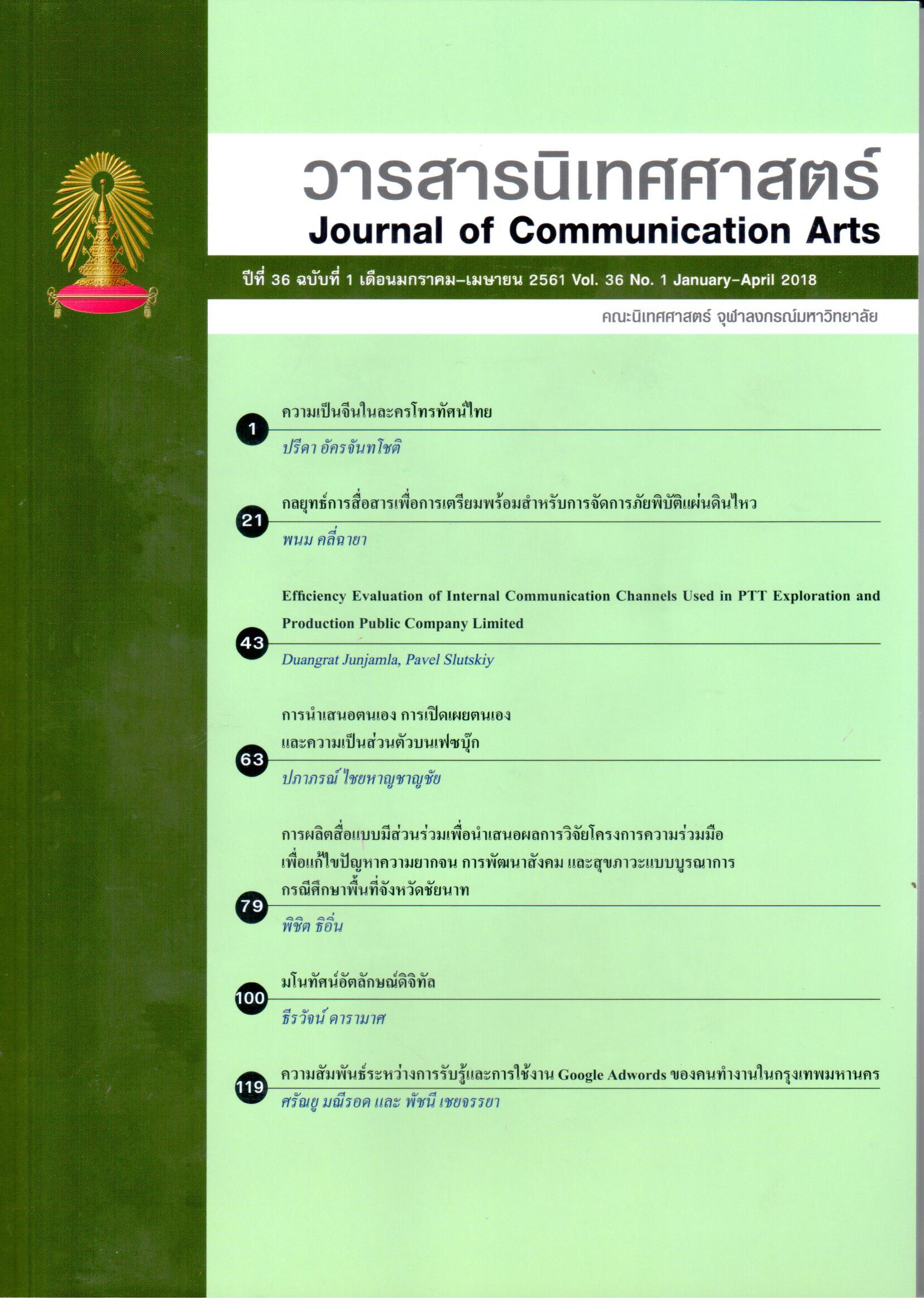
การนำเสนอตนเอง การเปิดเผยตนเอง และความเป็นส่วนตัวบนเฟซบุ๊ก
Article Sidebar
Main Article Content
บทคัดย่อ
ในช่วงหลายปีที่ผ่านมานี้ นักวิชาการต่างก็ให้ความสนใจกับประเด็นการศึกษาเรื่องการสื่อสารผ่านคอมพิวเตอร์ (Computer-mediated communication) โดยเฉพาะอย่างยิ่งการสื่อสารบนเครือข่ายสังคมออนไลน์ (Social network sites) อย่างเฟซบุ๊ก ที่ผู้คนต่างก็ให้เฟซบุ๊กเข้ามามีบทบาทในชีวิตประจำวันของตนเองเป็นอย่างมาก ไม่ว่าจะทำอะไรที่ไหน อย่างไร เมื่อไร มีความรู้สึกในใจอย่างไร ผู้ใช้เฟซบุ๊กต่างก็พากันโพสต์เรื่องราวและข้อมูลเหล่านี้ผ่านทั้งตัวหนังสือและภาพที่ตนได้เลือกสรรและคัดกรองก่อนที่จะนำเสนอสู่สาธารณชน กระนั้น ด้วยความต้องการที่จะนำเสนอตนเองอย่างมาก ทำให้ผู้ใช้เฟซบุ๊กบางคนอาจจะลืมนึกถึงขอบเขตความเป็นส่วนตัวของตัวเองไปว่าบางเรื่องควรเก็บไว้เป็นเรื่องส่วนตัวน่าจะดีกว่าเปิดเผยให้คนอื่นรู้
ด้วยเหตุนี้ จากปรากฏการณ์ข้างต้นทำให้ผู้เขียนมีความสนใจที่จะทบทวนถึงความสัมพันธ์ของการนำเสนอตนเอง (Self-presentation) การเปิดเผยตนเอง (Self-disclosure) และขอบเขตความเป็นส่วนตัว โดยอาศัยกรอบแนวคิดของการนำเสนอตนเอง การเปิดเผยตนเองตามแนวคิดการบริหารจัดการความเป็นส่วนตัวเชิงการ และทฤษฎีการสร้างความสัมพันธ์ทางสังคม ซึ่งหลังจากการทบทวนวรรณกรรมในเบื้องต้น ผู้เขียนได้นำเสนอข้อสันนิษฐานเกี่ยวกับประเด็นดังกล่าวไว้เพื่อเป็นแนวทางสำหรับการศึกษาครั้งต่อไปในอนาคต
Article Details
เอกสารอ้างอิง
Antheunis, M. L., Valkenburg, P. M., & Peter, J. (2010). Getting acquainted through social networking sites: Testing a model of online uncertainty reduction and social attraction. Computers in Human Behavior, 26, 100-109.
Bargh, J. A. (1996). Automaticity in social psychology. In E. T. Higgins & A. W. Kruglanski (Eds.), Social psychology: Handbook of basic principles (pp. 169–183). New York: Guilford Press.
Bargh, J. A., McKenna, K. Y. A., & Fitzsimons, G. M. (2002). Can you see the real me? Activation and expression of the ‘‘true self’’ on the Internet. Journal of Social Issues, 58, 33-48.
Baumeister, R. F. (1982). A self-presentational view of social phenomena. Psychological Bulletin, 91, 3-26.
Baumeister, R. F., & Jones, E. E. (1978). When self-presentation is constrained by the target’s knowledge: Consistency and compensation. Journal of Personality and Social Psychology, 36, 608-618.
Bazarova, N. N., Taft, J. G., Choi, Y. H., & Cosley, D. (2013). Managing impressions and relationships on Facebook: Self-presentational and relational concerns revealed through the analysis of language style. Journal of Language and Social Psychology, 32(2), 121-141.
Bem, D. J. (1972). Self-perception theory. In L. Berkowitz (Ed.), Advances in experimental social psychology, (pp. 1-62). New York: Academic Press.
Boyd, D. M., & Ellison, N. (2007). Social network sites: Definition, history, and scholarship. Journal of Computer-mediated Communication, 13(1), 210-230.
Bradley, B. (2009). He posted, she posted: Gender differences in self-disclosure on social networking sites. Communication Review 6(2), 29-37.
Brown, J. D. (1998). The self. Boston, MA: McGraw-Hill.
Buck, R., Losow, J. I., & Murphy, M. M. (1992). Social facilitation and inhibition of emotional expression and communication. Journal of Personality and Social Psychology, 63(6), 962-968.
Csibra, G., & Gergely, G. (2011). Natural pedagogy as evolutionary adaptation. Biological Sciences, 366, 1149-1157.
Chou, H.-T. G., & Edge, N. (2012). They are happier and having better lives than I am: The impact of using Facebook on perceptions of others’ lives. Cyberpsychology, Behavior, and Social Networking, 15(2), 117-121.
Cornwell, B., & Lundgren, D. C. (2001). Love on the Internet: Involvement and misrepresentation in romantic relationships in cyberspace vs. real space. Computers in Human Behavior, 17(2), 197-211.
Derlega, V., Metts, S., Petronio, S., & Margulis, S. T. (1993). Self-disclosure. Newbury Park, CA: Sage.
Derlega, V., Winstead, B., Wong, P., & Greenspan, M. (1987). Self-disclosure and relationship development: An attributional analysis. In M. E. Roloff & G. R. Miller (Eds.), Interpersonal processes: New directions in communication research (pp. 172–187). Thousand Oaks, CA: Sage.
DeWolf, R., & Pierson, J. (2012). Symbolic interactionist perspective on linking privacy and identity on social network sites. Paper presented at the International Communication Association Annual Conference, Phoenix, Arizona.
Douglas, K. M., & McGarty, C. (2001). Identifiability and self-presentation: Computer-mediated communication and intergroup interaction. British Journal of Social Psychology, 40, 399–416.
Emiley, C., Muise, A., & Desmarias, S. (2009). Information disclosure and control on Facebook: Are they two sides of the same coin or two different processes? Cyberpyschology & Behavior 12(3), 341-45.
Kathryn, D., Fitzpatrick, A. M., & Kenny, D. A. (1997). Self-disclosure in spouse and stranger interaction a social relations analysis. Human Communication Research, 23(3), 88-412.
Ellison, N. B., Heino, R. D., & Gibbs, J. L. (2006). Self-presentation processes in the online dating environment. Journal of Computer-mediated Communication, 11(2), 415-441.
Ellison, N. B., Steinfield, C., & Lampe, C. (2007). The benefit of Facebook ‘Friend’ social capital and college students’ use of online social network sites. Journal of Computer-mediated Communication, 12(4), 1143-1168.
Fazio, R. H., Effrein, E. A., & Falender, V. J. (1981). Self-perceptions following social interaction. Journal of Personality and Social Psychology, 41, 232-242.
Fitzpatrick, M. A. (1987). Marriage and verbal intimacy. In V. J., Derlega & J. H. Berg (Eds.), Self-disclosure: Theory, research, and therapy (pp. 131–154). New York: Plenum.
Galvin, K. M., Bylund, C. M., & Brommel, B. J. (2008). Family communication: Cohesion and change (7th ed.). Boston: Pearson Print.
Gergen, K. J. (1965). Effects of interaction goals and personality feedback on the presentation of self. Journal of Personality and Social Psychology, 1, 413-424.
Goffman, E. (1959). The presentation of self in everyday life. New York: Anchor.
Graham, S. M., Huang, J. Y., Clark, M. S., & Helgeson, V. S. (2008). The positives of negative emotions: Willingness to express negative emotions promotes relationships. Personality and Social Psychology Bulletin, 34(3), 394-406.
Guzzetti, B. J. (2006). Cybergirls: Negotiating social identities on cybersites. E-Learning, 3(2), 158-169.
Han, L., William, T., & Lin, Q. (2014). Emotional disclosure on social networking sites: The role of network structure and psychological needs. Computers in Human Behavior, 41, 342-350.
Hofstede insight. (2018). The 6 dimensions of national culture. Retrieved May 9, 2018 https://www.hofstede-insights.com/models/national-culture/
Hogan, B. (2010). The presentation of self in the age of social media: Distinguishing performances and exhibitions online. Bulletin of Science, Technology and Society, 30(6), 377-386.
Hum, N. J., Chamberlin, P. E., Hambright, B. L., Portwood, A. C., Schat, A. C., & Bevan, J. L. (2011). A picture is worth a thousand words: A content analysis of Facebook profile photographs. Computers In Human Behavior, 27(5), 1828-1833.
Jones, E. E., & Wortman, C. (1973). Ingratiation: An attributional approach. Morristown, NJ: General Learning Press.
Leary, M. R., & Allen, A. B. (2011). Personality and persona: Personality processes in self-presentation. Journal of Personality, 79(6), 1191-1218.
Ledbetter, A. M., Mazer, J. P., DeGroot, J. M., Meyer, K. R., Mao, Y., & Swafford, B. (2011). Attitudes toward online social connection and self-disclosure as predictors of Facebook communication and relational closeness. Communication Research, 38(1), 27-53.
Lee-Won, R. J., Shim, M., Joo, Y. K., & Park, S. G. (2014). Who puts the best ‘face’ forward on Facebook? Positive self-presentation in online social networking and the role of self-consciousness, actual-to-total Friends ratio, and culture Computers in Human Behavior, 39, 413-423.
Leung, L. (2002). Loneliness, self-disclosure, and ICQ (‘I Seek You’) use. Cyberpsychology & Behavior, 5(3), 241-251.
Liu, D., & Brown, B. (2014). Self-disclosure on social networking sites, positive feedback, and social capital among Chinese college students. Computers in Human Behavior, 38, 213–219.
Littlejohn, S. W., & Foss, K. A. (2008). Theories of human communication (9th ed.). Belmont, CA: Thomson/Wadsworth.
Magsamen-Conrad, K. (2012). Sharing personal information in relationships: The implications of anticipated responses for information management theory and measurement. (Unpublished doctoral dissertation). New Brunswick, NJ: Rutgers, the State University of New Jersey.
Mazer, J. P., Murphy, R. E., & Simonds, C. J. (2007). I’ll see you on ‘‘Facebook’’: The effects of computer-mediated teacher self-disclosure on student motivation, affective learning, and classroom climate. Communication Education, 56(1), 1-17.
McKenna, K., & Bargh, J. A. (1998). Coming out in the age of the Internet: Identity ‘‘demarginalization’’ through virtual group participation. Journal of Personality and Social Psychology, 75, 681-694.
Murstein, B. I., & Adler, E. R. (1995). Gender differences in power and self-disclosure in dating and married couples. Personal Relationships, 2(3), 199-209.
Paulhus, D. L., Shaffer, D. R., & Downing, L. L. (1997). Effects of making blood donor motives salient upon donor retention. Personality and Social Psychology Bulletin, 3, 99-102.
Parker, J. K., & Boyd, d. (2010). Hanging out with friends: MySpace, Facebook, and other networked publics. In J. K. Parker (Ed.), Teaching tech-savvy kids: Bringing digital media into the classroom, Grades 5–12 (pp. 15-36). Thousand Oaks, CA: Corwin Press.
Pempek, T. A., Yermolayeva, Y. A., & Calvert, S. L. (2009). College students' social networking experiences on Facebook. Journal of Applied Developmental Psychology, 30(3), 227-238.
Petronio, S. (2002). Boundaries of privacy: Dialectics of disclosure. Albany, NY: SUNY Press.
Rowatt, W. C., Cunningham, M. R., & Druen, P. B. (1998). Deception to get a date. Personality and Social Psychology Bulletin, 24(11), 1228-1242.
Rui, J. R., & Stefanone, M. A. (2013). Strategic self-presentation online: A Cross-cultural study. Computers in Human Behavior, 29(1), 110–118.
Schlenker, B. R., & Wowra, S. A. (2003). Carryover effects of feeling socially transparent or impenetrable on strategic self-presentation. Journal of Personality and Social Psychology, 85, 871-880.
Smith, C. (2012). How many people use the top social media? Digital marketing ramblings. Retrieved December 17, 2014, from http://expandedramblings.com/ index.php/resourcehow-many-people-use-the-top-social-media/
Sponder, M., & Khan, G. F. (2018). Digital analytics for marketing. NY: Routledge.
Sohn, D. (2014). Coping with information in social media: The effects of network structure and knowledge on perception of information value. Computers in Human Behavior, 32, 145-151.
Solano, C. H., & Dunnam, M. (1985). Two’s company: Self-disclosure and reciprocity in triads versus dyads. Social Psychology Quarterly, 48, 183-187.
Spears, R., & Lea, M. (1994). Panacea or panopticon? The hidden power in computer-mediated communication. Communication Research, 21, 427-459.
Taylor, D., & Altman, I. (1987). Communication in interpersonal relationships: Social penetration processes. In M. E. Roloff & G. R. Miller (Eds.), Interpersonal processes: New directions in communication research (pp. 257–277). Thousand Oaks, CA: Sage.
Thompson, A. W. (2012). To post or not to post: An examination of gender differences in undergraduates’ self-disclosure on Facebook. (Unpublished master’s thesis). Lynchburg, VA: Faculty Liberty University.
Tufekci, Z. (2008). Can you see me now? Audience and disclosure regulation in online social network sites, Bulletin of Science, Technology & Society, 28(1), 20-36.
Utz, S. (2011). Social network site use among Dutch students: Effects of time and platform. In F. Comunello (Ed.), Networked sociability and individualism: Technology for personal and professional relationships (pp. 104-126). Hershey, PA: IGI Global.
Walther, J. B. (1996). Computer-mediated communication: Impersonal, interpersonal, and hyperpersonal interaction. Communication Research, 23, 3–43.
Zhao, S., Grasmuck, S., & Martin, J. (2008). Identity construction on Facebook: Digital empowerment in anchored relationships. Computers in Human Behavior, 24(5), 1816–1836.
Zuckerberg, M. (2011). The Facebook blog: Our commitment to the Facebook community. Retrieved December 17, 2014, from https://blog.facebook.com
