
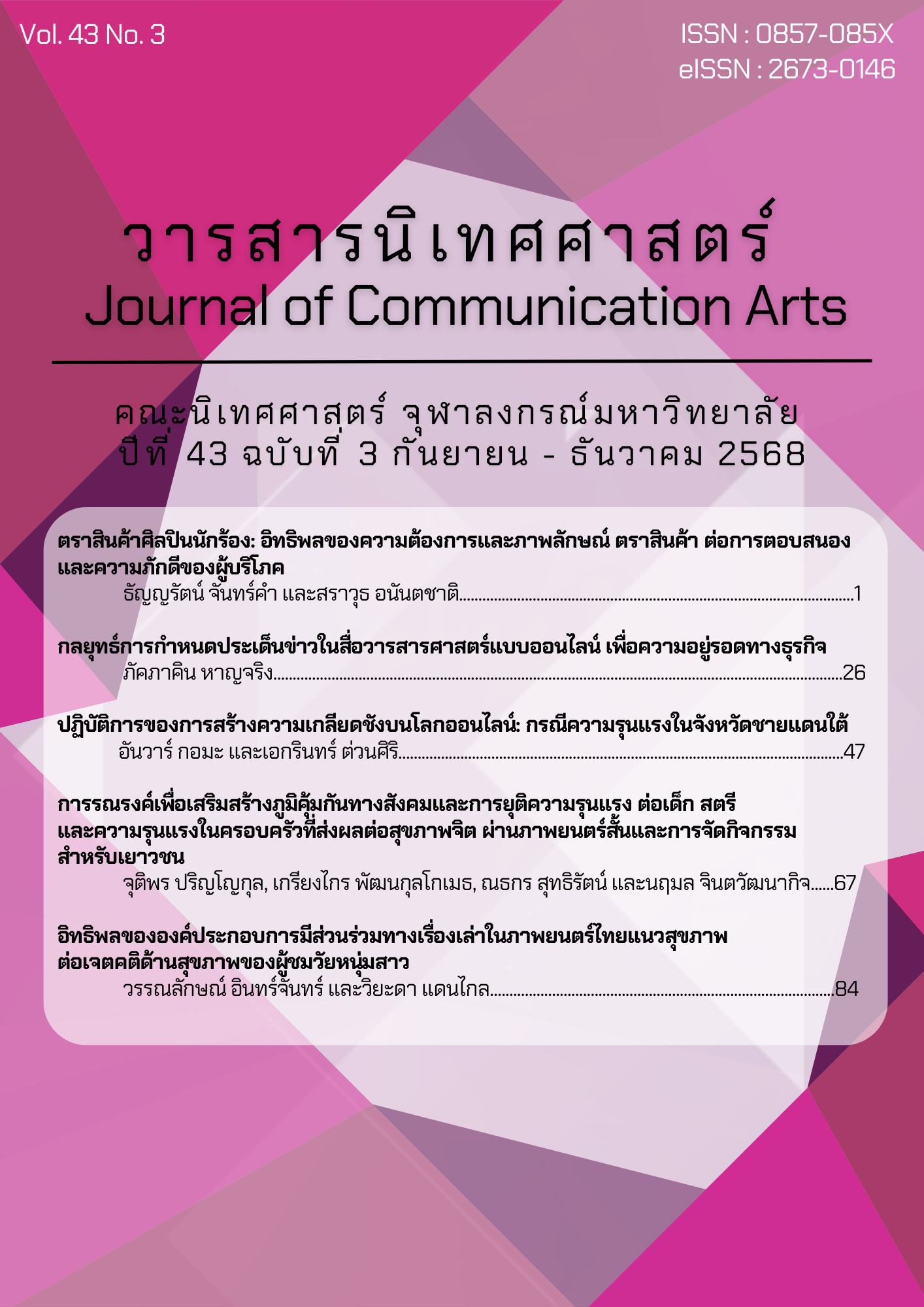
Music Artist Brand: Influences of Needs and Brand Image on Consumer Responses and Loyalty
Article Sidebar
Main Article Content
Abstract
This survey research aims to investigate: 1) consumer needs, music artist brand image, consumer responses (i.e., attachment, satisfaction, trust, commitment and purchase intention) and brand loyalty, 2) influences of consumer needs and music artist brand image on consumer responses, and 3) influences of consumer responses on music artist brand loyalty. Using a quantitative research, questionnaires were used to collect online data from 435 samples, aged between 18 and 34 years old who have followed ATLAS or PROXIE music artist brands’ social media platforms. The findings showed that the peer norm dimension of consumer needs had the most influence on consumer responses, and the design and versatility dimensions of music artist brand image had the most influence on consumer responses. In addition, consumer responses in terms of attachment and purchase intention had influences on consumer brand loyalty.
Article Details

This work is licensed under a Creative Commons Attribution-NonCommercial-NoDerivatives 4.0 International License.
References
Marketing Oops. (2565, 20 พฤษภาคม). อินไซต์ “แฟนด้อม” ในอาเซียน “คนไทยเปย์มากสุด-อัพสกิลภาษา” พร้อมจับเทรนด์ธุรกิจใหม่ คว้าโอกาสเจาะแฟนด้อม. https://www.marketingoops.com/reports/hill-asean-into-the-fandom-research/
Marketeer. (2566, 28 มิถุนายน). Sony Music เลือกไทยเป็นศูนย์กลางธุรกิจเพลง SEA ศิลปินไทยครีเอตสูง รูปลักษณ์ได้ ตลาดใหญ่ระดับเอเชีย. https://marketeeronline.co/archives/312806
Mindshare. (2566). มายด์แชร์เจาะกระแส Short Video และโอกาสของแบรนด์กับ T-Pop. https://www.focal-th.online/features/mindshare/t-pop/
Aaker, D. A. (1991). Managing brand equity: Capitalizing on the value of a brand name. Free Press.
Alvarez del Blanco, R. (2010). Personal brands: Managing your life with talent and turn it into a unique experience. Palgrave Macmillan.
Assael, H. (2004). Consumer behavior: A strategic approach. Houghton Mifflin.
Bowlby, J. (1982). Attachment and loss (2nd ed.). Basic Book.
Chuang, S. J., & Ding, C. G. (2013). Measuring celebrity singer image. International Journal of Market Research, 55(1), 149-172.
Deci, E. L., & Ryan, R. M. (2000). Self-determination theory and the facilitation of intrinsic motivation, social development, and well-being. American Psychologist, 55(1), 68-78.
Deci, E. L., & Ryan, R. M. (2002). Overview of self-determination theory: An organismic dialectical perspective. Handbook of Self-determination Research, 2, 3-33.
Deci, E. L., & Ryan, R. M. (2015). Self-determination theory. International Encyclopedia of the Social & Behavioral Sciences, 11, 486-491.
Delgado-Ballester, E., Munuera-Aleman, J. L., & Yague-Guillen, M. J. (2003). Development and validation of a brand trust scale. International Journal of Market Research, 45(1), 35-54.
Delgado‐Ballester, E., & Luis Munuera‐Alemán, J. (2005). Does brand trust matter to brand equity?. Journal of Product & Brand Management, 14(3), 187-196.
Huang, Y. A., Lin, C., & Phau, I. (2015). Idol attachment and human brand loyalty. European Journal of Marketing, 49(7/8), 1234-1255.
Kahn, B. E. (1995). Consumer variety-seeking among goods and services: An integrative review. Journal of Retailing and Consumer Services, 2(3), 139-148.
Keller, K. L., & Swaminathan, V. (2020). Strategic brand management: Building, measuring, and managing brand equity (5th ed.). Pearson.
Kotler, P., Armstrong, G., & Balasubramanian, S. (2024). Principles of marketing (19th ed.). Pearson.
Kotler, P., Keller, K. L., & Chernev, A. (2023). Marketing management (16th ed.). Pearson.
Lee, S. H., Choi, S., & Kim, H. W. (2021). Unveiling the success factors of BTS: A mixed-
methods approach. Internet Research, 31(5), 1518-1540.
Liu, C., Zhang, Y., & Zhang, J. (2020). The impact of self-congruity and virtual interactivity on online celebrity brand equity and fans’ purchase intention. Journal of Product & Brand Management, 29(6), 783-801.
Loroz, P. S., & Braig, B. M. (2015). Consumer attachments to human brands: The “Oprah effect.” Psychology & Marketing, 32(7), 751-763.
MacInnis D. J., Pieters, R., Hoyer, W. D., & Close-Scheinbaum, A. (2024). Consumer behavior (8th ed.). Cengage.
Mayer, R. C., Davis, J. H., & Schoorman, F. D. (1995). An integrative model of organizational trust. Academy of management review, 20(3), 709-734.
McNally, D., & Speak, K. D. (2011). Be your own brand : Achieve more of what you want by being more of who you are (2nd ed.). Berrett-Koehler.
Montoya, P., & Vandehey, T. (2009). The brand called you: Create a personal brand that wins attention and grows your business. McGraw-Hill.
Mothersbaugh, D. L., Kleiser, S. B., & Hawkins, D. I. (2024). Consumer behavior: Building marketing strategy (15th ed.). McGraw-Hill.
Oliver, R. L. (1999). Whence consumer loyalty?. Journal of Marketing, 63(4_suppl1), 33-44.
Peters, T. (1997). The brand called you. https://www.fastcompany.com/28905/brand-called-you
Rampersad, H. K. (2009). Authentic personal branding: A new blueprint for building and aligning a powerful leadership brand. Information Age Publishing.
Schiffman, L. G., & Wisenblit, J. (2019). Consumer behavior (12th ed., Global ed.). Pearson.
Shepherd, I. D. (2005). From cattle and Coke to Charlie: Meeting the challenge of self marketing and personal branding, Journal of Marketing Management, 21(5-6), 589-606.
Smith, A. (2024). Consumer behaviour and analytics (2nd ed.). Routledge.
Solomon, M. R., & Russell, C. A. (2024). Consumer behavior: Buying, having, and being (14th ed.). Pearson.
Spotify (2023). 2023 WRAPPED The top songs, artists, podcasts, and listening trends of 2023 revealed. https://newsroom.spotify.com/2023-11-29/top-songs-artists-podcasts-albums-trends-2023/
Thomson, M. (2006). Human brands: Investigating antecedents to consumers’ strong attachments to celebrities. Journal of Marketing, 70(3), 104-119.
Thomson, M., MacInnis, D. J., & Park, C. W. (2005). The ties that bind: Measuring the strength of consumers’ emotional attachments to brands. Journal of Consumer Psychology, 15(1), 77-91.
van Lange, P. A., Rusbult, C. E., Drigotas, S. M., Arriaga, X. B., Witcher, B. S., & Cox, C. L. (1997). Willingness to sacrifice in close relationships. Journal of Personality and Social Psychology, 72(6), 1373-1395.
