
Bridging The Concepts of Digital Media Literacy and ‘Sati’ (Mindfulness) To Clarify Meanings and The Self-Literacy Process
Article Sidebar
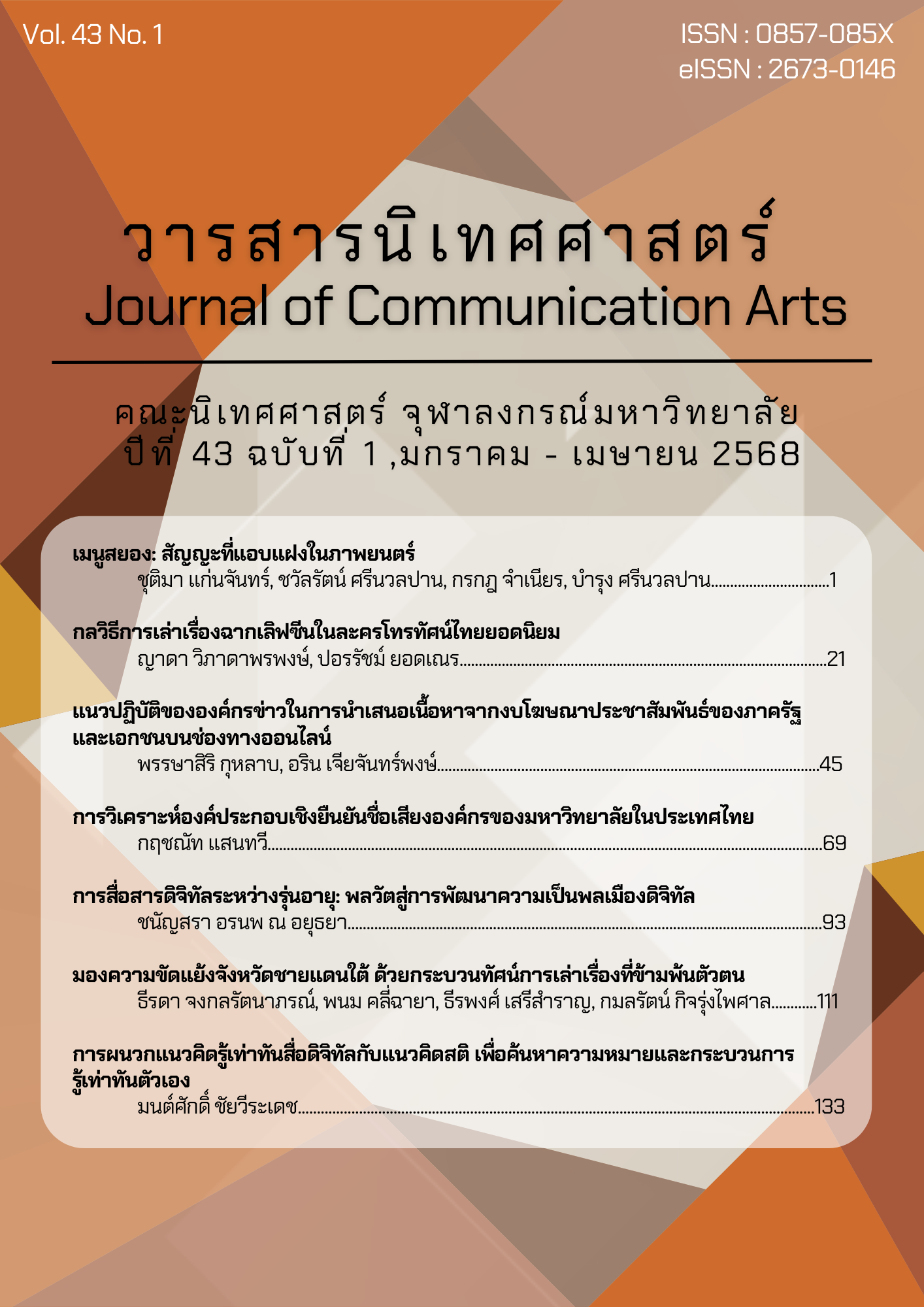
Main Article Content
Abstract
This article intends to outline partly of the key crucial points from the doctoral thesis of bridging digital media literacy with the Thai context of ‘Sati’ (mindfulness) with the objectives of visualizing the research study process and sharing the methodological design. Some findings are presented for discussion in order to encourage key stakeholders in Thailand to reconsider the new approaches for cultivating digital media literacy movement. With the freedom of speech underlying capability to question and decolonize the Western concepts that we have received for implementing in our society. Additionally, to support all stakeholders to initially designate their own ‘diverse approaches’ of digital media literacy to empower themselves to become an active citizen with regard to their own cultural contexts.
Article Details

This work is licensed under a Creative Commons Attribution-NonCommercial-NoDerivatives 4.0 International License.
References
พระธรรมปิฎก (ป.อ.ปยุตโต). (2545). พุทธรรม (ฉบับเดิม). กรุงเทพฯ: สำนักพิมพ์ธรรมสภา.
พระธรรมโฆษาจารย์ (ป.อ.ปยุตโต). (2560). พุทธรรม (ฉบับปรับขยาย). กรุงเทพฯ: สำนักพิมพ์ผลิธัมม์.
มนต์ศักดิ์ ชัยวีระเดช. (2562). เส้นทางการทบทวนวรรณกรรมสู่ความเข้าใจแนวคิดสติและแนวคิดรู้เท่าทันสื่อผ่านมุมมองและแนวคิดตะวันตก. วารสารศาสตร์, 12(12), 11-39.
Bawden, D. & Robinson, L. (2020). Information overload: an overview. Oxford Encyclopedia of Political Decision Making [online]. Oxford: Oxford University Press.
Bell, D. (2001). Introduction to cybercultures. London and New York: Routledge.
Berger, G., (2019). Whither MIL: thoughts for the road ahead. In: Carlsson, U., ed. Understanding media and information literacy (MIL) in the digital age: a question of democracy. Gothenburg: Department of Journalism, Media and Communication (JMC), University of Gothenburg, 25-36.
Center of Media Literacy. (2020). Five key questions form foundation for media inquiry [online]. Retrieved 19 September 2022 from: https://www.medialit.org/reading-room/five-key-questions-form-foundation-media-inquiry
Chaiveeradech, M. (2022). Bridging digital media literacy with the Thai context of ‘Sati’ (mindfulness). Doctoral Thesis (Doctoral). Bournemouth University.
Craig, D. V. (2009). Action Research essentials. San Francisco: Jossey-Bass.
De Abreu, B. S. and Mihailidis, P. (2014). Introduction. In De Abreu B. S. and Mihailidis, P. (Eds). Media literacy education in action: theoretical and pedagogical perspectives. New York: Routledge, p.xxiii-xxx.
Hobbs, R. (2010). Digital media literacy: a plan of action [online]. Washington: The Aspen Institute.
Keiny, S and Orland-Barak, L. (2009). Educational action research as a paradigm for change. In: Noffke, S. and Somekh, B., eds. The SAGE handbook of educational action research. London: SAGE, 166-177.
Keller, D. and Share, J. (2019). The critical media literacy guide: engaging media and transforming education. Leiden: BRILL | SENSE.
Kemp, S. (2024). Digital 2022: Thailand [online]. Singapore: DATAREPORTAL.
McAteer, M. (2013). Action research in Education. London: SAGE.
McDougall, J. (2014). Media literacy: an incomplete project. In De Abreu B. S. and Mihailidis, P. (Eds). Media literacy education in action: theoretical and pedagogical perspectives. New York: Routledge, p.3-10.
McDougall, J. (2020). Unbending the springs of action. In: Bennett, P., McDougall, J. and Potter, J., eds. The uses of media literacy. Oxon: Routledge, 66-84.
McNiff, J. (2013). Action research: principles and practice. Oxon: Routledge.
Mihailidis, P. (2014). Media literacy and the emerging citizen: youth, engagement and participation in digital culture. New York: Peter Lang.
Milan, S. (2016). Liberated technology: inside emancipatory communication activism. In: Gordon, E. and Mihailidis, P., eds. Civic media: technology / design / practice. Cambridge, MA: MIT Press, 107-124.
Nussbaum, M. (2011). Creating capabilities: the human development approach. Massachusette: The Belknap Press of Harvard University Press.
Petranker, J. (2017). The mindful self in space and time. In: Purser, R. E., Forbes, D. and Burke, A., eds. Handbook of mindfulness: culture, context, and social engagement. Switzerland: Springer, 95 – 106.
Ramasubramanian, S. & Darzabi, R. C. (2020). Civic engagement, social justice, and media literacy. In: Christ, W. G. and De Abreu, B. S., eds. Media literacy in a disruptive media environment. New York: Routledge.
Rheingold, H. (1998). A slide of life in my virtual community, MIT press [online], Retrieved 9 October 2020 from: https://www.cs.indiana.edu/docproject/bdgtti/bdgtti_18.html
Sen, A. (1993). Capability and well-being. In: Nussbaum, M. C. and Sen, A., eds. The quality of life. Oxford: Oxford University Press, 30-53.
Sen, A. (2009). The idea of justice. London: Penguin Books.
UNESCO. (2013). Global media and information literacy (MIL) assessment framework: country readiness and competencies [online]. Paris: UNESCO.
UNESCO, (2017). Reading the past, writing the future: fifty years of promoting literacy [online]. Paris: UNESCO.
Walker, M. & Unterhalter, E. (2007). The capability approach: its potential for work in education. In: Walker, M. and Unterhalter, E., eds. Amartya Sen’s capability approach and social justice in education. New York: Palgrave Macmillan, 1-18.
Walker, M. (2009). Capabilities, flourishing and the normative purposes of action research. In: Noffke, S. and Somekh, B., eds. The SAGE handbook of educational action research. London: SAGE, 301-312.
Whitehead, J. & McNiff, J. (2006). Action research: living theory. London: SAGE.
Winter, R. (2009). Developing relationships, developing the self: Buddhism and action research. In: Noffke, S. and Somekh, B., eds. The SAGE handbook of educational action research. London: SAGE, 336-346.
