
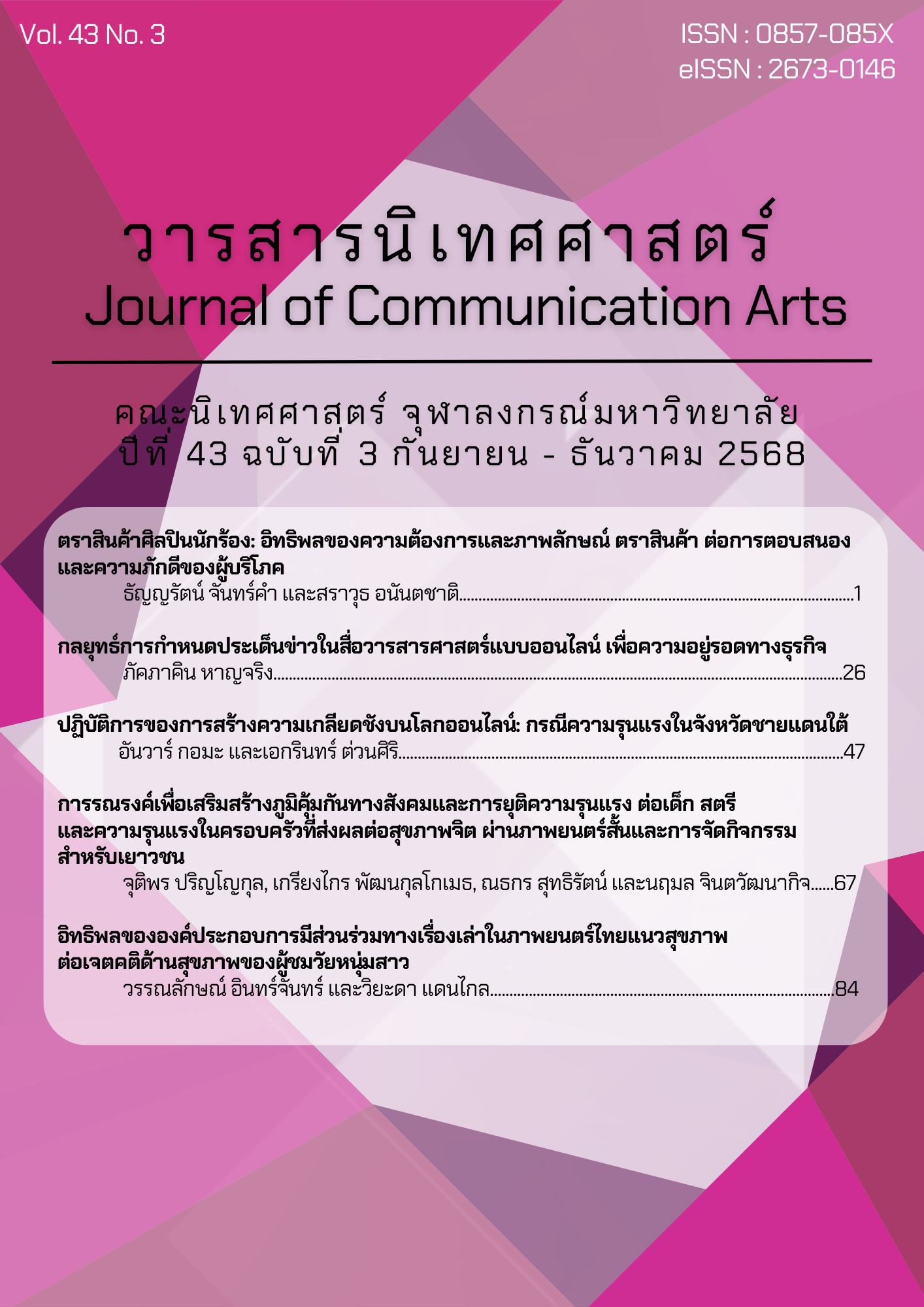
Operation of Online Hate Speech: A Case of the Violence in Southern Thailand
Article Sidebar
Main Article Content
Abstract
The protracted ethno-nationalist conflict in Thailand's Southern Border Provinces (Patani region) continues, yet the role of digital platforms in fueling this violence remains a critical research gap. This study examines the characteristics and sources of online hate speech pertaining to the conflict. Employing a social listening methodology, a dataset of 1,061 posts and messages was collected from Facebook using the Zocial Eye tool over a one-year period (1 November 2020 – 31 October 2021). The analysis reveals that anonymous pages were the primary producers of inflammatory, one-directional hate speech, while established media outlets' pages were the most influential in shaping community reaction. The operations of hate speech were primarily ex-post event commentary, exhibiting ethnic bias, dehumanization, and violence justification. Crucially, a direct, causal correlation between the detected online hate speech and specific violent incidents on the ground cannot be definitively confirmed. The findings underscore a need for a more nuanced state approach. To achieve sustainable peace, the central government must fundamentally restructure its approach to how hate speech targeting the Malay-Muslim minority is addressed. This requires constructive engagement by delegating the monitoring and counter-intervention tasks to a multi-stakeholder platform. Crucially, the state must collaborate transparently with trusted local and international academics and civil society organizations to develop evidence-based mechanisms that effectively mitigate dangerous speech and cultivate social cohesion.
Article Details

This work is licensed under a Creative Commons Attribution-NonCommercial-NoDerivatives 4.0 International License.
References
โครงการโคแฟค. (2025). รายงานพิเศษ: แนวทางการสร้างสมดุลระหว่างเสรีภาพในการพูดและมาตรฐานความน่าเชื่อถือและความปลอดภัยในโลกออนไลน์ด้วยการกลั่นกรองเนื้อหาที่มีประสิทธิภาพ. https://blog.cofact.org/th/special-report-neo-momentum/
ปาตานีฟอรั่ม. (2020). โครงการต่อต้านคำพูดที่สร้างความเกลียดชัง. เอกสารรายงานฉบับสมบูรณ์, ปัตตานี.
พิรงรอง รามสูต. (2558). ประทุษวาจากับโลกออนไลน์. กรุงเทพมหานคร: คบไฟ.
มัทนา นันตา และพิรงรอง รามสูต. (2557). เว็บไซต์ยูทูบ (ภาษาไทย) กับการสื่อสารความเกลียดชัง. วารสารนิเทศศาสตร์, 32(3), 39–67.
สำนักข่าวทูเดย์. (2564). ย้อนรอย กรือเซะ—ตากใบ ความทรงจำโหดร้าย ของ ‘ทักษิณ ชินวัตร’. สำนักข่าวทูเดย์. https://www.youtube.com/watch?v=cCHaMuthPIg
องค์กร ARTICLE 19. (2015). คู่มือไขข้อสงสัยเรื่อง‘ถ้อยคําสร้างความเกลียดชัง’. Article 19. https://www.article19.org/wp-content/uploads/2019/12/Hate-Speech-Explained-A-Toolkit-Thai-Version-min.pdf
อันวาร์ กอมะ และเอกรินทร์ ต่วนศิริ. (2022). เงื่อนไขไตรลักษณ์ของความรุนแรงที่กระทำโดยรัฐต่อมุสลิมชนกลุ่มน้อย: ศึกษาเทียบเคียงกรณีโรฮีนจาในรัฐยะไข่ของเมียนมากับกรณีมลายูมุสลิมในจังหวัดชายแดนใต้ของไทย. วารสารสังคมศาสตร์ จุฬาลงกรณ์มหาวิทยาลัย, 52(2), 150–177. https://doi.org/10.61462/cujss.v52i2.910
เอกรินทร์ ต่วนศิริ, ชนัญสรา อรนพ ณ อยุธยา, และชาญชัย ชัยสุขโกศล. (2562). วิเคราะห์ภาวะอขันติธรรมระหว่างศาสนาในสังคมไทยผ่านการแสดงความคิดเห็นในสื่อออนไลน์. กรุงเทพมหานคร: ศูนย์มานุษยวิทยาสิรินธร (องค์การมหาชน).
Allard K. Lowenstein International Human Rights Clinic, Yale Law School. (2015). Persecution of the Rohingya Muslims: Is Genocide Occurring in Myanmar’s Rakhine State? A Legal Analysis. Fortify Rights. https://www.fortifyrights.org/mya-inv-rep-2015-10-29/
Carl Schmitt. (2007). The Concept of the Political. Chicago: University of Chicago Press.
Chalk, F. (1999). Hate Radio in Rwanda. In A. Suhrke (Ed.), The Path of a Genocide: The Rwanda Crisis from Uganda to Zaire (pp. 93–108). New York: Routledge.
Dangerous Speech Project. (2020, August 4). Dangerous Speech: A Practical Guide. https://dangerousspeech.org/guide/
Galtung, J. (1990). Cultural Violence. Journal of Peace Research, 27(3), 291–305.
George, C. (2017). Hate Spin: The Manufacture of Religious Offense and Its Threat to Democracy. Cambridge, MA, USA: MIT Press.
Koma, A. (2025, January 29). Breaking the Cycle: Addressing the Security Dilemma and Cultural Violence in Southern Thailand. International Institute of Advanced Islamic Studies. https://iais.org.my/publications-sp-1447159098/articles/3431-breaking-the-cycle-addressing-the-security-dilemma-and-cultural-violence-in-southern-thailand
Oranop, C., Tuansiri, E., & Chaisukkosol, hanchai. (2020). Social Listening of Events Relating to Buddhist and Muslim Relationships between 2015 and 2019: How does Online Hate Speech Emerge among Thai Internet Users. Hate Speech in Asia: Challenges and Solutions, 4–12. Bangkok: Asia Center. https://asiacentre.org/wp-content/uploads/Conference-Proceedings_Hate-Speech-In-Asia-Challenges-and-Solutions.pdf
Stecklow, S. (2018, August 15). Why Facebook is losing the war on hate speech in Myanmar. https://www.reuters.com/investigates/special-report/myanmar-facebook-hate/
Straus, S. (2007). What Is the Relationship between Hate Radio and Violence? Rethinking Rwanda’s “Radio Machete”. Politics & Society, 35(4), 609–637. https://doi.org/10.1177/0032329207308181
