
Book Review: “Museum of Modern Aluminum” – Bridging Industry and Art through Sustainable Design
Article Sidebar
Main Article Content
Abstract
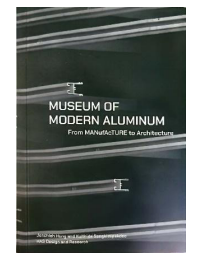
The book Museum of Modern Aluminum from Manufacture to Architecture documented an innovative architectural project by HAS Design and Research Company that redefines the application of aluminum in contemporary architecture. Inspired by the organic form of a dandelion and the ecological landscape of Thailand’s Koh Kret Island, the Museum of Modern Aluminum (MoMA) integrates aluminum as both a structural and aesthetic element, showcasing its lightweight, malleable, and sustainable properties. The design features a dynamic façade composed of modular aluminum strips, paired with energy-efficient LED lighting that simulates the glow of fireflies, and landscape spaces that blend artificial and natural elements. This project not only highlights the potential of aluminum in green architecture but also explores cultural transplantation, urban memory, and the balance between innovation and tradition. Through detailed case studies and reflections on materiality, this book offers insights into sustainable design practices and reveals the evolving role of aluminum in shaping future-built environments.
Downloads
Article Details

This work is licensed under a Creative Commons Attribution-NonCommercial-NoDerivatives 4.0 International License.
All material is licensed under the terms of the Creative Commons Attribution 4.0 International (CC-BY-NC-ND 4.0) License, unless otherwise stated. As such, authors are free to share, copy, and redistribute the material in any medium or format. The authors must give appropriate credit, provide a link to the license, and indicate if changes were made. The authors may do so in any reasonable manner, but not in any way that suggests the licensor endorses you or your use. The authors may not use the material for commercial purposes. If the authors remix, transform, or build upon the material, they may not distribute the modified material, unless permission is obtained from JARS. Final, accepted versions of the paper may be posted on third party repositories, provided appropriate acknowledgement to the original source is clearly noted.
References
Biedrońska, J., & Misiołek, W. Z. (2009). Application of aluminum in “green” architecture—Today and tomorrow. Architecture Civil Engineering Environment, 2(1), 5–10. https://delibra.bg.polsl.pl/Content/28139/BCPS31737-Application-of-alumi0000.pdf
de la Torre, M. (2013). Values and heritage conservation. Heritage & Society, 6(2), 155–166. https://doi.org/10.1179/2159032X13Z.00000000011
Efthymiou, E., Cöcen, Ö. N., & Ermolli, S. R. (2010). Sustainable aluminium systems. Sustainability, 2(9), 3100–3109. https://doi.org/10.3390/su2093100
Ellen MacArthur Foundation. (2015). Towards a circular economy: Business rationale for an accelerated transition. https://content.ellenmacarthurfoundation.org/m/4384c08da576329c/original/Towards-a-circular-economy-Business-rationale-for-an-accelerated-transition.pdf
European Aluminium. (2025). An action plan for European aluminium. https://european-aluminium.eu/wp-content/uploads/2025/02/25-01-13-An-Action-Plan-for-European-Aluminium.pdf
Ge, Y. (2025). The homogenization of man-made historical landscapes and its solution: Case analysis of Tang Dynasty Never Nights City and Chongquan Ancient Town. Highlights in Business, Economics and Management, 48, 1–6. https://doi.org/10.54097/55hf0h27
Malinowska, A. (2014). Cultural transplantation and problems of transferability. Word and Text: A Journal of Literary Studies and Linguistics, 4(2), 24–36. https://jlsl.upg-ploiesti.ro/documente/documente/Arhiva/Wordandtextno2_2014/02Malinowska.pdf
Miller, D. (2010). Stuff. Polity. https://www.politybooks.com/bookdetail?book_slug=stuff--9780745644233
Radlbeck, C., Dienes, E., & Kosteas, D. (2005). Sustainable competitiveness of aluminium building products. Structural Survey, 23(2), 131–137. https://doi.org/10.1108/02630800510593693
Rogers, E. M. (2003). Diffusion of innovations (5th ed.). Free Press.
