
Reframing Authorship and Ethics in AI-driven and Immersive Architectural Environments: A Transdisciplinary Review
Article Sidebar
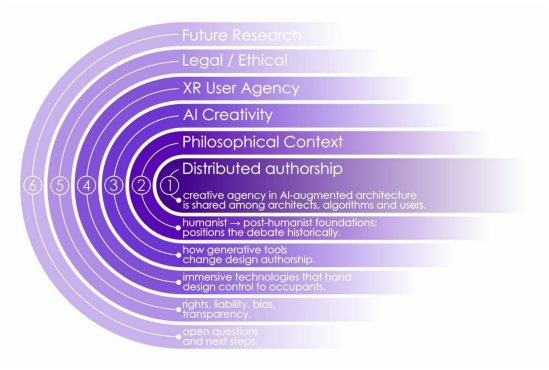
Main Article Content
Abstract
This article presents a comprehensive transdisciplinary review of the ways in which artificial intelligence (AI) and immersive technologies are transforming foundational concepts of authorship, ethics, and creativity within contemporary architecture and spatial design. The traditional notion of the architect as a singular, authoritative creator increasingly is challenged by computational processes that introduce generative, autonomous, and distributed forms of design agency. Through a synthesis of architectural theory, AI ethics, media studies, and posthuman philosophy, the review interrogates the shifting locus of authorship in design environments mediated by intelligent systems and extended reality (XR) platforms.
At the core of this inquiry is an ontological reframing of authorship, informed by scholars such as Rosi Braidotti, Tony Fry, Humberto Maturana, and Anne-Marie Willis. These frameworks position the architect not as an originator of form, but as a participant in a relational field of human and non-human agents, including algorithms, data, environments, and users. Adopting an ontological design lens, under which design practices and their tools co-produce forms of life and ways of world-making, the article argues that AI/XR systems do not merely assist representation but actively configure professional authorship, agency, and ethics. This framing links practical workflows to normative guidance for disclosure, responsibility, and education. The review explores how generative design, neural networks, and parametric modeling redefine design intention and originality, situating authorship as a curatorial and computationally entangled process. In parallel, immersive media such as virtual and augmented reality introduce new forms of user co-authorship and spatial manipulation, prompting ethical questions about consent, agency, presence, and the authenticity of digital space.
The article maps emerging discourses around design accountability, legal attribution, algorithmic bias, and data governance, proposing an expanded ethical vocabulary for posthuman design practices. Through a critical examination of scholarly literature, experimental studios, and case-based applications, the review identifies epistemological and practical challenges in reconciling human-centered traditions with distributed technological agency.
Ultimately, this article argues for a redefinition of authorship as a dynamic, ethically situated, and ontologically pluralistic concept in architecture. It advocates for the development of integrative frameworks that embed ethical foresight and philosophical reflexivity into AI-augmented and immersive design methodologies. By repositioning the architect as a negotiator within hybrid systems of creativity and control, the article contributes a forward-looking perspective to architectural theory, technological practice, and planning discourse.
Downloads
Article Details

This work is licensed under a Creative Commons Attribution-NonCommercial-NoDerivatives 4.0 International License.
All material is licensed under the terms of the Creative Commons Attribution 4.0 International (CC-BY-NC-ND 4.0) License, unless otherwise stated. As such, authors are free to share, copy, and redistribute the material in any medium or format. The authors must give appropriate credit, provide a link to the license, and indicate if changes were made. The authors may do so in any reasonable manner, but not in any way that suggests the licensor endorses you or your use. The authors may not use the material for commercial purposes. If the authors remix, transform, or build upon the material, they may not distribute the modified material, unless permission is obtained from JARS. Final, accepted versions of the paper may be posted on third party repositories, provided appropriate acknowledgement to the original source is clearly noted.
References
Alberti, L. B. (1991). On the art of building in ten books. MIT Press.
Arief, B. (2014?). Authorship: Role of the architect in emergent design. Academia.edu. https://www.academia.edu/9648560/AuthorshipRoleoftheArchitectinEmergent_Design
AIA Contract Documents. (2024, May 22). The ownership dilemma: Who owns building design in the age of AI? https://learn.aiacontracts.com/articles/the-ownership-dilemma-who-owns-building-design-in-the-ageof-ai
Banakou, D., Hanumanthu, P. D., & Slater, M. (2016). Virtual embodiment of white people in a black virtual body leads to a sustained reduction in their implicit racial bias. Frontiers in Human Neuroscience, 10, 601. https://doi.org/10.3389/fnhum.2016.00601
Behm, D. (2016, September 13). No common ground on Pokemon Go. Milwaukee Journal Sentinel. https://www.jsonline.com/story/news/local/milwaukee/2016/09/13/no-common-ground-pokemon-go/90322362/
Braidotti, R. (2017). Posthuman critical theory. Journal of Posthuman Studies, 1(1), 9–25. https://doi.org/10.5325/jpoststud.1.1.0009
Braidotti, R. (2013). The posthuman. Polity Press.
Carpo, M. (2011). The alphabet and the algorithm. MIT Press.
Carpo, M. (2017). The second digital turn: Design beyond intelligence (Writing Architecture). MIT Press.
Conroy, D. T. (2017). Property rights in augmented reality. Michigan Telecommunications & Technology Law Review, 24(1), 17–43. https://repository.law.umich.edu/cgi/viewcontent.cgi?article=1232&context=mttlr
Commis Tech LLC. (2024, May 30). Ethical considerations in VR: Privacy, consent, and immersion. Status Update. LinkedIn. https://www.linkedin.com/pulse/ethical-considerations-vr-privacy-consent-virtual-realities-zqxec
Day, M. (2024, July 25). EvolveLab: Bringing AI to architecture. AEC Magazine. https://aecmag.com/ai/evolvelab-bringing-ai-to-architecture
El Moussaoui, M. (2025a, September 4). Redefining authorship: How AI is changing what it means to be an architect. Common Edge. https://commonedge.org/redefining-authorship-how-ai-is-changing-what-it-means-to-be-an-architect
El Moussaoui, A. (2025b). Redefining authorship in architecture in the age of AI. In H. Philipp (Ed.), Oxford intersections: AI in society. Oxford University Press. https://doi.org/10.1093/9780198945215.003.0033
Ethics in Virtual Reality. (2022). IEEE 2nd International Conference on Intelligent Reality (ICIR). https://digitalreality.ieee.org/publications/ethics-in-virtual-reality/
Fry, T. (1999). New design philosophy: An introduction to defuturing. University of New South Wales Press.
Globa, A., Beza, B. B., & Wang, R. (2022). Towards multi-sensory design: Placemaking through immersive environments—Evaluation of the approach. Expert Systems with Applications, 204, 117614. https://doi.org/10.1016/j.eswa.2022.117614
Hosseini, M., Rasmussen, L. M., & Resnik, D. B. (2024). Using AI to write scholarly publications. Accountability in Research, Ethics, Integrity and Policy, 31(7), 715–723. https://doi.org/10.1080/08989621.2023.2168535
Judge, E. F., & Brown, T. E. (2018). A right not to be mapped? Augmented reality, real property, and zoning. Laws, 7(2), 23. https://doi.org/10.3390/laws7020023
Kaebnick, G. E., Magnus, D. C., Kao, A., Hosseini, M., Resnik, D., Dubljevic, V., Rentmeester, C., Gordijn, B., & Cherry, M. J. (2023). Editors’ statement on the responsible use of generative AI technologies in scholarly journal publishing. Medicine, Health Care and Philosophy, 26(4), 499–503. https://doi.org/10.1007/s11019-023-10176-6
Kemkomnerd, W., & Tirapas, C. (2025). The Silicon architect: Transformation towards a data-centric mindset. Journal of Architectural/Planning Research and Studies (JARS), 22(1), 269892. https://doi.org/10.56261/jars.v22.269892
Madary, M., & Metzinger, T. K. (2016). Real virtuality: A code of ethical conduct: Recommendations for good scientific practice and the consumers of VR-technology. Frontiers in Robotics and AI, 3, 3. https://www.frontiersin.org/articles/10.3389/frobt.2016.00003/full
Malakhatka, E., Bellis, S., Stenberg, R., & Jonsson, A. Z. (2025). Virtual spaces, real changes: VR as a tool for sustainable and inclusive campus co-design. International Journal of Architectural Computing, 0(0), 1–21. https://doi.org/10.1177/14780771251352938
Masood, A. (2025, April 4). Intellectual property rights and AI-generated content: Issues in human authorship, fair use doctrine, and output liability. Medium. https://medium.com/@adnanmasood/intellectual-property-rights-and-ai-generated-content-issues-in-human-authorship-fair-use-8c7ec9d6fdc3
Maturana, H. R., & Varela, F. J. (1980). Autopoiesis and cognition: The realization of the living. D. Reidel Publishing Company.
Park, C.-S., Lee, D.-Y., Kwon, O.-S., & Wang, X. (2013). A framework for proactive construction defect management using BIM, augmented reality and ontology-based data collection template. Automation in Construction, 33, 61–71. https://doi.org/10.1016/j.autcon.2012.09.010
Pinto-Coelho, L., Laska-LeSniewicz, A., Pereira, E. T., & Sztobryn-Giercuszkiewicz, J. (2023). Inclusion and adaptation beyond disability: Using virtual reality to foster empathy. Medycyna Pracy – Workers’ Health and Safety, 74(3), 171–185. https://doi.org/10.13075/mp.5893.01386
PresenceSecure. (2025). Ethical AR/VR development: Ensuring user privacy in virtual environments. https://www.presencesecure.com/ethical-ar-vr-development-privacy-in-virtual-environments
Raja, U. S., & Al-Baghli, R. (2025). Ethical design in immersive environments. Frontiers in Virtual Reality, 6, 1451273. https://doi.org/10.3389/frvir.2025.1451273
Rebenitsch, L., & Owen, C. (2016). Review on cybersickness in applications and visual solutions. Virtual Reality, 20(2), 101–125. https://doi.org/10.1007/s10055-016-0285-9
Regulation (EU) 2024/1689 of the European Parliament and of the Council of 13 June 2024 laying down harmonised rules on artificial intelligence and amending Regulations (EC) No 300/2008, (EU) No 167/2013, (EU) No 168/2013, (EU) 2018/858, (EU) 2018/1139 and (EU) 2019/2144 and Directives 2014/90/EU, (EU) 2016/797 and (EU) 2020/1828 (Artificial Intelligence Act). (2024). Official Journal of the European Union, 2024/1689. https://eur-lex.europa.eu/eli/reg/2024/1689/oj/eng
Rizzo, A. S., & Koenig, S. T. (2017). Is clinical VR ready for primetime? Neuropsychology, 31(8), 877–899. https://doi.org/10.1037/neu0000405
Schnädelbach, H., Jäger, N., & Urquhart, L. (2019). Adaptive architecture and personal data. ACM Transactions on Computer-Human Interaction (TOCHI), 26(2), 12. https://doi.org/10.1145/3301426
Sharples, S., Cobb, S., Moody, A., & Wilson, J. R. (2008). Virtual reality induced symptoms and effects (VRISE): Comparison of head mounted display (HMD), desktop and projection display systems. Displays, 29(2), 58–69. https://doi.org/10.1016/j.displa.2007.09.005
Sherman, W. R., & Craig, A. B. (2018). Understanding virtual reality: Interface, application, and design (2nd ed.). Morgan Kaufmann.
Slater, M., & Sanchez-Vives, M. V. (2016). Enhancing our lives with immersive virtual reality. Frontiers in Robotics and AI, 3, 74. https://doi.org/10.3389/frobt.2016.00074
Slater, M., Gonzalez-Liencres, C., Haggard, P., Vinkers, C., Gregory-Clarke, R., Jelley, S., Watson, Z., Breen, G., Schwarz, R., Steptoe, W., Szostak, D., Halan, S., Fox, D., & Silver, J. (2020). The ethics of realism in virtual and augmented reality. Frontiers in Virtual Reality, 1, 1. https://doi.org/10.3389/frvir.2020.00001
Softaoglu, H. (2022). What is posthuman architecture/cities as a potential and emerging term of post-pandemic world. In H. A. Nia (Ed.), 5th International Conference of Contemporary Affairs in Architecture and Urbanism (ICCAUA-2022), 11–13 May 2022 (pp. 291–296). https://doi.org/10.38027/ICCAUA2022EN0008
Steinitz, C. (2020). On landscape architecture education and professional practice and their future challenges. Land, 9(7), 228. https://doi.org/10.3390/land9070228
Sunil, N. (2024, November 14). The ethics of AI in architecture: Balancing automation and human intent. Parametric Architecture. https://parametric-architecture.com/the-ethics-of-ai-in-architecture
SecurePrivacy. (2025, April 17). Designing consent in virtual spaces: The critical challenge of VR/AR safety. https://secureprivacy.ai/blog/consent-in-virtual-spaces-vr-ar-safety
Theodoropoulou, I. (2007). Architectural authorship in generative design [Master’s thesis, University College London]. UCL Discovery. https://discovery.ucl.ac.uk/id/eprint/8005
Vasari, G. (1907). Vasari on technique: Being the introduction to the three arts of design, architecture, sculpture and painting, prefixed to the lives of the most excellent painters, sculptors and architects. J. M. Dent & Co.
Vergunova, N., & Vergunov, S. (2022). Optimization of design process based on 3D-model. In O. Arsenyeva, T. Romanova, M. Sukhonos, & Y. Tsegelnyk (Eds.), Smart technologies in urban engineering: Proceedings of STUE 2022 (pp. 45–56). https://doi.org/10.1007/978-3-031-20141-7_5
Weech, S., Kenny, S., & Barnett-Cowan, M. (2019). Presence and cybersickness in virtual reality are negatively related: A review. Frontiers in Psychology, 10, 158. https://doi.org/10.3389/fpsyg.2019.00158
Willis, A.-M. (2006). Ontological designing. Design Philosophy Papers, 4(2), 69–92. https://doi.org/10.2752/144871306X13966268131514
Yee, N., & Bailenson, J. (2007). The Proteus effect: The effect of transformed self-representation on behavior. Human Communication Research, 33(3), 271–290. https://doi.org/10.1111/j.1468-2958.2007.00299.x
