
Mental Images and the Shaping of Place Identity: How Creative Professionals Perceive a Revitalized Creative District in Bangkok
Article Sidebar
Main Article Content
Abstract
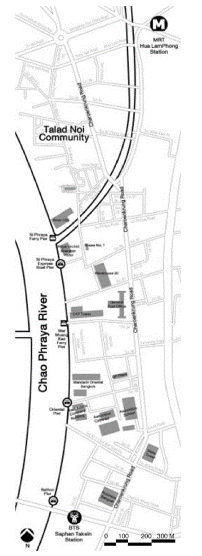
Creative districts increasingly are promoted as engines of urban revitalization and cultural production, yet little is known about how such spaces are perceived by the creative professionals who inhabit and shape them. This study explores the mental images of creative professionals in Bangkok’s Charoen Krung Creative District, aiming to understand how they cognitively construct the district’s identity through everyday spatial experiences. Drawing upon theoretical frameworks in environmental psychology and creative city concepts, the research employed a qualitative approach using an open-ended listing task. A total of 418 participants who had engaged with the district through creative work and activities were asked to generate mental images based on their perceptions of the area. Thematic analysis of the data yielded ten distinct image clusters, which were synthesized into four overarching themes: historical urban context and cultural knowledge; collective meaning of place; local life; and urban life. The findings revealed that creative professionals interpret the district not only through its physical attributes but also through symbolic, social, and emotional associations. Differences in perception emerged across occupational subgroups, suggesting that creative identity significantly shapes spatial interpretation. The study reveals the merit of mental imagery as an interpretive tool for understanding how place meaning is constructed in urban spaces. The findings have implications for urban design and planning, highlighting the need for inclusive strategies in creating place identity that correspond to diverse perceptual experiences.
Downloads
Article Details

This work is licensed under a Creative Commons Attribution-NonCommercial-NoDerivatives 4.0 International License.
All material is licensed under the terms of the Creative Commons Attribution 4.0 International (CC-BY-NC-ND 4.0) License, unless otherwise stated. As such, authors are free to share, copy, and redistribute the material in any medium or format. The authors must give appropriate credit, provide a link to the license, and indicate if changes were made. The authors may do so in any reasonable manner, but not in any way that suggests the licensor endorses you or your use. The authors may not use the material for commercial purposes. If the authors remix, transform, or build upon the material, they may not distribute the modified material, unless permission is obtained from JARS. Final, accepted versions of the paper may be posted on third party repositories, provided appropriate acknowledgement to the original source is clearly noted.
References
Anton, C. E., & Lawrence, C. (2014). Home is where the heart is: The effect of place of residence on place attachment and community participation. Journal of Environmental Psychology, 40, 451–461. https://doi.org/10.1016/j.jenvp.2014.10.007
Birer, E., & Adem, P. (2022). Role of public space design on the perception of historical environment: A pilot study in Amasya. Frontiers of Architectural Research, 11(1), 13–30. https://doi.org/10.1016/j.foar.2021.09.003
Cheng, C., & Kuo, H. (2015). Bonding to a new place never visited: Exploring the relationship between landscape elements and place bonding. Tourism Management, 46, 546–560. https://doi.org/10.1016/j.tourman.2014.08.006
Clouse, C., Dixit, A., & Turken, N. (2020). The role of place image for business site selection: A research framework, propositions, and a case study. Place Branding and Public Diplomacy, 16(2), 174–186. https://doi.org/10.1057/s41254-019-00144-4
Cullen, G. (1961). The concise townscape. Architectural Press.
Dastgerdi, A. S., & De Luca, G. (2019). Strengthening the city’s reputation in the age of cities: An insight into city branding theory. City, Territory and Architecture, 6, Article 2. https://doi.org/10.1186/s40410-019-0101-4
Droseltis, O., & Vignoles, V. L. (2010). Towards an integrative model of place identification: Dimensionality and predictors of intrapersonal-level place preferences. Journal of Environmental Psychology, 30(1), 23–34. https://doi.org/10.1016/j.jenvp.2009.05.002
Ewing, R., & Handy, S. (2009). Measuring the unmeasurable: Urban design qualities related to walkability. Journal of Urban Design, 14(1), 65–84. https://doi.org/10.1080/13574800802451155
Ferru, M., Rallet, A., & Cariou, C. (2022). A topological approach to the creative city: Artists’ perceptions of cultural places in Paris. Journal of Economic Geography, 22(6), 1125–1148. https://doi.org/10.1093/jeg/lbab049
Florida, R. (2002). The rise of the creative class: And how it’s transforming work, leisure, community, and everyday life. Basic Books.
Gehl, J. (2010). Cities for people. Island Press.
Gilboa, S., Jaffe, E.D., Vianelli, D., Pastore, A., & Herstein, R. (2015). A summated rating scale for measuring city image. Cities, 44, 50-59. https://doi.org/10.1016/j.cities.2015.01.002
Grandadam, D., Cohendet, P., & Simon, L. (2013). Places, spaces and the dynamics of creativity: The video game industry in Montreal. Regional Studies, 47(10), 1701–1714. https://doi.org/10.1080/00343404.2011.600225
Harachai, P., & Bejrananda, M. (2019). The perception of the insider and outside of place identity Buriram Province. Journal of Architectural/Planning Research and Studies (JARS), 16(2), 49–68. https://doi.org/10.56261/jars.v16i2.174711
He, J. L., & Gebhardt, H. (2013). Space of creative industries: A case study of spatial characteristics of creative clusters in Shanghai. European Planning Studies, 22(11), 2351–2368. https://doi.org/10.1080/09654313.2013.837430
He, J., Huang, X., & Xi, G. (2018). Urban amenities for creativity: An analysis of location drivers for photography studios in Nanjing, China. Cities, 74, 310-319. https://doi.org/10.1016/j.cities.2017.12.020
Jacobs, J. (1961). The death and life of great American cities. Random House.
Janjamlah, T., & Kaewlai, P. (2020). Magnetizing creative talent: the influences of creative ecology on spatial behavior of creative class in Charoen Krung. Journal of Architectural/Planning Research and Studies (JARS), 18(1), 99-114. https://doi.org/10.56261/jars.v18i1.240083
Knox, P., & Pinch, S. (2010). Urban social geography: An introduction (6th ed.). Routledge.
Landry, C. (2008). The creative city: A toolkit for urban innovators (2nd ed.). Routledge.
Lewicka, M. (2011). Place attachment: How far have we come in the last 40 years? Journal of Environmental Psychology, 31(3), 207–230. https://doi.org/10.1016/j.jenvp.2010.10.001
Lynch, K. (1960). The image of the city. MIT Press.
Luque-Martínez, T., Del Barrio-García, S., Ibáñez-Zapata, J., & Rodriguez-Molina, M. (2007). Modeling a city’s image: The case of Granada. Cities. 24(5): 335-352. https://doi.org/10.1016/j.cities.2007.01.010
Montgomery, J. (1998). Making a city: Urbanity, vitality and urban design. Journal of Urban Design, 3(1), 93–116. https://doi.org/10.1080/13574809808724418
Pintong, W. (2023). Outdoor workspace at TCDC, Charoen Krung [Photograph]. Unpublished. Used with permission
Pratt, A. C. (2011). The cultural contradictions of the creative city. City, Culture and Society, 2(3), 123-130. https://doi.org/10.1016/j.ccs.2011.08.002
Punson, B., & Pokharatsiri, J. (2023). A land use approach to promote Charoenkrung District as a creative industry hub - Possibilities under the Bangkok Comprehensive Plan. Journal of Architectural/Planning Research and Studies (JARS), 21(1), 49–62. https://doi.org/10.56261/jars.v21.254892
Relph, E. (1976). Place and placelessness. Pion.
Richards, G. (2014). Creativity and tourism in the city. Current Issues in Tourism, 17(2), 119-144. https://doi.org/10.1080/13683500.2013.783794
Rollero, C., & Piccoli, N. D. (2010). Place attachment, identification and environment perception: An empirical study. Journal of Environmental Psychology, 30(2), 198–205. https://doi.org/10.1016/j.jenvp.2009.12.003
Scannell, L., & Gifford, R. (2017). The experienced psychological benefits of place attachment. Journal of Environmental Psychology, 51, 256–269. https://doi.org/10.1016/j.jenvp.2017.04.001
Scott, A. J. (2010a). Creative cities: The role of culture. Revue d’Économie Politique, 120(1), 181–204. https://doi.org/10.3917/redp.201.0181
Scott, A. J. (2010b). Cultural economy and the creative field of the city. Geografiska Annaler: Series B, Human Geography, 92(2), 115–130. https://doi.org/10.1111/j.1468-0467.2010.00377.x
Spence, C. (2020). Senses of place: architectural design for the multisensory mind. Cognitive Research: Principles and Implications, 5, Article 46. https://doi.org/10.1186/s41235-020-00243-4
Stylidis, D., Sit, J., & Biran, A. (2016). An exploratory study of residents’ perception of place image: The case of Kavala. Journal of Travel Research, 55(5), 659-674. https://doi.org/10.1177/0047287514563163
Tuan, Y. F. (1977). Space and place: The perspective of experience. University of Minnesota Press.
Vanolo, A. (2008). The image of the creative city: Some reflections on urban branding in Turin. Cities, 25(6), 370–382. https://doi.org/10.1016/j.cities.2008.08.001
Zaman, U., & Aktan, M. (2021). Examining residents’ cultural intelligence, place image and foreign tourist attractiveness: A mediated-moderation model of support for tourism development in Cappadocia (Turkey). Journal of Hospitality and Tourism Management, 46, 393–404. https://doi.org/10.1016/j.jhtm.2021.01.017
Zenker, S. (2009). Who’s your target? The creative class as a target group for place branding. Journal of Place Management and Development, 2(1), 23-32. https://doi.org/10.1108/17538330910942771
