
Memorable Places on Campuses Across Generations
Article Sidebar
Main Article Content
Abstract
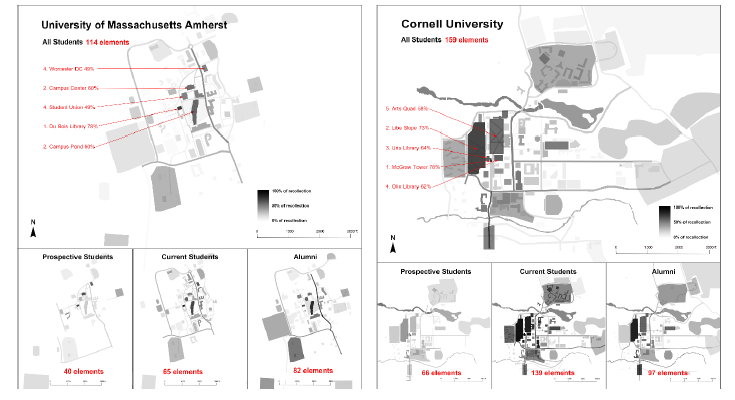
This study explores the method of recording memorable places and highlights the peak recollection spots of college town universities across generations--prospective, present current, and past students. The chosen campus areas are the University of Massachusetts Amherst and Cornell University. Ninety participants produced mental maps based on memory, including landmarks, meaningful places, paths, landscapes, and anything they associated with the campus. Following Lynch’s methods, elements from sketch maps were mainly were landmarks (87%). Current students had a higher percentage of buildings recalled, but fewer landscapes recalled than prospective students and alumni. Adapting from Appleyard’s methods, over four-fifths of student populations provided spatial dominant maps, which indicated more substantial stages of spatial knowledge. Categorizing by functional aspects, the highest recollection of all students was landscape and roads (28%), exceeding academic buildings (25%). The researcher counted an element from sketch maps that demonstrated at least one stage of spatial knowledge development, and extracted and transformed it into digital maps. The collective memory-significant maps presented different patterns of recall frequency among student subgroups of the three student generations. The top three places with the highest intensities were iconic buildings and adjacent landscapes at the core campus. Memory intensity did not diminish equally as distance increased from the central zone. The Hot Spot Analysis, utilizing the Getis-Ord-Gi* statistic and inverse distance weighting (IDW), revealed different patterns of hot spots among generations. A landscape landmark served as a memorable hot spot in every subpopulation of all three generational groups. This innovative method could serve as an additional tool in bridging the gap between practical and theoretical knowledge, enabling the recording of intangible memory aspects into databases and measurable plans. Other campuses could implement the procedure and include the memory-significant assessment to design institutional environments that meet diverse student perceptions.
Downloads
Article Details

This work is licensed under a Creative Commons Attribution-NonCommercial-NoDerivatives 4.0 International License.
All material is licensed under the terms of the Creative Commons Attribution 4.0 International (CC-BY-NC-ND 4.0) License, unless otherwise stated. As such, authors are free to share, copy, and redistribute the material in any medium or format. The authors must give appropriate credit, provide a link to the license, and indicate if changes were made. The authors may do so in any reasonable manner, but not in any way that suggests the licensor endorses you or your use. The authors may not use the material for commercial purposes. If the authors remix, transform, or build upon the material, they may not distribute the modified material, unless permission is obtained from JARS. Final, accepted versions of the paper may be posted on third party repositories, provided appropriate acknowledgement to the original source is clearly noted.
References
Afrooz, A., White, D., & Parolin, B. (2018). Effects of active and passive exploration of the built environment on memory during wayfinding. Applied Geography, 101(October), 68–74.https://doi.org/10.1016/j.apgeog.2018.10.009
Akhir, N. M., Md Sakip, S. R., Abbas, M. Y., & Othman, N. (2018). Landscape spatial character: Students’preferences on outdoor campus spaces. Asian Journal of Quality of Life, 3(13), 89–97.https://doi.org/10.21834/ajqol.v3i13.165
Al-Alwan, H. A. S., Al-Bazzaz, I. A., & Mohammed Ali, Y. H.(2022). The potency of architectural probabilism in shaping cognitive environments: A psychophysical approach. Ain Shams Engineering Journal, 13(1),101522.https://doi.org/10.1016/j.asej.2021.06.008
Alhusban, A. A., Alhusban, S. A., & Al-Betawi, Y. N. (2019). The degree of the Hashemite university students’ desires, needs, and satisfaction with their campus urban design. Journal of Place Management and Development, 12(3), 408–448. https://doi.org/10.1108/JPMD-08-2018-0062
Alptekin, O. (2017). A Reading Attempt of the Urban Memory of Eskisehir Osmangazi University Meselik Campus via Cognitive Mapping. IOP Conference Series: Materials Science and Engineering, 245(5).https://doi.org/10.1088/1757-899X/245/5/052016
Altman, I., & Low, S. M. (1992). Place attachment. Plenum Press.
Anantsuksomsri, S., Positlimpakul, K., Chatakul, P.,Janpathompong, D., Chen, G., & Tontisirin, N.(2024).Carbon sequestration analysis of the university campuses in the Bangkok Metropolitan Region. Journal of Infrastructure, Policy and Development, 8(6), 1–22.https://doi.org/10.24294/jipd.v8i6.3385
Anaya, G. J., & Lehto, X. (2023). ‘Moments to be Had’:Understanding the experience of memorable tourism moments. Tourism Management, 95(November 2021),104674.https://doi.org/10.1016/j.tourman.2022.104674
Appleyard, D. (1969). Why buildings are known. Environment and Behavior, 1(2), 131–156. https://doi.org/10.1177/001391656900100202
Appleyard, D. (1970). Styles and methods of structuring a city. Environment and Behavior, 2(1), 100–117.
Ding, Y., Lee, C., Chen, X., Song, Y., Newman, G., Lee, R., Lee, S., Li, D., & Sohn, W. (2024). Exploring the association between campus environment of higher education and student health: A systematic review of findings and measures. Urban Forestry and Urban Greening, 91(December 2023), 128168.https://doi.org/10.1016/j.ufug.2023.128168
Education Advisory Board. (2018). 4 of the most iconic campus landscapes—and the impact they have on students. 2018. https://eab.com/resources/research-report/4-of-the-most-iconic-campus-landscapes-andthe-impact-they-have-on-students/
Gehl, J. (1971). Life between buildings. Van Nostrand Reinhold.
Hajrasouliha, A. (2017). Campus score: Measuring university campus qualities. Landscape and Urban Planning, 158, 166–176. https://doi.org/10.1016/j.landurbplan.2016.10.007
Hami, A., & Abdi, B. (2021). Students’ landscaping preferences for open spaces for their campus environment. Indoor and Built Environment, 30(1), 87–98. https://doi.org/10.1177/1420326X19887207
Hanan, H. (2013). Open Space as a Meaningful Place for Students in the ITB Campus. Procedia - Social and Behavioral Sciences, 85, 308–317.https://doi.org/10.1016/j.sbspro.2013.08.361
Ishikawa, T., & Montello, D. R. (2006). Spatial knowledge acquisition from direct experience in the environment:Individual differences in the development of metric knowledge and the integration of separately learned places. Cognitive Psychology, 52(2), 93–129.https://doi.org/10.1016/j.cogpsych.2005.08.003
Jacobs, J. (1961). The death and life of Great American Cities.
Janpathompong, S., Tontisirin, N., & Murakami, A. (2022).How far people walk during lunchtime: Comparing actual and perceived walking distances in the Central Business District of Bangkok, Thailand. Nakhara:Journal of Environmental Design and Planning, 21(3).https://doi.org/10.54028/NJ202221227
Jessup-Anger, J. E., Rullman, L. J., Schermer, B., Dibbell, S.,& Hahn, J. (2022). Creating Inclusive Places: Recommendations for Practice. About Campus: Enriching the Student Learning Experience, 27(4), 22–30.https://doi.org/10.1177/10864822221123937
Jun, B.-W. (2003). Mapping Students’ Perception of the University of Oregon Campus. June, 123.
Kaplan, R., & Kaplan, S. (1989). The experience of nature:A psychological perspective (1st ed.). Cambridge University Press.
Lewicka, M. (2008). Place attachment, place identity, and place memory: Restoring the forgotten city past. Journal of Environmental Psychology, 28(3), 209–231.https://doi.org/10.1016/j.jenvp.2008.02.001
Lewicka, M. (2011). Place attachment: How far have we come in the last 40 years? Journal of Environmental Psychology, 31(3), 207–230.https://doi.org/10.1016/j.jenvp.2010.10.001
Liu, Q., Zhang, Y., Lin, Y., You, D., Zhang, W., Huang, Q., Konijnendijk, C. C., Bosch, V. Den, & Lan, S. (2018). Urban Forestry & Urban Greening: The relationship between self-rated naturalness of university green space and students’ restoration and health. Urban Forestry & Urban Greening, 34(July), 259–268.https://doi.org/10.1016/j.ufug.2018.07.008
Lynch, K. (1960). The image of the city. The MIT Press.
Munawar, K., Kuhn, S. K., & Haque, S. (2018). Understanding the reminiscence bump: A systematic review. PLOS ONE,13(12). https://doi.org/10.1371/journal.pone.0208595
National Center for Education Statistics. (2025). Fast Facts: Enrollment.https://nces.ed.gov/fastfacts/display.aspid=98#:~:text=In%20fall%202021%2C%20total%20undergraduate,students)%20between%202021%20and%202031.
Otto, J., Borgström, S., Haase, D., & Andersson, E. (2024). Capturing residents’ perceptions of green spaces in densifying urban landscapes - The potentials of mental mapping. Urban Forestry and Urban Greening,94(May 2023). https://doi.org/10.1016/j.ufug.2024.128266
Oyama, Y. (2024). Spatial city image and its formative factors: A street-based neighborhood cognition analysis.Cities, 149(April), 104898.https://doi.org/10.1016/j.cities.2024.104898
Patjantawiwat, P., & Natakun, B. (2022). Spatial design and management guidelines promoting human perception toward cultural environment for community-based tourism: A case study of Khlong Daen in Songkhla and Nakhon Si Thammarat Provinces. Journal of Architectural/Planning Research and Studies, 19(2),145–161. https://doi.org/10.56261/jars.v19i2.247297
Peng, J., Strijker, D., & Wu, Q. (2020). Place identity: How far have we come in exploring its meanings? Frontiers in Psychology, 11(March), 1–19.https://doi.org/10.3389/fpsyg.2020.00294
Pociunaite, J., & Zimprich, D. (2023). Characteristics of positive and negative autobiographical memories central to identity: emotionality, vividness, rehearsal, rumination,and reflection. Frontiers in Psychology,14(1225068).https://doi.org/10.3389/fpsyg.2023.1225068
Proshansky, H. M. (1978). The city and self identity. Sage Publications, 139–291.https://journals.sagepub.com/doi/epdf/10.1177/0013916578102002 Relph, E. (1976). Place and placelessness.Pion.
Sandström, N., & Nevgi, A. (2020). From needs to deeds: Where is pedagogy in changing the working and learning environments on a university campus? Journal of Corporate Real Estate, 22(1), 1–20.https://doi.org/10.1108/JCRE-01-2019-0003
Scannell, L., & Gifford, R. (2010). Defining place attachment: A tripartite organizing framework. Journal of Environmental Psychology, 30(1), 1–10.https://doi.org/10.1016/j.jenvp.2009.09.006
Sthapit, E., Björk, P., & Coudounaris, D. N. (2023). Memorable nature-based tourism experience, place attachment and tourists’ environmentally responsible behavior. Journal of Ecotourism, 22(4), 542–565. https://doi.org/10.1080/14724049.2022.2091581
Schroeder, H. W. (1991). Preference and meaning of arboretum landscapes: Combining quantitative and qualitative data. Journal of Environmental Psychology,11(3), 231–248.https://doi.org/10.1016/S0272-4944(05)80185-9
Siegel, A. W., & White, S. (1975). The development of spatial representations of large-scale environments.Advances in Child Development and Behavior, 9–55.https://www.sciencedirect.com/science/article/abs/pii/S0065240708600075
Smaldone, D. (2006). The role of time in place attachment. Methods, 47–56.http://www.nrs.fs.fed.us/pubs/gtr/gtr_nrs-P-14.pdf#page=56
Stone, M. J., Soulard, J., Migacz, S., & Wolf, E. (2018).Elements of memorable food, drink, and culinary tourism experiences. Journal of Travel Research, 57(8), 1121–1132.https://doi.org/10.1177/0047287517729758
Strange, C. C., & Banning, J. H. (2015). Designing for learning: Creating campus environments for student success (2nd ed.). Jossey-Bass.
Topcu, K. D., & Topcu, M. (2012). Visual presentation of mental images in urban design education: Cognitive maps. Procedia - Social and Behavioral Sciences, 51, 573–582.https://doi.org/10.1016/j.sbspro.2012.08.208
Tuan, Y.-F. (1977). Space and place. The University of Minnesota Press.
Turk, Y. A., Sen, B., & Ozyavuz, A. (2015). Students exploration on campus legibility. Procedia - Social and Behavioral Sciences, 197(February), 339–347.https://doi.org/10.1016/j.sbspro.2015.07.147
Tulving, E. (1972). Episodic and semantic memory. In E.Tulving & W. Donaldson (Eds.), Organization of memory(pp. 381–403). Academic Press.https://doi.org/10.1016/B978-0-12-809324-5.21037-7
Tulving, E. (1985). Memory and consciousness. Canadian Psychology, 26(1), 1–12.https://doi.org/10.5489/cuaj.4785
Tulving, E. (2002). Episodic memory: From mind to brain. Annual Review of Psychology, 53, 1–25.
Waters, Y. L., Wilson, K. A., & Dean, A. J. (2024). The role of iconic places, collective efficacy, and negative emotions in climate change communication. Environmental Science and Policy, 151(September 2023),103635.https://doi.org/10.1016/j.envsci.2023.103635
Wurianturi, I., Hasibuan, H. S., & Suganda, E. (2022).Optimizing open green space on urban campuses through the case of UI Salemba Campus: A step towards improved green metric ranking. Nakhara: Journal of Environmental Design and Planning, 21(3), 1–24.https://doi.org/10.54028/NJ202221224
Zamparini, A., & Lurati, F. (2023). Iconic buildings in the making of city identity: The role of aspirational identity artefacts. 60(12), 2474–2495.https://doi.org/10.1177/00420980221144157
Zhang, J., Jin, J., & Liang, Y. (2024). The Impact of green space on university students’ mental health: The mediating roles of solitude competence and perceptual restoration. Sustainability (Switzerland),16(2).https://doi.org/10.3390/su16020707
