
A Study of Design Management Guideline for Private Dog Park in Bangkok
Article Sidebar
Main Article Content
Abstract
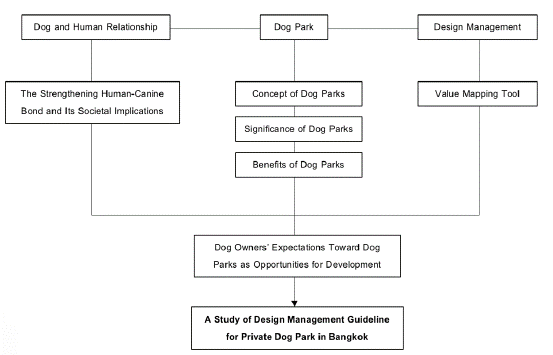
Urbanization intensifies in Bangkok; changes in social dynamics have led to a notable rise in pet ownership. Dogs, particularly, have become an integral part of urban life for many residents, serving not only as companions but also as sources of emotional and mental support. Despite this shift, there remains a considerable shortage of purpose-built dog-friendly environments, particularly in the form of well-managed, privately operated dog parks. These spaces are essential not only for dogs’ physical activities and behavioral development but also for enhancing social bonding between owners and their pets. However, limited insight into the design and management of such parks in Bangkok presents a major barrier to their effective implementation. As a result, the objective of this research was to study the values influencing the decision-making of dog owners in Bangkok, aiming to create effective and appropriate guidelines for the management, design, and physical utilization of dog parks under private sector management in the Bangkok area. A quantitative research method was employed, with data collected from 401 dog owners aged 18 years and above residing in the Bangkok metropolitan area. A research tool, a structured questionnaire, was designed based on the Value Mapping Tool, covering four domains: dog park space, dog behavior, relationship, and management and design. The responses were analyzed using Exploratory Factor Analysis (EFA), revealing four major domains of user expectations: physical space, behaviour, well-being, and design and management. The research resulted in the formulation of the term "PAWSCAPERS" guideline, a design and management framework named after ten thematic principles: Progress, Activity, Welfare, Sphere, Clean, Advisor, Play, Equipment, Relationship, and Scape. This study makes significant contributions to three sections: theoretical, practical, and stakeholder contributions. Theoretical contributions include the development of the PAWSCAPERS Guideline, a new framework for managing and designing dog parks under private sector management, with a focus on Bangkok’s context. It expands existing knowledge on pet-friendly urban spaces and explores the impact of structured dog park designs on canine well-being, social behavior, and owner satisfaction. Practically, the study provides actionable guidelines for dog park operators, urban planners, and private investors to create sustainable, high-quality dog parks. It also offers insights into dog owners’ needs and advocates for integrating dog-friendly spaces in urban planning. Implications for stakeholders include guidance for dog owners on park selection, improved design for private operators, and recommendations for urban planners and policymakers to develop pet-friendly spaces. Additionally, it provides veterinarians and experts with guidelines for advancing canine health and offers researchers a foundation for exploring the impact of dog parks on pet welfare and community engagement.
Downloads
Article Details

This work is licensed under a Creative Commons Attribution-NonCommercial-NoDerivatives 4.0 International License.
All material is licensed under the terms of the Creative Commons Attribution 4.0 International (CC-BY-NC-ND 4.0) License, unless otherwise stated. As such, authors are free to share, copy, and redistribute the material in any medium or format. The authors must give appropriate credit, provide a link to the license, and indicate if changes were made. The authors may do so in any reasonable manner, but not in any way that suggests the licensor endorses you or your use. The authors may not use the material for commercial purposes. If the authors remix, transform, or build upon the material, they may not distribute the modified material, unless permission is obtained from JARS. Final, accepted versions of the paper may be posted on third party repositories, provided appropriate acknowledgement to the original source is clearly noted.
References
Alger, J. M., & Alger, S. F. (1999). Cat culture, human culture: An ethnographic study of a cat shelter. Society & Animals, 7(3), 199–218. https://brill.com/view/journals/soan/7/3/article-p199_2.xml
Allen, L. (2007). Dog parks: Benefits and liabilities [Master’s thesis, University of Pennsylvania]. Scholarly Commons. https://repository.upenn.edu/handle/20.500.14332/40135
American Pet Products Association (APPA). (2007). Manufacturers & pet product brands industry trends and stat. http://www.americanpetproducts.org/press_industrytrends.asp
Arkow, P. (1998). Pet therapy: A study and resource guide for the use of companion animals in selected therapies (8th ed.). Stratford, NJ: Humane Society of the Pikes Peak Region.
Askew, H. R. (2003). Treatment of behavior problems in dogs and cats: A guide for the small animal veterinarian (2nd ed.). Wiley Blackwell.
Beck, A. M., & Katcher, A. H. (1996). Between pets and people: The importance of animal companionship. Purdue University Press.
Bennett, P. C., Cooper, N., Rohlf, V. I., & Mornement, K. (2007). Factors influencing owner satisfaction with companion-dog-training facilities. Journal of Applied Animal Welfare Science, 10(3), 217–241. https://doi.org/10.1080/10888700701353626
Berryman, J. C., Howells, K., & Lloyd-Evans, M. (1985). Pet owner attitudes to pets and people: A psychological study. Veterinary Record, 117(25–26), 659–661. https://pubmed.ncbi.nlm.nih.gov/4095881/
Bocken, N. M. P., Short, S. W., Rana, P., & Evans, S. (2013). A value mapping tool for sustainable business modelling. Corporate Governance: The International Journal of Business in Society, 13(5),482–497. https://doi.org/10.1108/CG-06-2013-0078
Brooks, D., Churchill, J., Fein, K., Linder, D., Michel, K. E., Tudor, K., Ward, E., & Witzel, A. (2014). 2014 AAHA weight management guidelines for dogs and cats. Journal of the American Animal Hospital Association, 50(1), 1–11. https://doi.org/10.5326/jaaha-ms-6331
Brown, L. M. (2012). Landscape barkitecture: Guidelines for behaviorally, mentally and physically responsive dog parks [Master’s thesis, Ball State University]. http://cardinalscholar.bsu.edu/handle/20.500.14291/195965
Chen, S., Wu, Z., Sleipness, O. R., & Wang, H. (2022). Benefits and conflicts: A systematic review of dog park design and management strategies. Animals, 12(17), 2251. https://doi.org/10.3390/ani12172251
Crawford, E. K., Worsham, N. L., & Swinehart, E. R. (2006). Benefits derived from companion animals, and the use of the term “attachment”. Anthrozoös, 19(2), 98–112. https://doi.org/10.2752/089279306785593757
Dotson, M. J., & Hyatt, E. M. (2008). Understanding dog–human companionship. Journal of Business Research, 61(5), 457–466. https://doi.org/10.1016/j.jbusres.2007.07.019
Doyle, D. (2006). Canine design: A design approach for creating the modern dog park [Master’s thesis, Auburn University]. http://hdl.handle.net/10415/387
Fairfax County Park Authority. (2021). Planning and improvements: Dog park study. https://www.fairfaxcounty.gov/parks/planningdevelopment/dog-park-study
Gómez, E., Baur, J. W. R., & Malega, R. (2018). Dog park users: An examination of perceived social capital and perceived neighborhood social cohesion. Journal of Urban Affairs, 40(3), 349–369. https://doi.org/10.1080/07352166.2017.134363
Graham, T. M., & Glover, T. D. (2014). On the fence: Dog parks in the (un)leashing of community and social capital. Leisure Sciences, 36(3), 217–234. https://doi.org/10.1080/01490400.2014.888020
GfK Custom Research North America. (2008). AP-Petside poll: Most owners say they can talk to pets. GfK Roper Public Affairs & Media. http://www.petside.com/article/ap-petside-poll-mostowners-say-they can-talk-pets
Harnik, P., & Bridges, C. (2005, January 1). Creating dog parks—without rancor. The Trust for Public Land. http://cloud.tpl.org/pubs/ccpe_Dog_Park_Report.pdf
Hennessy, M. B., Williams, M. T., Miller, D. D., Douglas, C. W., & Voith, V. L. (1998). Influence of male and female petters on plasma cortisol and behaviour: Can human interaction reduce the stress of dogs in a public animal shelter?. Applied Animal Behaviour Science, 61(1), 63–77. https://doi.org/10.1016/s0168-1591(98)00179-8
Holderness-Roddam, B. (2020). Dog park design, planning and management. Australian Planner, 56(1), 48–57. https://doi.org/10.1080/07293682.2020.1739092
Howell, T., King, T., & Bennett, P. (2015). Puppy parties and beyond: The role of early age socialization practices on adult dog behavior.Veterinary Medicine: Research and Reports, 6, 143–153. https://doi.org/10.2147/vmrr.s62081
Irvine, L. (2004). If you tame me: Understanding our connection with animals. Temple University Press.
Jackson, P. (2012). Situated activities in a dog park: Identity and conflict in human-animal space. Society & Animals, 20(3), 254–272. https://doi.org/10.1163/15685306-12341237
Juthathamporn, C. (2014). Guidelines of condominium development for dogs’ owner [Master’s thesis, Thammasat University]. https://digital.library.tu.ac.th/tu_dc/frontend/Info/item/dc:140539
Kellert, S. R. (2018). Nature by design: The practice of biophilic design. Yale University Press.
Kresnye, K. C., Theisz, A. A., Trester, L., & Shih, P. C. (2019). Barks & rec: A Dog park socio-technical system. In ACI’19 proceedings of the sixth international conference on animal-computer interaction (p. 1-6). Association for Computing Machinery. https://doi.org/10.1145/3371049.3371064
Krohe, J. (2005). Who let the dogs out?. Journal of the American Planning Association, 71(2), 24–27.
Kongwiroj, S. (2021). Dog parks that satisfy public park users: Case study of Bang Khae Phirom Park. Sarasatr: Journal of Architecture and Design, 4(1), 165-180. https://so05.tci-thaijo.org/index.php/sarasatr/article/view/24687
Lee, H.-S., Shepley, M., & Huang, C.-S. (2009). Evaluation of off-leash dog parks in Texas and Florida: A study of use patterns, user satisfaction, and perception. Landscape and Urban Planning, 92(3–4), 314–324. https://doi.org/10.1016/j.landurbplan.2009.05.015
Likert, R. (1932). A technique for the measurement of attitudes. The Science Press and Columbia University. https://legacy.voteview.com/pdf/Likert_1932.pdf
Marinelli, L., Adamelli, S., Normando, S., & Bono, G. (2007). Quality of life of the pet dog: Influence of owner and dog’s characteristics. Applied Animal Behaviour Science, 108(1–2), 143–156. https://doi.org/10.1016/j.applanim.2006.11.018
Matisoff, D., & Noonan, D. (2012). Managing contested greenspace: Neighborhood commons and the rise of dog parks. International Journal of the Commons, 6(1), 28–51. https://doi.org/10.18352/ijc.299
McCormack, G. R., Rock, M., Sandalack, B., & Uribe, F. A. (2011). Access to off-leash parks, street pattern and dog walking among adults. Public Health, 125(8), 540–546. https://doi.org/10.1016/j.puhe.2011.04.008
Melnick, J. H. (2013). Dog park design: A successful Southwest dog park [Master’s thesis, University of Arizona]. https://repository.arizona.edu/handle/10150/291179
Melson, G. F. (1988). Availability of and involvement with pets by children: Determinants and correlates. Anthrozoös, 2(1), 45–52. https://doi.org/10.2752/089279389787058181
Messent, P. (1983). Social facilitation of contact with other people by pet dogs. In A. H. Katcher & A. M. Beck (Eds.), New perspectives on our lives with companion animals (pp. 37–460). University of Pennsylvania Press
Middle, I. (2020). Between a dog and a green space: Applying ecosystem services theory to explore the human benefits of off-the leash dog parks. Landscape Research, 45(1), 81–94. https://doi.org/10.1080/01426397.2019.1580353
National Geographic Thailand. (2017, October 25). Thammai sunak bāng tūa thưng kāo rāo čhang [Why are some dogs more aggressive]. https://ngthai.com/animals/5301/why-are-some-dogs-more-aggressive/
Nitzschner, M., Melis, A. P., Kaminski, J., & Tomasello, M. (2012). Dogs(Canis familiaris) evaluate humans on the basis of direct experiences only. PLoS ONE, 7(10), e46880.https://doi.org/10.1371/journal.pone.0046880
Niyomthai, A. (2019). Māttrakān nai kān pō̜ʻong kan kān thārunnakam sat tām kotmāi Thai [Measures for preventing animal cruelty under Thai law]. Julaniti Journal, 16(1), 161-170.https://senate.go.th/assets/portals/93/fileups/272/files/S%E0%B9%88ub_Jun/11all/all49.pdf
Odendaal, J. S. J. (1997). A diagnostic classification of problem behavior in dogs and cats. Veterinary Clinics of North America: Small Animal Practice, 27(3), 427–443. https://doi.org/10.1016/s0195-5616(97)50047-7
Rahim, T., Barrios, P. R., McKee, G., McLaws, M., & Kosatsky, T. (2017). Public health considerations associated with the location and operation of off-leash dog parks. Journal of Community Health, 43(2), 433–440.https://doi.org/10.1007/s10900-017-0428-2
Richards, D. (2008). Fighting for a dog park. In I. E. Newkirk & J. Ratcliffe (Eds.), One can make a difference: how simple actions can change the world (pp. 187–190). Adams Media.
Robinson, I. (Ed.). (2014). The Waltham book of human-animal interaction: Benefits and responsibilities of pet ownership. Amsterdam: Elsevier Science.
Serpell, J. A. (1996). In the company of animals: A study of human animal relationships. Cambridge University Press.
Staats, S., Wallace, H., & Anderson, T. (2008). Reasons for companion animal guardianship (pet ownership) from two populations. Society &Animals, 16(3), 279–291.https://www.animalsandsociety.org/wp-content/uploads/2016/04/staats.pd
Stevens, J. P. (1992). Applied multivariate statistics for the social sciences (2nd ed.). Erlbaum.
Stewart, M. (1983). Loss of a pet—loss of a person: A comparative study of bereavement. In A. H. Katcher & A. M. Beck (Eds.), New perspectives on our lives with companion animals (pp. 390–404). University of Pennsylvania Press.
Sutthigavilgul, P. (2012). The study of Chatuchak park user’s attitude on the preparation of a dog exercice area [Master’s thesis, Silpakorn University]. Silpakorn University Central Library.https://sure.su.ac.th/xmlui/handle/123456789/1278
Szasz, K. (1969). Petishism: Pets and their people in the western world. Holt, Rinehart and Winston.
Sutthigavilgul, P. (2012). The study of Chatuchak park user’s attitude on the preparation of a dog exercice area [Master’s thesis, Silpakorn University]. Silpakorn University Central Library. https://sure.su.ac.th/xmlui/handle/123456789/12788
Terrain Group Open Space Solution. (2019, July 15). Urban planner Fiona De Rosa on designing dog parks. https://terraingroup.com.au/terrain-group/urban-planner-fiona-de-rosa-on-designing-dog-park
Trisko, R. K., & Smuts, B. B. (2015). Dominance relationships in a group of domestic dogs (Canis lupus familiaris). Behaviour, 152(5), 677–704. http://www.jstor.org/stable/24526273
Urbanik, J., & Morgan, M. (2013). A tale of tails: The place of dog parks in the urban imaginary. Geoforum, 44, 292–302.https://doi.org/10.1016/j.geoforum.2012.08.001
Veitch, J., Christian, H., Carver, A., & Salmon, J. (2019). Physical activity benefits from taking your dog to the park. Landscape and Urban Planning, 185, 173–179.https://doi.org/10.1016/j.landurbplan.2019.02.013
Voith, V. L. (1985). Attachment of people to companion animals. Veterinary Clinics of North America: Small Animal Practice, 15(2), 289–295. https://doi.org/10.1016/s0195-5616(85)50301-0
Walls, M. (2009). Parks and recreation in the United States: Local park systems. Resources for the Future.https://media.rff.org/documents/RFF-BCK-ORRG_Local20Parks.pdf
Walsh, C. J., Howse, M., Green, C., Butler, L., & Anderson, R. E. (2011). “Stop that!”: People interrupting dog behaviors in a dog park setting. Journal of Veterinary Behavior, 6(1), 77.https://doi.org/10.1016/j.jveb.2010.09.015
Westgarth, C., Christley, R. M., & Christian, H. E. (2014). How might we increase physical activity through dog walking?: A comprehensive review of dog walking correlates. International Journal of Behavioral Nutrition and Physical Activity, 11(83), 1-14.https://doi.org/10.1186/1479-5868-11-83
Weston, M. A., Fitzsimons, J. A., Wescott, G., Miller, K. K., Ekanayake, K. B., & Schneider, T. (2014). Bark in the park: A review of domestic dogs in parks. Environmental Management, 54(3), 373–382.https://doi.org/10.1007/s00267-014-0311-1
Wolch, J. R., & Rowe, S. (1992). Companions in the park: Laurel canyon dog park. Landscape, 31(3), 16–23.
