
An Analysis for the establishment of a public transportation system for all in Thailand: A case study of Trang Municipality, Trang Province
Article Sidebar
Main Article Content
Abstract
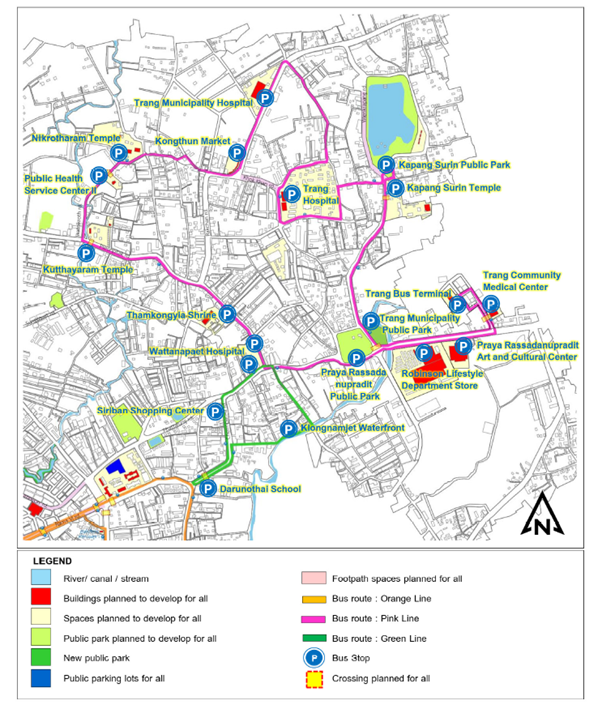
The establishment of a public transportation system for all is a pertinent issue in Thailand due to the significant increase in the elderly and disabled population over the past decade. The establishment of an inclusive public transportation system is a crucial aspect of creating an urban environment that accommodates the elderly. Systematic data analysis is essential to adequately address the requirements of all user groups. Our research aims to examine the possibilities, challenges, and requirements of users to inform the design of public transportation services for all in Trang Municipality, employing the principle of universal design throughout the process. The research instruments employed include evaluation of satisfaction with public transportation services based on the World Health Organization’s criteria for age-friendly urban environments, a survey assessing the travel requirements of the Trang Municipality residents, and in-depth interviews in January, 2025 with stakeholders engaged in the development of public transportation systems within the study area. The research findings indicated that the majority of the older sample group utilized private vehicles due to the absence of public transit infrastructure in the municipality capable of accommodating the elderly and disabled. The survey identified 93 public buildings and spaces frequently utilized by the elderly in Trang Municipality and its vicinity, the majority of which were in the commercial center, administrative center, Wat Kuttaram region, and Trang Hospital area. These frequently visited hubs could be serviced efficiently by establishing a new public bus system. The examination of satisfaction with amenities and public transportation systems in Trang City revealed a significantly low level of satisfaction, mostly due to the high costs of public transportation and its inadequate support for the elderly and disabled. The research findings culminated in the formulation of a comprehensive master plan for a public transportation system for all, encompassing three public bus route designs, 11 projects for the enhancement of sidewalks, intersections, and junctions to facilitate accessibility for the elderly and disabled, the establishment of 38 public bus stops, and strategic management recommendations aimed at ensuring the sustainable development of a public transportation system for all within Trang Municipality.
Downloads
Article Details

This work is licensed under a Creative Commons Attribution-NonCommercial-NoDerivatives 4.0 International License.
All material is licensed under the terms of the Creative Commons Attribution 4.0 International (CC-BY-NC-ND 4.0) License, unless otherwise stated. As such, authors are free to share, copy, and redistribute the material in any medium or format. The authors must give appropriate credit, provide a link to the license, and indicate if changes were made. The authors may do so in any reasonable manner, but not in any way that suggests the licensor endorses you or your use. The authors may not use the material for commercial purposes. If the authors remix, transform, or build upon the material, they may not distribute the modified material, unless permission is obtained from JARS. Final, accepted versions of the paper may be posted on third party repositories, provided appropriate acknowledgement to the original source is clearly noted.
References
Ahern, A., & Hine, J. (2010, August 31–September 1). Transport needs of older people in rural Ireland [Conference presentation]. Irish Transport Research Network, Dublin, Ireland.
Anthony, B., Jr., Abbas Petersen, S., Helfert, M., Ahlers, D., & Krogstie, J. (2021). Modeling pervasive platforms and digital services for smart urban transformation using an enterprise architecture framework. Information Technology & People, 34(4), 1285-1312. DOI: https://doi.org/10.1108/ITP-07-2020-0511
Anthony, B., Jr. (2020). Applying enterprise architecture for digital transformation of electro mobility towards sustainable transportation. In Proceedings of the 2020 Computers and People Research Conference (pp. 38-46). Association for Computing Machinery. DOI: https://doi.org/10.1145/3378539.3393858
Böcker, L., van Amen, P., & Helbich, M. (2017). Elderly travel frequencies and transport mode choices in Greater Rotterdam, the Netherlands. Transportation, 44, 831–852. DOI: https://doi.org/10.1007/s11116-016-9680-z
Fatima, K., Moridpour, S., De Gruyter, C., & Saghapour, T. (2020). Elderly sustainable mobility: Scientific paper review. Sustainability, 12, 7319. DOI: https://doi.org/10.3390/su12187319
Goh, M. M., Irvine, K., & Ung, M. I. (2022). To bus or not to bus: Structural equation modelling of ridership perceptions among university students as a planning tool to increase use of public transit in Phnom Penh, Cambodia. Journal of Architectural/Planning Research and Studies (JARS), 19(2), 105-124. DOI: https://doi.org/10.56261/jars.v19i2.245681
Gorman, M., Jones, S., & Turner, J. (2019). Older people, mobility and transport in low-and middle-income countries: A review of the research. Sustainability, 11, 6157. DOI: https://doi.org/10.3390/su11216157
Guzman, L. A., & Hessel, P. (2022). The effects of public transport subsidies for lower-income users on public transport use: A quasi-experimental study. Transport Policy, 126, 215-224. DOI: https://doi.org/10.1016/j.tranpol.2022.07.016
Hjorthol, R., Nordbakke, S., Vågane, L., Levin, L., Sirén, A., & Ulleberg, P. (2011). Eldres Mobilitet og Velferd: Utvikling, Reisebehov og Tiltak [Mobility and welfare of the older people – development, travel needs and policy formation]. https://www.toi.no/getfile.php?mmfileid=22881
Lawhon, L.L. (2014). Neighborhood unit. In A. C. Michalos (Ed.), Encyclopedia of quality of life and well-being research. Springer. https://doi.org/10.1007/978-94-007-0753-5_3335 DOI: https://doi.org/10.1007/978-94-007-0753-5_3335
Leopairojna, S. K. (2011). Improving access to public transportation for canalside communities near Kasetsart University, Bangkhen. Journal of Architectural/Planning Research and Studies (JARS), 8(2), 27-50.
Metz, D.H. (2000). Mobility of older people and their quality of life. Transport Policy, 7, 149–152. DOI: https://doi.org/10.1016/S0967-070X(00)00004-4
Marling, G. (2012). Urban songlines: the City experienced by ordinary people. In V. Andrade, D. Bendix Lanng, & S. Smith (Eds.), Musings: An urban design anthology (pp. 142-153). Aalborg Universitetsforlag.
Oxley, J., Langford, J., & Charlton, J. (2010) The safe mobility of older drivers: A challenge for urban road designers. Journal of Transport Geography, 18, 642-648. DOI: https://doi.org/10.1016/j.jtrangeo.2010.04.005
Rantanen, T. (2013). Promoting mobility in older people. Journal of Preventive Medicine and Public Health, 46, S50. DOI: https://doi.org/10.3961/jpmph.2013.46.S.S50
Santinha, G., Costa, C., & Diogo, S. (2018) How are local policies promoting older people’s mobility? A case study. Urban Science, 2, 63. DOI: https://doi.org/10.3390/urbansci2030063
Somenahalli, S., Hayashi, Y., Taylor, M., Akiyama, T., Adair, T., & Sawada, D. (2016). Accessible transportation and mobility issues of elderly—How does Australia compare with Japan? Journal of Sustainable Urbanization, Planning and Progress, 1, 31–43. DOI: https://doi.org/10.18063/JSUPP.2016.01.001
Trang Provincial Social Development and Human Security Office. (2024). Report on social situation of Trang Province 2024. https://www.dcy.go.th/public/subwebsite/province/trangshelter/file_download/1722310963001-766431871.pdf.
The Bureau of Registration Administration, Department of Provincial Administration. (2024). Monthly population registration statistics. https://stat.bora.dopa.go.th/stat/statnew/statMONTH/statmonth/#/mainpage
Velho, R. (2019). Transport accessibility for wheelchair users: A qualitative analysis of inclusion and health. International Journal of Transportation Science and Technology, 8, 103–115. DOI: https://doi.org/10.1016/j.ijtst.2018.04.005
World Health Organization. (2007). Global age-friendly cities: A guide. https://apps.who.int/iris/handle/10665/43755
World Health Organization. (2017). Global strategy and action plan on aging and health
World Health Organization. (2019). Age-Friendly cities and communities. https://www.paho.org/en/topics/age-friendly-cities-and-communities.
Yamane, T. (1973). Statistics: An introductory analysis. Harper & Row.
