
Mathematical Coding as an Application of Graph Theory: A Sustainable Approach to Urban Structure Analysis
Article Sidebar
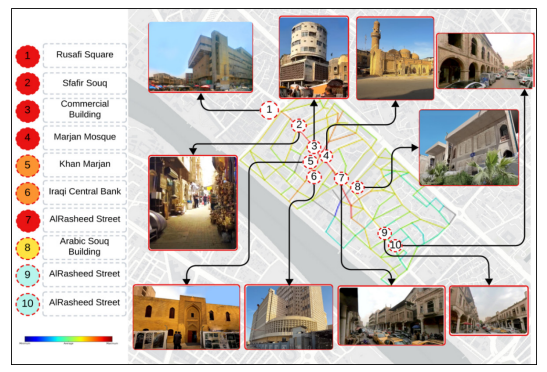
Main Article Content
Abstract
This study investigates the application of graph theory through mathematical coding in structuring and developing pedestrian pathways within the complex morphology of traditional Arabic souqs (historic marketplaces). By employing Eulerian paths, space syntax analysis, and circulation assessments, we demonstrate how urban walkability can be enhanced through systematic network transformations. The research conceptualizes path labeling as a coding sequence, demonstrating how mathematical structures can reconstruct pedestrian networks to minimize discontinuity and maximize accessibility. Focusing on the historic Arabic souq in Baghdad, this study examines an urban pedestrian network shaped by organic alleyways, which have been disrupted by modern vehicular interventions. We assess how traditional pedestrian routes have been reconfigured, resulting in a reduction of their spatial integration. Through the graph theory-based transformation, we resolve odd-degree nodes, ensuring that pedestrian paths form Eulerian circuits with continuous, uninterrupted movement sequences. Applying space syntax, we measure the changes in spatial configuration, revealing a recalibrated urban fabric with improved mobility and socio-spatial cohesion. Findings showed that leveraging graph-theoretic principles in urban design fosters sustainable pedestrian environments, reinstating historic circulation patterns and enhancing integration values. The results demonstrate a tangible improvement in spatial intelligibility and accessibility by ensuring seamless pedestrian flow. Unlike conventional vehicle-centric planning, which often disrupts the historical spatial syntax, this approach offers an algorithmic strategy that balances heritage conservation with contemporary urban demands. By fostering urban walkability as a computational problem, this study underscores the transformative role of mathematical coding in urban planning. The research encourages the integration of graph theory into spatial design, proposing a novel methodology for reconciling modern mobility needs with the intrinsic logic of historic pedestrian networks.
Downloads
Article Details

This work is licensed under a Creative Commons Attribution-NonCommercial-NoDerivatives 4.0 International License.
All material is licensed under the terms of the Creative Commons Attribution 4.0 International (CC-BY-NC-ND 4.0) License, unless otherwise stated. As such, authors are free to share, copy, and redistribute the material in any medium or format. The authors must give appropriate credit, provide a link to the license, and indicate if changes were made. The authors may do so in any reasonable manner, but not in any way that suggests the licensor endorses you or your use. The authors may not use the material for commercial purposes. If the authors remix, transform, or build upon the material, they may not distribute the modified material, unless permission is obtained from JARS. Final, accepted versions of the paper may be posted on third party repositories, provided appropriate acknowledgement to the original source is clearly noted.
References
Ain, Q. T., He, J.-H., Qiang, X.-L., & Kou, Z. (2024). The two-scale fractal dimension: A unifying perspective to metabolic law. Fractals, 32(1), 2450016. https://doi.org/10.1142/S0218348X24500166
Al Ani, M. Q. A. G. (2014). Place identity in defining urban space of border rivers in historical city centres. Journal of Engineering, 20(2), 150–168. https://doi.org/10.31026/j.eng.2014.02.10
Albazzaz, I., & Hussien, H. D. (2017). The effect of advertising signs on the urban scene of cities centers (Al Bab Al Sharqi–Al Tahrir Square) case study. Journal of Engineering, 23(12), 1–25. https://doi.org/10.31026/j.eng.2017.12.01
Alessandretti, L., Natera Orozco, L. G., Saberi, M., Szell, M., & Battiston, F. (2023). Multimodal urban mobility and multilayer transport networks. Environment and Planning B: Urban Analytics and City Science, 50(8), 2038–2070. https://doi.org/10.1177/23998083221108190
Alkaissi, Z. A. (2022). Traffic simulation of urban street to estimate capacity. Journal of Engineering, 28(4), 51–63. https://doi.org/10.31026/j.eng.2022.04.04
Almasan, P., Suárez-Varela, J., Rusek, K., Barlet-Ros, P., & Cabellos-Aparicio, A. (2022). Deep reinforcement learning meets graph neural networks: Exploring a routing optimization use case. Computer Communications, 196, 184–194.
Al-Saffar, M. (2020). Baghdad: The city of cultural heritage and monumental Islamic architecture. Disegnarecon, 13(25), Article 14-1.
Al-Saffar, M. H. M., & Al-Siliq, G. M. R. (2014). The sustainable urban development in Al_Kharkh historic center. Journal of Engineering, 20(11), 1–28. https://doi.org/10.31026/j.eng.2014.11.01
Alsalig, G. M. R., & Alshami, H. A. A. (2015). Rehabilitation of monumental, historical, and traditional buildings (Pilot project strategy in historical and traditional buildings rehabilitation). Journal of Engineering, 21(3), 1–23. https://doi.org/10.31026/j.eng.2015.03.10
Al Siliq, G. M. (2008). Baghdad. Images and memories. DC PAPERS, Revista de crítica y teoría de la arquitectura, (1), 49–72.
Altunina, Y., & Boikova, G. (2023). Pedestrian flows analysis to create a sustainable development concept for a metropolitan area. E3S Web of Conferences, 403, Article 07016. EDP Sciences. https://doi.org/10.1051/e3sconf/202340307016
Amaya, J., & Holweg, M. (2024). Using algorithms to improve knowledge work. Journal of Operations Management, 70(3), 482–513. https://doi.org/10.1002/joom.1296
Anciaes, P., & Jones, P. (2022). Pedestrian priority in street design—how can it improve sustainable mobility? Transportation Research Procedia, 60, 220–227. https://doi.org/10.1016/j.trpro.2022.02.029
Asriana, N., Khidmat, R. P., Ujung, V. A., Satria, W. D., Hartono, T., Nugraha, M. D., Santo, A. A., Putra, M. I. E., Lubis, T., & Brilianto, M. Y. (2024). Connectedness and integration analysis in Kampung settlement: Using space syntax as spatial reconfiguration model. IOP Conference Series: Earth and Environmental Science, 1361, Article 012023.
Bahmanian, A., & Shan, S. (2024). Spanning Euler tours in hypergraphs. arXiv. https://arxiv.org/abs/2403.12713
Barron, E. N. (2024). Game theory: An introduction. John Wiley & Sons.
Benedikt, M. (1979). To take hold of space: Isovist and isovist fields. Environment and Planning B: Planning and Design, 6(1), 47–65. https://doi.org/10.1068/b060047
Bianca, S. (2000). Urban form in the Arab world: Past and present (Vol. 46). vdf Hochschulverlag AG.
Biggs, N., Lloyd, E. K., & Wilson, R. J. (1986). Graph theory, 1736–1936. Clarendon Press.
Blanchard, P., & Volchenkov, D. (2008). Mathematical analysis of urban spatial networks. Springer.
Boeing, G. (2022). Street network models and indicators for every urban area in the world. Geographical Analysis, 54(3), 519–535. https://doi.org/10.1111/gean.12281
Bolea, S. C., Pirnau, M., Bejinariu, S.-I., Apopei, V., Gifu, D., & Teodorescu, H.-N. (2024). Some properties of Zipf’s law and applications. Axioms, 13(3), Article 146. https://doi.org/10.3390/axioms13030146
Caprotti, F., Cowley, R., Datta, A., Broto, V. C., Gao, E., Georgeson, L., Herrick, C., Odendaal, N., & Joss, S. (2017). The new urban agenda: Key opportunities and challenges for policy and practice. Urban Research & Practice, 10(3), 367–378. https://doi.org/10.1080/17535069.2017.1293489
Carbonaro, B., & Menale, M. (2024). Markov chains and kinetic theory: A possible application to socio-economic problems. Mathematics, 12(10), Article 1571. https://doi.org/10.3390/math12101571
Chernov, N., & Markarian, R. (2023). Chaotic billiards (2nd ed., Mathematical Surveys and Monographs, Vol. 127). American Mathematical Society. (Original work published 2006).
Dawes, M., & Ostwald, M. J. (2013). Precise locations in space: An alternative approach to space syntax analysis using intersection points. Architecture Research, 3(1), 1–11. https://doi.org/10.5923/j.arch.20130301.01
Dawes, M. J., & Ostwald, M. J. (2020). The mathematical structure of Alexander’s A Pattern Language: An analysis of the role of invariant patterns. Environment and Planning B: Urban Analytics and City Science, 47(1), 7–24. https://doi.org/10.1177/2399808318761396
Dursun, P. (2007). Space syntax in architectural design. In 6th International Space Syntax Symposium (pp. 01–56). ITU Faculty of Architecture.
Eboli, L., Forciniti, C., Mazzulla, G., & Bellizzi, M. G. (2023). Establishing performance criteria for evaluating pedestrian environments. Sustainability, 15(4), Article 3523. https://doi.org/10.3390/su15043523
Echarri, V., & Brebbia, C. A. (Eds.). (2018). Heritage architecture studies. WIT Press.
Freire de Almeida, H., Lopes, R. J., Carrilho, J. M., & Eloy, S. (2021). Unfolding the dynamical structure of Lisbon’s public space: Space syntax and micromobility data. Applied Network Science, 6, Article 49. https://doi.org/10.1007/s41109-021-00387-2
Gajjar, K., Jha, A. V., Kumar, M., & Lahiri, A. (2024). Reconfiguring shortest paths in graphs. Algorithmica, 86(10), 3309–3338. https://doi.org/10.1007/s00453-024-01263-y
Griffiths, I. (2024). Programming C# 12: Build cloud, web, and desktop applications. O’Reilly Media.
Griffiths, S. (2012). The use of space syntax in historical research: Current practice and future possibilities. In M. Greene, J. Reyes, & A. Castro (Eds.), Proceedings of the Eighth International Space Syntax Symposium (pp. 8193:1–8193:26). PUC, Santiago, Chile.
Hammack, R. H., & Kainen, P. C. (2024). Eulerian 2-complexes. Mathematics Magazine, 97(1), 23–35.
Han, J.-X., Bai, Z., & Wang, R.-W. (2024). Unraveling power-law scaling through exponential cell division dynamics. BioSystems, 238, Article 105190. https://doi.org/10.1016/j.biosystems.2024.105190
Hidayati, I., Yamu, C., & Tan, W. (2021). You have to drive: Impacts of planning policies on urban form and mobility behavior in Kuala Lumpur, Malaysia. Journal of Urban Management, 10(1), 69–83. https://doi.org/10.1016/j.jum.2021.03.002
Hillier, B. (1985). The social logic of space. Cambridge University Press.
Hillier, B., Leaman, A., Stansall, P., & Bedford, M. (1976). Space syntax. Environment and Planning B: Planning and Design, 3(2), 147–185.
Hillier, B., & Julienne, H. (2014). The social logic of space. Cambridge University Press.
Jusriadi, J., Abusini, S., & Krisnawati, V. H. (2024). Analysis of city transportation routes with Fleury algorithm on bus route network: Case study of Trans Mamminasata Makassar City Indonesia. Asian Research Journal of Mathematics, 20(2), 27–36.
Khalid, Z., & Abaas, Z. R. (2021). Defining the aspects of the local urban sustainability: Eco-cities as a model. IOP Conference Series: Earth and Environmental Science, 690, Article 012005. https://doi.org/10.1088/1755-1315/690/1/012005
Khan, A. H. (2024). The impact of sequencing human genome on genetic determinism: Is our behavior controlled by our genes? Clinical Reviews and Case Reports, 3(5).
Kirtikar, M. (2011). Once upon a time in Baghdad: The two golden decades the 1940s and 1950s. Xlibris Corporation.
Kitchin, R., & Perng, S. Y. (Eds.). (2016). Code and the city. Routledge.
Major, M. D., & Tannous, H. O. (2020). Form and function in two traditional markets of the Middle East: Souq Mutrah and Souq Waqif. Sustainability, 12(17), Article 7154. https://doi.org/10.3390/su12177154
McIntosh, S., Kamei, Y., Adams, B., & Hassan, A. E. (2014). The impact of code review coverage and code review participation on software quality: A case study of the Qt, VTK, and ITK projects. In Proceedings of the 11th Working Conference on Mining Software Repositories (pp. 192–201). ACM.
Meckin, R. (2024). Self-similarity and synthetic biology: A possible fractal anticipation. Journal of Responsible Innovation, 11(1), Article 2345457. https://doi.org/10.1080/23299460.2024.2345457
Nazar, M., Azeem, M., & Jamil, M. K. (2024). Localisation of honeycomb rectangular torus. Molecular Physics, 122(4), Article e2252530. https://doi.org/10.1080/00268976.2023.2252530
O’Regan, G. (2020). Mathematics in computing: An accessible guide to historical, foundational, and application contexts. Springer.
Ostwald, M. J., & Dawes, M. J. (2018). The mathematics of the modernist villa: Architectural analysis using space syntax and isovists. Springer.
Penn, A. (2003). Space syntax and spatial cognition: Or why the axial line? Environment and Behavior, 35(1), 30–65.
Peponis, J., & Wineman, J. (2002). Spatial structure of environment and behavior. In R. B. Bechtel & A. Churchman (Eds.), Handbook of environmental psychology (pp. 271–291). John Wiley & Sons.
Qais, S., & Al Ani, M. Q. A. G. (2022). The rules of generative code module to achieve new approach of urban development. International Journal of Mechanical Engineering, 7(1), 341–351.
Reba, M. A., & Shier, D. R. (2014). Puzzles, paradoxes, and problem solving: An introduction to mathematical thinking. CRC Press.
Rozhkov, A. (2024). Applying graph theory to find key leverage points in the transition toward urban renewable energy systems. Applied Energy, 361, Article 122854. https://doi.org/10.1016/j.apenergy.2023.122854
Sandifer, C. E. (2007). The early mathematics of Leonhard Euler (Vol. 1). Mathematical Association of America.
Sari, D. P., Kurniadi, F., Wibowo, T., & Bayu, C. (2024). Study of space configuration in the Directorate Building of Politeknik Negeri Pontianak using the space syntax analysis approach. IOP Conference Series: Earth and Environmental Science, 1418, Article 012008. IOP Publishing.
Said, B., Lathamaheswari, M., Singh, P. K., Ouallane, A. A., Bakhouyi, A., Bakali, A., Talea, M., Dhital, A., & Deivanayagampillai, N. (2022). An intelligent traffic control system using neutrosophic sets, rough sets, graph theory, fuzzy sets and its extended approach: A literature review. Neutrosophic Sets and Systems, 50(1), 2. https://doi.org/10.5281/zenodo.6774620
Silberger, D. (2024). Eulerian directed multigraphs. arXiv. https://arxiv.org/abs/2408.12699
Sivanesan, G., Selvaraj, C., & Tamizh Chelvam, T. (2024). Eulerian character degree graphs of solvable groups. AKCE International Journal of Graphs and Combinatorics, 21(2), 161–166. https://doi.org/10.1080/09728600.2024.2309620
Taylor, P. J. (2004). World city network: A global urban analysis. Routledge.
van Nes, A., & Yamu, C. (2021). Introduction to space syntax in urban studies. Springer. https://doi.org/10.1007/978-3-030-59140-3
Yang, T., Wu, H., Yi, B., Feng, G., & Zhang, X. (2023). Semantic-preserving linguistic steganography by pivot translation and semantic-aware bins coding. IEEE Transactions on Dependable and Secure Computing, 21(1), 139–152. https://doi.org/10.1109/TDSC.2023.3247493
Yönder, V. M., Dogan, F., Cavka, H. B., Tayfur, G., & Dulgeroglu, O. (2023). Decoding and predicting the attributes of urban public spaces with soft computing models and space syntax approaches. Proceedings of eCAADe 2023, 1.
Yousif, Y. A., & Abdulwahab, K. (2024). Urban rivers: Catalysts for sustainable cityscapes. Academia Open, 9(1). https://doi.org/10.21070/acopen.9.2024.8850
