
Characteristics of Ceramic Tiling Facade in the Metropolitan Condominium: Evidence from Japan and Thailand
Article Sidebar
Main Article Content
Abstract
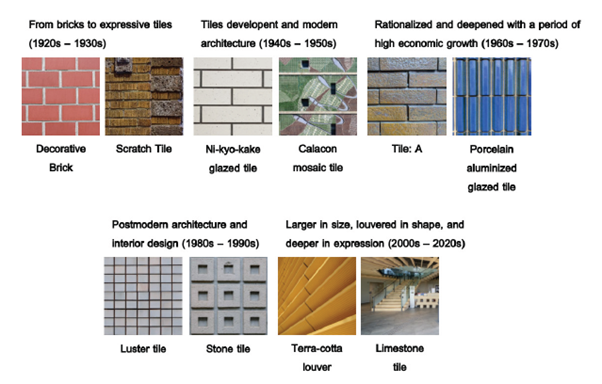
This research aims to: (1) clarify the actual state of acceptance of international architectural design styles and factors influencing acceptance in Japan and Thailand; and (2) examine the changes in architectural styles and characteristics of the metropolitan condominium façade in Japan and Thailand during the 1960s - 2010s. The research methods included a literature review, survey observation, photography, and interview, which focused on 524 samples of low-rise, high-rise, and skyscraper condominiums in two metropolises: Tokyo and Bangkok. The results show the trend of changes in characteristics of the condominium façade. The first period of investigation was the 1960s – 1970s, covering the shift from spray-painting to tiling façade. There were spray painting condominiums before the 1960s, followed by tiling façades, which started to become popular in the 1970s. During the 1980s – 1990s the popularity of tiling façades increased, as condominium façades mostly were fully tiled in Japan. These ceramic tiles became an export product to Southeast Asia, including Thailand. Later, in the 21st century, after some accidents, frequent speculations, and higher cost of maintenance, ceramic tiling façade’s popularity started to decline in Japan but still dominated more than half of the housing market. Thus, by the 2000s – 2010s, glass, glazed, and glamorous was the crucial point of the fate of ceramic tiling façade. In Thailand, tile managed to slightly bounce back in the Futuristic style condominium in the late 2010s, even though glass and metal started to dominate the skyline of Bangkok. Overall, the condominium façades in Tokyo reflected the characteristics of Japan as the ‘Galapagos Effect’, which gradually accepted the new cultural elements. In Bangkok, condominiums reflected Thailand’s globalization-driven adaptation through several significant differences in the architectural style and characteristics in the area. Thus, the condominium façade played a crucial role in shaping the city skyline of Tokyo and Bangkok, contributing to the visual identity, character, and liveability of these cities.
Downloads
Article Details

This work is licensed under a Creative Commons Attribution-NonCommercial-NoDerivatives 4.0 International License.
All material is licensed under the terms of the Creative Commons Attribution 4.0 International (CC-BY-NC-ND 4.0) License, unless otherwise stated. As such, authors are free to share, copy, and redistribute the material in any medium or format. The authors must give appropriate credit, provide a link to the license, and indicate if changes were made. The authors may do so in any reasonable manner, but not in any way that suggests the licensor endorses you or your use. The authors may not use the material for commercial purposes. If the authors remix, transform, or build upon the material, they may not distribute the modified material, unless permission is obtained from JARS. Final, accepted versions of the paper may be posted on third party repositories, provided appropriate acknowledgement to the original source is clearly noted.
References
Albertsen, N. (1999). Urbane atmosfærer [Urban atmospheres]. Sosiologi i dag, 29, 5-29.
Barnes, K., Waitt, G., Gill, N., & Gibson, C. (2006). Community and nostalgia in urban revitalisation: A critique of urban village and creative class strategies as remedies for social ‘problems’. Australian Geographer, 37, 335–354. https://doi.org/10.1080/00049180600954773
Beynon, D. (2012). Superflat architecture: Culture and dimensionality. In A. White & F. Marcello (Eds.), Interspaces: Art + architectural exchanges from East to West (pp. 1-9). University of Melbourne, School of Culture and Communication. https://arts.unimelb.edu.au/__data/assets/pdf_file/0006/2777055/5.1_BEYNON_Superflat_Architecture.pdf
Böhme, G. (2017). The aesthetics of atmospheres. Routledge.
Frühauf, H. (1997). Urban exoticism and its Sino-Japanese scenery, 1910 – 1923. Asian and African Studies, 6 (2), 126–169. https://www.sav.sk/journals/aas/full/aas297b.pdf
Hashimoto, Y., Hong, G. H., & Zhang, X. (2020). Demographics and the housing market: Japan’s disappearing cities (IMF Working Paper No. 20/187). International Monetary Fund. https://doi.org/10.5089/9781513557700.001
Ho, M.C., & Chiu, Y.C. (2021). Evaluating stress relief from architecture: A case study based on buildings in Taiwan, China and Japan. Sustainability, 13(14), 7899. https://doi.org/10.3390/su13147899
Intaraksa, S., & Ongsavangchai, N. (2022). Urban identity represented by concept stores converted from Machiya in Central Kyoto. Journal of Urban Culture Research, 25, 233 – 253. https://doi.org/10.14456/jucr.2022.31
Koolhaas, R., & Mau, B. (1995). S,M,L,XL. 010 Publishers.
Maglumtong, M., Srihabhak, S. & Maglumtong, M. (2024). Transformation of condominium types and appearances in Bangkok 1990 - 2019. Asian Creative Architecture, Art and Design, 37(2), 1-17. https://doi.org/10.55003/acaad.2024.272742
Porntavakool, T., & Ongsavangchai, N. (2020). Japanese characteristics in high-rise buildings of Tokyo, Japan. Journal of Architectural/Planning Research and Studies, 17(2), 93 – 109. https://doi.org/10.56261/jars.v17i2.239541
Prieto, A.J., Silva, A., de Brito, J., & Macias, J.M. (2017). Serviceability of façade claddings. Building Research & Information, 46(2), 179-190. https://doi.org/10.1080/09613218.2016.1264808
Sadeghifar, M., Pazhouhanfar, M., & Farrokhzad, M. (2018). An exploration of the relationships between urban building façade visual elements and people’s preferences in the City of Gorgan, Iran. Architectural Engineering and Design Management, 15(6), 445–458. https://doi.org/10.1080/17452007.2018.1548340
Sternberg, R. (1991). The urban aesthetics in comparative perspective. Proceedings – AAG Middle States Division, 24, 70 – 78. https://msaag.aag.org/wp-content/uploads/2013/04/12_Sternberg.pd
Tecturemag. (2023). The 100-year history of Japanese tiles, traced through time. https://mag.tecture.jp/feature/20210930-tile-history
Thanakijsombat, I., & Julasai, B. (2020). Condominiums in Bangkok (1981 – 2017). Sarasatr, 1/2563, 54 – 67. https://so05.tci-thaijo.org/index.php/sarasatr/article/view/189692/164357
Toplicic-Curcic, G., Dusan, G., Ristic, N., & Grdic, Z. (2015). Ceramic façade cladding as an element of sustainable development. Facta Universitatis, Series: Architecture and Civil Engineering, 13(2), 219-231. https://scispace.com/pdf/ceramic-facade-cladding-as-an-element-of-sustainable-2bbu0y4ee5.pdf
Vance, P., & Goodrick-Clarke, C. (1994). The mosaic book: Ideas, projects and techniques. Conran Octopus.Wongphyat, W. (2017). From tradition to modernity: The in-between space in Japanese dwellings. Academic Journal of Architecture, 66, 139-156. https://so01.tci-thaijo.org/index.php/AJA/article/view/115433/89176
Yamanashi, T. (2015). Innovative façade systems of Japan. CTBUH Journal, 2015 (II), 42 – 27. https://global.ctbuh.org/resources/papers/download/2340-innovative-facade-systems-of-japan.pdf
