
Spatial Configuration and Urban Identity: Analysing Cultural Change in Mardin’s Madrasas
Article Sidebar
Main Article Content
Abstract
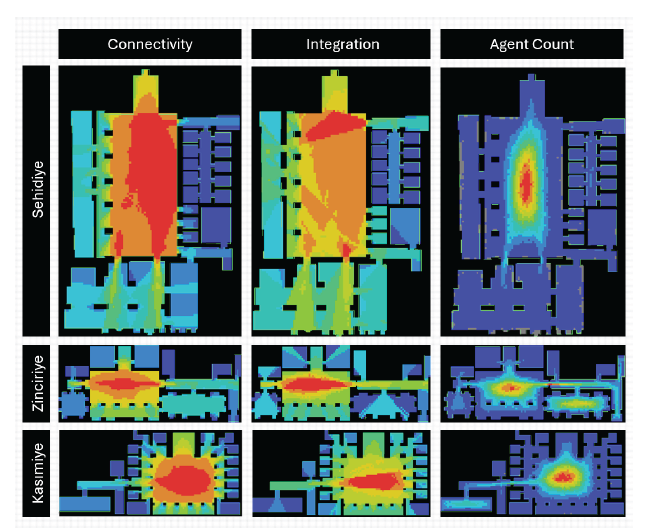
Mardin is famous for its extensive historical and cultural heritage, which includes numerous madrasas that were important architectural and educational institutions in Islamic civilisation.. This study investigatesthe interior organisation of three madrasas in Mardin—Sehidiye, Zinciriye, and Kasımiye—using a spatial syntax approach. The innovative aspect of this study is that it approaches the madrasas in Mardin using both a comparative typological analysis and a quantitative spatial syntax method based on socio-cultural changes. Thus, going beyond traditional interpretations, the analysis was based on numerical data to examine how the space was organised in terms of user behaviour, accessibility, and privacy. The results reveal that the construction of religious environments with increasing spatial depth reflects dominant social traditions and ensures user accessibility. The circulation areas in the three madrasas, which reflect a clearly defined movement hierarchy that encourages organised access and interaction, have the best integration scores. The higher control scores, particularly in these areas, indicate an architectural aim to manage spatial experiences within the complex. This study underlines the importance of including spatial analysis methods in heritage conservation and architectural discussion, revealing previously unknown aspects of the relation between space, culture, and society.
Downloads
Article Details

This work is licensed under a Creative Commons Attribution-NonCommercial-NoDerivatives 4.0 International License.
All material is licensed under the terms of the Creative Commons Attribution 4.0 International (CC-BY-NC-ND 4.0) License, unless otherwise stated. As such, authors are free to share, copy, and redistribute the material in any medium or format. The authors must give appropriate credit, provide a link to the license, and indicate if changes were made. The authors may do so in any reasonable manner, but not in any way that suggests the licensor endorses you or your use. The authors may not use the material for commercial purposes. If the authors remix, transform, or build upon the material, they may not distribute the modified material, unless permission is obtained from JARS. Final, accepted versions of the paper may be posted on third party repositories, provided appropriate acknowledgement to the original source is clearly noted.
References
Abdelsalam, M., & Ibrahim, M. (2019). Fractal dimension of Islamic architecture: The case of the Mameluke Madrasas-Al-Sultan Hassan Madrasa. Gazi University Journal of Science, 32(1), 27-37.
Acat Akgül, F. (2022). The 12-15th centuries Mardin: Cultural environment, educational buildings and Kasımiye Madrasa, [Master’s thesis, Hacettepe University, Ankara, Türkiye].
Al-Mohannadi, A. S., & Furlan, R. (2022). The syntax of the qatari traditional house: Privacy, gender segregation and hospitality constructing Qatar architectural identity. Journal of Asian Architecture and Building Engineering, 21(2), 263-283.https://doi.org/10.1080/13467581.2020.1869555
Alioglu, E. F. (2000). Mardin: Sehir dokusu ve evler [Mardin: City landscape and houses]. Türkiye Ekonomik ve Toplumsal Tarih Vakfı Publishing. (In Turkesh).
Altman, I. (1976). Human behavior and the environment: Advances in theory and research. Plenum Press.
Arjmand, R. (2016). Public urban space, gender and segregation: Women-Only urban parks in Iran. Routledge.
Atalan, Ö. (2008). A model approach to the protection of monumental architecture of Artuqy Architecture: The sample of Kasmiye Madrasah. 1st International Symposium Of Artuqy, 25, 26-27.
Aziz, N. S., & Ismail, A. S. (2018). The role of traditional madrasa design in transforming Islamic education towards the development of societal communal values. Advanced Science Letters, 24(6), 4528-4532.https://doi.org/10.1166/asl.2018.11645
Bekleyen, A. (2024). Mekân Dizimi: Mekânsal Örgütlenmeyi Grafikleştirme, Sayısallastırma, Okuma ve Yorumlama [Space Syntax: Graphicizing, Digitizing, Reading and Interpreting the Spatial Configuration]. PLANARCHDesign and Planning Research, 8(2), 348-360. (In Turkesh)
Berkey, J. P. (2007). Madrasas medieval and modern: Politics, education, and the problem of Muslim identity. Schooling Islam: The culture and politics of modern Muslim education, 40-60.
Buldaç, M., & Eren, G. H. (2019). Evaluation of water item in terms of physical and sensual values on education spaces: Example of Mardin Zinciriye And Kasimiye Madrasahs. Euroasia Journal Of Social Sciences &Humanities, 6(10), 83-96.
Burak, G. (2013). Dynasty, Law, and the Imperial Provincial Madrasa: The Case of al-Madrasa al-ʿUthmaniyya in Ottoman Jerusalem. International Journal of Middle East Studies, 45(1), 111-125.
Çaça, S. (2013). A medresseh belonging to the period of Artuk in Mardin: The Medresseh of Zinciriye (SultanIsa) [Master’s thesis, Sakarya University, Sakarya, Türkiye.]
Çaglayan, M. (2016). A cultural heritage from Aqquyunlu period in Anatolia: Mardin Kasımiye Madrasah. International Conference On Natural Science And Engineering, 19-20.
Çaglayan, M. (2017). Mardin Ortaçag anıtları ve yapım teknikleri [Mardin Medieval monuments and construction techniques]. Hiperlink Publishing House.(In Turkish).
Çatakoglu, M. (2002) The scholarly activities during the period of the Anatolian Selchukies and their impact on the period of the Early Ottoman scholarly activities [Master’s thesis, Süleyman Demirel University,Isparta, Türkiye.]
Çelik, A. B., Ay, I., Dal, M., & Ergin, S. (2023a). Stone alterations in Zinciriye Madrasah. Advanced Engineering Days, 7, 89-91.
Çelik, A. B., Ay, I., Ergin, S., & Dal, M. (2023b). Stone alterations in Mardin Madrasas: The case of Sehidiye and Hatuniye Madrasas. Kültürel Miras Arastırmaları, 4(2), 79-90. https://doi.org/10.59127/kulmira.1381600
Demir, H. (2019). The mosque and madrasah’s common courtyard use in the Anatolian Seljukid Complexes. Hacettepe University Journal Of Turkish Studies, (30), 143-166.https://doi.org/10.20427/turkiyat.478383
Dilek, H. (2015). Zinciriye Medresesi’nin Cumhuriyet dönemindeki durumu [The Status of Zinciriye Madrasah during the Republican Era]. Harran Ilahiyat Journal, 34(34), 172-188. (In Turkish).
Dovey, K., & Fisher, K. (2014). Designing for adaptation: The school as socio-spatial assemblage. The Journal of Architecture, 19(1), 43-63.https://doi.org/10.1080/13602365.2014.882376
Dudek, M. (2007). Schools and kindergartens: A design manual. Birkhäuser.https://doi.org/10.1007/978-3-7643-8329-9
Firat, N. (2024). The historical and cultural value of Kasımiye Madrasa. International Journal of Mardin Studies, 5(1), 68-79. https://doi.org/10.63046/Ijms.1459194
Furat, A. (2003). Ottoman Madrasahs in the establishment period according to the relation between education and architectural design. Journal of Istanbul University Faculty of Theology, (8), 181-208.
Göreci, N. E., & Bilgiç, D. E. (2023). The effect of space formation on dome usage preference in Anatolian Madrasahs. Architecture And Life, 8(1), 183-197. https://doi.org/10.26835/my.1169485
Green, N. (2011). The Madrasas of Oxford: Iranian interactions with the English Universities in the early nineteenth century. Iranian Studies, 44(6), 807-829.
Gregory, D., & Urry, J. (Eds.). (1985). Social relations and spatial structures. Red Globe Press.
Halaç, H., & Akdag, H. (2018). Swot analysis method for creating strategic plans of immovable cultural assets; Mardin Kasimiye (Sultan Kasim) Madrasa sample. The Journal of International Lingual Social and Educational Sciences, 4(1), 65-77.
Hanson, J. (1998). Decoding homes and houses. Cambridge University Press.
Hanson, J. (2012). Foreword: ‘The anatomy of privacy in architects’ London Houses’. Journal of Space Syntax, 3(1), 61-68.
Has, S. S. (1988). The Use Of Multaqa’l-Abhur in the Ottoman Madrasas and Legal Scholarship. Osmanlı Araştırmaları, 7(07-08).
Has, A. C. (2022). Determining density in the historical region with space syntax analysis, Erzurum City Center example. Forestist, 72(3), 299-312.https://doi.org/10.5152/forestist.2022.21045
Hegazi, Y. S., & Fouda, M. (2019). Re-Imaging Rosetta Historic Core through space syntax. Archnet-Ijar:International Journal of Architectural Research, 13(3), 645-669. https://doi.org/10.1108/arch-05-2019-0109
Hertzberger, H. (2008). Space and learning: Lessons in architecture. 010 Publishers.
Hillier, B., Hanson, J., & Peponis, J. (1984). What do we mean by building function?. E & Fn Spon Ltd.
Hillier, B., & Hanson, J. (1989). The social logic of space. Cambridge University Press.
Hillier, B., & Iida, S. (2005). Network and psychological effects in urban movement. International Conference On Spatial Information Theory, Springer Berlin Heidelberg, 475-490.
Huang, B. X., Chiou, S. C., & Li, W. Y. (2019). Study on courtyard residence and cultural sustainability: Reading Chinese traditional Siheyuan through Space Syntax. Sustainability, 11(6), 1582.
Ihsanoglu, E. (2004). The Madrasas of the Ottoman Empire. In: S. Al-Hasani (Ed.). Foundation for Science Technology and Civilization, FSTC Limited.https://www.politikadergisi.com/sites/default/files/kutuphane/the_madrasas_of_the_ottoman_empire_-_politikadergisi.com_.pdf
Karimi, K. (2012). A configurational approach to analytical urban design:‘Space syntax’methodology. Urban Design International, 17(4), 297-318. https://doi.org/10.1057/udi.2012.19
Lefebvre, H. (1991). The production of space. Cambridge.
Lefebvre, H. (1992). Rhythmanalysis: Space, time and everyday life. Continuum.
Lyu, Y., Abd Malek, M. I., Jaafar, N. H., Sima, Y., Han, Z., & Liu, Z. (2023). Unveiling the potential of space syntax approach for revitalizing historic urban areas: A case study of Yushan Historic District, China.Frontiers of Architectural Research, 12(6), 1144-1156. https://doi.org/10.1016/j.foar.2023.08.004
Markus, T. A. (2013). Buildings and power: Freedom and control in the origin of modern building types. Routledge.
Ostwald, M. J. (2011). The mathematics of spatial configuration: Revisiting, revising and critiquing justified plan graph theory. Nexus Network Journal, 13, 445-470. https://doi.org/10.1007/S00004-011-0075-3
Ödekan, A. (1997). Eczacıbası sanat ansiklopedisi “Medrese” [Eczacıbası art encyclopaedia ‘Medrese’]. Yem Publishing. (In Turkish).
Psarra, S. (2010). Architecture and narrative: The formation of space and cultural meaning. The Journal of Architecture, 15(4), 543-549.
Rapoport, A. (1969). House form and culture. Prentice-Hall.
Semerci, F. (2017). A study on Mardin limestone as a construction component: Kasımiye Madrasah Example. Journal of Architectural Sciences and Applications, 2(2), 60-79. https://doi.org/10.30785/mbud.342002
Semerci, F., & Özkafa, A. (2020). Analysis of space and facade quality in Anatolian Seljuks Madrasas: Konya Madrasas Sample. Journal of Islamic Civilization Studies, 5(1), 58-90. https://doi.org/10.20486/imad.693366
Tamari, S. (2001). Ottoman Madrasas: the Multiple Lives of Educational Institutions in Eighteenth-Century Syria1.Journal of Early Modern History, 5(2), 99-127.
Tetik, A. (2018). Development of refunctioning recommendations for Mardin Kasimiye Madrasah [Master’s thesis, Gazi University, Ankara.]
Turner, A. (2004). Depthmap 4: A researcher’s handbook [Graduate Studies, University College, London, United Kingdom.] Retrieved February 15, 2025, from https://discovery.ucl.ac.uk/id/eprint/2651
Vaughan, L. (2007). The spatial syntax of urban segregation. Progress In Planning, 67(3), 199-294. http://dx.doi.org/10.1016/j.progress.2007.03.001
Xu, Y., Rollo, J., Jones, D. S., Esteban, Y., Tong, H., & Mu, Q. (2020). Towards sustainable heritage tourism: a space syntax-based analysis method to improve tourists’ spatial cognition in Chinese historic districts.Buildings, 10(2), 29.https://doi.org/10.3390/buildings10020029
Yesilbas, E. (2020). The design and decorative properties of the 13th-15th century mosques and madrasah’s portals in Mardin.Mukaddime, 11(1), 235-273.https://doi.org/10.19059/mukaddime.710770
