
Using Artificial Intelligence to Transform Sketches into Realistic Visualizations of Iconic Buildings
Article Sidebar
Main Article Content
Abstract
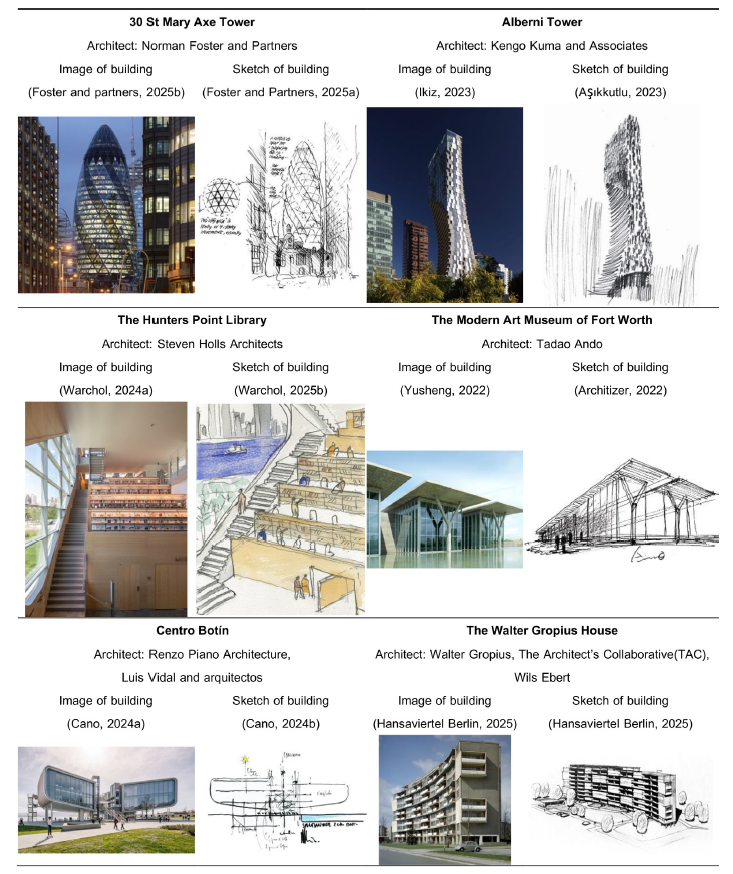
The sketch phase in architectural design is a process where design requirements are not fully defined, but decisions regarding the architectural product largely become clear. The integration of artificial intelligence (AI) into this process can be considered an exploration of potential design products that address early-stage design decisions. This paper examines how AI technologies can be utilized in the field of architecture, starting from the sketch phase and continuing through 3D visualization and rendering processes. Inspired by the sketches of pioneering modernist architects, the aim is to demonstrate how “sketch-to-sketch rendering” and “sketch-to-3D rendering” can be produced using AI-based tools. Based on the selected sketches by well-known architects and actual visuals of the buildings as references, prompts obtained from ChatGPT were used to generate sketch-to-sketch and sketch-to-3D render visuals in the artificial intelligence tools Air for SketchUp and Leonardo AI, and the results are compared. The applications demonstrate that Air for SketchUp provides more realistic and visually successful results, especially in the 3D rendering phase. Leonardo AI was notable for its capacity to generate quick alternatives that are more experimental and artistic in nature. However, these outputs tend to show weaker ties to architectural context. The findings suggest that human-machine collaboration can offer new potential in architectural design processes and that artificial intelligence tools can transform the traditional sketch process, taking on a supportive role for designers. It was determined that AI tools can contribute to architectural design processes in terms of creativity, reflecting environmental context in design, and developing design ideas.
Downloads
Article Details

This work is licensed under a Creative Commons Attribution-NonCommercial-NoDerivatives 4.0 International License.
All material is licensed under the terms of the Creative Commons Attribution 4.0 International (CC-BY-NC-ND 4.0) License, unless otherwise stated. As such, authors are free to share, copy, and redistribute the material in any medium or format. The authors must give appropriate credit, provide a link to the license, and indicate if changes were made. The authors may do so in any reasonable manner, but not in any way that suggests the licensor endorses you or your use. The authors may not use the material for commercial purposes. If the authors remix, transform, or build upon the material, they may not distribute the modified material, unless permission is obtained from JARS. Final, accepted versions of the paper may be posted on third party repositories, provided appropriate acknowledgement to the original source is clearly noted.
References
Aatty, H. M. S., & Al Slik, G. M. R. (2019). Iconic architecture and sustainability as a tool to attract the global attention. IOP Conference Series: Materials Science and Engineering, 518(2), 022076.https://doi.org/10.1088/1757-899x/518/2/022076
Air for SketchUp. (2024). Artistic inspiration render. https://www.airforsketchup.com/
Architizer (Ed.). (2022, May 4). Architects’ sketchbooks:Tadao Ando.https://architizer.com/blog/practice/tools/architects-sketchbooks-tadao-ando/
Architectures. (2024). Architechtures - AI architecture generator: Building design [Computer software Online].https://architechtures.com/en
Aksamija, A. (2018). Methods for integrating parametric design with building performance analysis. In K. Wingert-Playdon (Chair), ARCC-EAAE 2018 International Conference. https://www.arcc-journal.org/index.php/repository/article/view/459
Annamalai, N., Bervell, B., Mireku, D. O., & Andoh, R. P. K. (2025). Artificial intelligence in higher education:Modelling students’ motivation for continuous use of ChatGPT based on a modified self-determination theory. Computers and Education: Artificial Intelligence,8,100346.https://doi.org/10.1016/j.caeai.2024.100346
Avinç, G. M. (2024).Mimaride biyofilik tasarım içinmetinden görüntü üretme potansiyeli olan yapay zekâ araçlarının kullanımı.Black Sea Journal of Engineering and Science,7(4), 641-648.https://doi.org/10.34248/bsengineering.1470411
Aşıkkutlu, B. E. (2023, March 6). Eskiz Defteri 04: Kengo Kuma. gzt.https://www.gzt.com/infografik/arkitekt/eskiz-defteri-04-kengo-kuma-20687
Banihashemi, S., Ding, G., & Wang, J. (2017). Developing a hybrid model of prediction and classification algorithms for building energy consumption. Energy Procedia, 110,371-376. https://doi.org/10.1016/j.egypro.2017.03.155
Belhadi, A., Djenouri, Y., Belbachir, A. N., Michalak, T., &Srivastava, G. (2024). Shapley visual transformers for image-to-text generation. Applied Soft Computing, 166,112205. https://doi.org/10.1016/j.asoc.2024.112205
Biswas, S. S. (2023). Potential use of Chat GPT in global warming. Annals of Biomedical Engineering, 51,1126-1127. https://doi.org/10.1007/s10439-023-03171-8
Bölek, B., Tutal, O., & Özbaşaran, H. (2023). A systematic review on artificial intelligence applications in architecture. Journal of Design for Resilience in Architecture and Planning, 4(1), 91-104.https://doi.org/10.47818/drarch.2023.v4i1085
Cai, Q., Ma, M., Wang, C., & Li, H. (2023). Image neural style transfer: A review. Computers and Electrical Engineering,108,108723.https://doi.org/10.1016/j.compeleceng.2023.108723
Caliò, F., Lazzari, C., & Marchetti, E. (2021). Roses in architecture: One symbol, different objects. In P.Magnaghi-Delfino, G. Mele & T. Norando (Eds.), Faces of Geometry (2nd ed., pp. 59-73). Springer.https://doi.org/10.1007/978-3-030-63702-6_5
Castiglioni, I., Rundo, L., Codari, M., Di Leo, G., Salvatore,C., Interlenghi, M., Gallivanone, F., Cozzi, A.,D’Amico,N. C., & Sardanelli, F. (2021). AI applications to medical images: From machine learning to deep learning.Physica medica European Journal of Medical Physics, 83, 9-24.https://doi.org/10.1016/j.ejmp.2021.02.006
Chaillou, S. (2020). Archigan: Artificial intelligence x architecture. In P. F. Yuan, M. Xie, N. Leach, J. Yao & X.Wang (Eds.), Architectural intelligence: Selected papers from the 1st international conference on computational design and robotic fabrication (CDRF 2019) (pp. 117-127).Springer. https://doi.org/10.1007/978-981-15-6568-7_8
CompVis, Stability AI & Runway. (2024). Stable Diffusion (3.5 version) [Large language model].https://github.com/CompVis/stable-diffusion
Cano, E. (2024a, Julu 5). Centro Botín / Renzo Piano building workshop + luis vidal + arquitectos. [Photograph]. Archdaily. https://www.archdaily.com/875209/centro-botin-renzo-piano-building-workshop
Cano, E. (2024b, Julu 5). Centro Botín / Renzo Piano building workshop + luis vidal + arquitectos 22/22.[Photograph]. Archdaily.https://www.archdaily.com/875209/centro-botin-renzo-piano-building-workshop/595d1777b22e38d88b000039-centro-botin-renzo-piano-building-workshop-sketch?next_project=no
Davarpanah, S. (2012). A query on the impact of place on the formation of iconic buildings in architecture (Master’s thesis, Eastern Mediterranean University). http://hdl.handle.net/11129/59
DeepAI.org. (2024). DeepAI (December 1 version) [Large language model]. https://deepai.org/publication/imagecaptioning
Disco Diffusion. (2024). Disco Diffusion [Computer software Online]. https://github.com/alembics/disco-diffusion
Elhagla, K., Nassar, D. M., & Ragheb, M. A. (2020). Iconic buildings’ contribution toward urbanism. Alexandria Engineering Journal, 59(2), 803-813.https://doi.org/10.1016/j.aej.2020.01.020
Enjellina, Beyan, E. V. P., & Rossy, A. G. C. (2023). A Review of AI image generator: Influences, challenges, and future prospects for architectural field. Journal of Artificial Intelligence in Architecture, 2(1), 53-65.https://doi.org/10.24002/jarina.v2i1.6662
Foroughi, B., Senali, M. G., Iranmanesh, M., Khanfar, A.,Ghobakhloo, M., Annamalai, N., & Naghmeh-Abbaspour,B. (2024). Determinants of intention to use ChatGPT for educational purposes: Findings from PLS-SEM and fsQCA. International Journal of Human–Computer Interaction, 40(17), 4501-4520.https://doi.org/10.1080/10447318.2023.2226495
Foster and Partners. (2025b). 30 St Mary Axe: 2004-London, UK [Photograph].https://www.fosterandpartners.com/projects/30-st-mary-axe
Foster and Partners. (2025a). 30 St Mary Axe Tower/Foster + Partners: sketch 33/35 [Photograph].Archdaily.https://www.archdaily.com/928285/30-st-mary-axe-tower-foster-plus-partners/5dcac3a13312fd0ac9000033-30-st-mary-axe-tower-foster-plus-partners-sketch
Google LLC. (2024). Google Cloud Vision API [Computer software Online]. https://cloud.google.com/vision
Hanafy, N. O. (2023). Artificial intelligence’s effects on design process creativity: “A study on used AI text-toimage in architecture”. Journal of Building Engineering, 80, 107999. https://doi.org/10.1016/j.jobe.2023.
Hansaviertel Berlin. (2025). 24 Händelallee 3–9 W. Gropius – TAC, W. Ebert. https://hansaviertel.berlin/en/bauwerke/haendelallee-3-9-w-gropius-tac-w-ebert/
Holzer, D. (2015). BIM and parametric design in academia and practice: The changing context of knowledge acquisition and application in the digital age.International Journal of Architectural Computing,13(1),65-82. https://doi.org/10.1260/1478-0771.13.1.65
Imagen. (2024). Imagen [Computer software Online]. https://imagen-ai.com/
Ikiz, S. U.PA (2023, June 23). Kengo Kuma-designed Alberni Tower features impressive sculptural symmetry.https://parametric-architecture.com/kengo-kuma-designed-alberni-tower-features-impressive-sculpturalsymmetry/
Jie, P., Shan, X., & Chung, J. (2023). A comparative analysis between< Leonardo. Ai> and< Meshy> as AI texture generation tools. International Journal of Advanced Culture Technology, 11(4), 333-339.https://doi.org/10.17703/IJACT.2023.11.4.333
Kasneci, E., Sessler, K., Küchemann, S., Bannert, M., Dementieva, D., Fischer, F., Gasser, U., Groh, G., Günneman,S., Hüllermeier, E., Krusche, S., Kutyniok, G., Michaeli, T., Nerdel, C., Pfeffer, J., Poquet, O., Sailer, M.,Schmidt, A., Seidel, T., … Kasneci, G. (2023). ChatGPT for good? On opportunities and challenges of large language models for education. Learning and Individual Differences, 103, 102274.https://doi.org/10.1016/j.lindif.2023.102274
Kim, H., & Clayton, M. J. (2020). A multi-objective optimization approach for climate-adaptive building envelope design using parametric behavior maps. Building and Environment, 185, 107292.https://doi.org/10.1016/j.buildenv.2020.107292
Kohnke, L. (2022). A qualitative exploration of student perspectives of chatbot use during emergency remote teaching. International Journal of Mobile Learning and Organisation, 16(4), 475–488.https://doi.org/10.1504/IJMLO.2022.125966
Krohn, C. (2019). Walter gropius: Buildings and projects. Birkhäuser.
Leach, N., & Yuan, P. F. (2020). Introduction. In P. F. Yuan, M. Xie, N. Leach, J. Yao & X. Wang (Eds.), Architectural intelligence: Selected papers from the 1st International conference on computational design and robotic fabrication (CDRF 2019) (pp. 3-11).Springer.https://doi.org/10.1007/978-981-15-6568-7_1
Lehmann, S. (2024). Reimaging the library of the future:From social condenser and community hub to regenerative design. Public Library Quarterly, 43(2), 223-259. https://doi.org/10.1080/01616846.2023.2242626
Leonardo Interactive Pty Ltd. (2024). Leonardo AI (November 16 version) [Large language model].https://leonardo.ai/
Liu, V., & Chilton, L. B. (2022). Design guidelines for prompt engineering text-to-image generative models. In S. Barbosa, C. Lampe & C. Appert (Eds.), CHI’22:Proceedings of the 2022 CHI Conference on Human Factors in Computing Systems (Article no.384, pp.1-23). https://doi.org/10.1145/3491102.3501825
Liu, V., Vermeulen, J., Fitzmaurice, G., & Matejka, J. (2023).3DALL-E: Integrating text-to-image AI in 3D design workflows. In D. Byrne, N. Martelaro, A. Boucher, D.Chatting, S. F. Alaoui, S. Fox, I. Nicenboim & C.MacArthur (Eds.), DIS’23: Proceedings of the 2023 ACM Designing Interactive Systems Conference (pp.1955-1977). https://doi.org/10.1145/3563657.3596098
Lyu, Y., Wang, X., Lin, R., & Wu, J. (2022). Communication in human–AI co-creation: Perceptual analysis of paintings generated by text-to-image system. Applied Sciences, 12(22), 11312. https://doi.org/10.3390/app122211312
MacCarthy, F. (2019). Walter Gropius: Visionary founder of the Bauhaus. Faber & Faber.
Magnific. (2024). Magnific AI [Computer software Online]. https://magnific.ai/
Miao, L., & Yang, F. X. (2023). Text-to-image AI tools and tourism experiences. Annals of Tourism Research,102, 103642.https://doi.org/10.1016/j.annals.2023.103642
Midjourney, Inc. (2024). Midjourney [Computer software Online]. https://www.midjourney.com/home
Nandhini Abirami, R., Durai Raj Vincent, P. M., Srinivasan, K., Tariq, U., & Chang, C. Y. (2021). Deep CNN and Deep GAN in computational visual perception‐driven image analysis. Complexity, 2021(1),5541134.https://doi.org/10.1155/2021/5541134
Núñez-Morales, J. D., Jung, Y., & Golparvar-Fard, M.(2024). Bi-directional image-to-text mapping for NLPBased schedule generation and computer vision progress monitoring. In J. S. Shane, K. M. Madson, Y.Mo, C.Poleacovschi & R. E. Sturgill, Jr (Eds.), Construction research congress 2024: Advanced technologies,automation, and computer applications in construction (pp. 826-835).https://doi.org/10.1061/9780784485262.084
Open AI. (2024c). GitHub (December 1 version) [Large language model]. https://github.com/openai/CLIP
Özel, G. (2020). Interdisciplinary AI: A machine learning system for streamlining external aesthetic and cultural influences in architecture. In P. F. Yuan, M. Xie, N. Leach,J. Yao & X. Wang (Eds.), Architectural intelligence:Selected Papers from the 1st International Conference on Computational Design and Robotic Fabrication (CDRF2019) (pp. 103-116). Springer.https://doi.org/10.1007/978-981-15-6568-7_7
OpenAI. (2024a). CahtGPT (December 17 version) [Large language model]. https://chatgpt.com/
OpenAI. (2024b). DALL-E (December 13 Version) [Large language model]. https://openai.com/index/dall-e-2/
Pena, M. L. C., Carballal, A., Rodríguez-Fernández, N.,Santos, I., & Romero, J. (2021). Artificial intelligence applied to conceptual design: A review of its use in architecture. Automation in Construction, 124, 103550.https://doi.org/10.1016/j.autcon.2021.103550
Piano, R., & Vidal, L. (2015). Centro Botín, en Santander.Un proyecto en tres movimientos [Centro Botín, in Santander. A project in three movements].Cercha: Revista de la Arquitectura Técnica,126, 16-26.http://hdl.handle.net/20.500.12251/529
Rian, I. M., & Asayama, S. (2016). Computational design of a nature-inspired architectural structure using the concepts of self-similar and random fractals. Automation in Construction, 66, 43-58.https://doi.org/10.1016/j.autcon.2016.03.010
Sartori, T., Drogemuller, R., Omrani, S., & Lamari, F.(2021). A schematic framework for life cycle assessment(LCA) and green building rating system (GBRS). Journal of Building Engineering, 38, 102180.https://doi.org/10.1016/j.jobe.2021.102180
Serednicki, A. (2024). Here’s a Twist: In Vancouver’s sea of steely, boxy skyscrapers, the Alberni tower leans into the greatness of the outdoors. Maclean’s, 136(11), 26-26.link.gale.com/apps/doc/A779055107/AONE?u=anon~63856626&sid=googleScholar&xid=73454301
Sherzad, M., Arar, M., & Jung, C. (2022). Analyzing the architectural characteristics of Tadao Ando’s museum projects. International Journal of Advanced Research in Engineering Innovation, 4(3), 1-17.https://doi.org/10.55057/ijarei.2022.4.3.1
Soddu, C. (2020). Generative city design aleatority and urban species, unique, unrepeatable and recognizable identity, like in nature.Domus Argenia.
Tamke, M., Nicholas, P., & Zwierzycki, M. (2018). Machine learning for architectural design: Practices and infrastructure. International Journal of Architectural Computing, 16(2), 123-143.https://doi.org/10.1177/1478077118778580
Tian, Y., Liu, A., Dai, Y., Nagato, K., & Nakao, M. (2024). Systematic synthesis of design prompts for large language models in conceptual design. CIRP Annals,73(1), 85-88.https://doi.org/10.1016/j.cirp.2024.04.062
Ulug, E. (2022). An investigation into the connotations of iconic buildings by using a semiotic model of architecture. Social Semiotics, 32(2), 279-300.https://doi.org/10.1080/10350330.2020.1756590
Warchol, P. (2024a, November 3). Hunters Point Library / Steven Holl architects: Courtesy of Steven Holl architects 4/29. [Photograph]. Archdaily.https://www.archdaily.com/925389/hunters-point-library-stevenholl-architects/5d8a6080284dd1676d0000c3-hunters-point-library-steven-holl-architects-image
Warchol, P. (2024b, November 3). Hunters Point Library / Steven Holl architects: Courtesy of Steven Holl architects 26/29. [Photograph]. Archdaily.https://www.archdaily.com/925389/hunters-point-library-stevenholl-architects/5d8a6339284dd1676d0000cf-hunters-point-library-steven-holl-architects-image?next_project=no
Yeh, I.-C. (2006). Architectural layout optimization using annealed neural network. Automation in Construction,15(4), 531-539.https://doi.org/10.1016/j.autcon.2005.07.002
Yildirim, E. (2023). Comparative analysis of Leonardo AI, Midjourney, and DALL-E: AI’s perspective on future cities. Urbanizm: Journal of Urban Planning and Sustainable Development, 28, 82-96.https://doi.org/10.58225/urbanizm.2023-28-82-96
You, H., Zhou, L., Xiao, B., Codella, N., Cheng, Y., Xu, R.,.Chang, S.-F., & Yuan, L. (2022). Learning visual representation from modality-shared contrastive language-image pre-training. In S. Avidan, G. Brostow,M.Cissé, G. M. Farinella, T. Hassner (Eds.),Computer Vision – ECCV 2022: 17th European Conference,Tel Aviv, Israel, October 23–27, 2022,Proceedings, Part XXVII (pp. 69-87). Springer.https://doi.org/10.1007/978-3-031-19812-0_5
Yusheng, L. (2022, December 22). Flashback: Modern Art Museum of Fort Worth / Tadao Ando Architect &Associates 6/19. [Photograph]. Archdaily.https://www.archdaily.com/213084/flashback-modern-artmuseum-of-fort-worth-tadao-ando/503827bd28ba0d599b001142-flashback-modern-art-museum-of-fortworth-tadao-ando-photo?next_project=no
Wen, W., Hong, L., & Xueqiang, M. (2010). Application of fractals in architectural shape design. In 2010 IEEE 2nd Symposium on Web Society (pp. 185-190). IEEE.https://doi.org/10.1109/sws.2010.5607455
Zamparini, A., Gualtieri, G., & Lurati, F. (2023). Iconic buildings in the making of city identity: The role of aspirational identity artefacts. Urban Studies, 60(12),2474-2495.https://doi.org/10.1177/00420980221144157
Zhang, S. (2025). 3D modeling in the art of photographic expansion. The Imaging Science Journal, 73(5), 527-542.https://doi.org/10.1080/13682199.2024.2430870
