
The Conceptualization of Space: The Case of Long Long Rak Cave, Pang Mapha, Mae Hong Son, Thailand
Article Sidebar
Main Article Content
Abstract
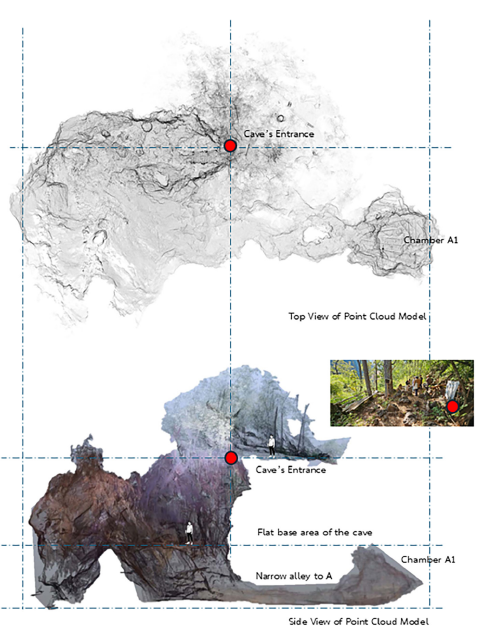
Caves are often used as metaphors for spaces of transformation—spaces that symbolize shifts in perspectives and understanding, moving from old frameworks to new ones. This transition frequently involves moving beyond material attachments toward a deeper comprehension of knowledge and intelligence (Tearle, 2023). In architectural discipline, caves are often portrayed as abstract spaces, mysterious and complex, evoking curiosity and excitement (Bashir, 2013 and Sukkarieh, 2013). However, in this article, the "caves" in question are not metaphorical but physical spaces specifically used to house coffins, as part of the "coffin culture" of tribes that have inhabited Pang Mapha District since prehistoric times. These “Coffin Caves” are well-defined areas with precise locations. Rather than focusing on expanding archaeological knowledge of Coffin Caves, this article delves into the conceptualization and spatial design of caves to reveal new perspectives on the relationship between the cave environment and the placement of wooden coffins. This exploration is particularly enriched when viewed through an architectural and spatial lens, supported by archaeological data. The article discusses the mechanisms and techniques employed to analyze and interpret these relationships, ranging from simple methods to the application of advanced technology. By integrating data sets related to the caves and the wooden coffins' locations, the design team explored ways to adapt the cave spaces into a medium for learning and preserving the “wooden coffin culture” and the heritage of “Coffin Caves.”
Downloads
Article Details

This work is licensed under a Creative Commons Attribution-NonCommercial-NoDerivatives 4.0 International License.
All material is licensed under the terms of the Creative Commons Attribution 4.0 International (CC-BY-NC-ND 4.0) License, unless otherwise stated. As such, authors are free to share, copy, and redistribute the material in any medium or format. The authors must give appropriate credit, provide a link to the license, and indicate if changes were made. The authors may do so in any reasonable manner, but not in any way that suggests the licensor endorses you or your use. The authors may not use the material for commercial purposes. If the authors remix, transform, or build upon the material, they may not distribute the modified material, unless permission is obtained from JARS. Final, accepted versions of the paper may be posted on third party repositories, provided appropriate acknowledgement to the original source is clearly noted.
References
Bashir, S. (2013, November 9). Primitive future – Sou Fujimoto. Iaac. https://www.iaacblog.com/programs/primitive-future-sou-fujimoto/
Buajan, S., Pumijumnong, N., Maungsong, C., Cai, B., Wang, F., & Li, M. (2020). The potential of teak log coffins collected from Namjang Cave in Northwestern Thailand for studying the coffin culture and paleoclimate in Southeast Asia. Archaeological and Anthropological Sciences, 12(7), 137. https://doi.org/10.1007/s12520-020-01105-2
Carlhoff, S., Kutanan, W., Rohrlach, A. B., Posth, C., Stoneking, M., Nägele, K., Shoocongdej, R., & Krause, J. (2023). Genomic portrait and relatedness patterns of the iron age log coffin culture in northwestern Thailand. Nature Communications, 14, 8527. https://doi.org/10.1038/s41467-023-44328-2
Evans, R. (2000). The projective cast: Architecture and its three geometries. MIT Press.
Forty, A. (2000). Words and buildings: A vocabulary of modern architecture. Thames & Hudson.
Javaid, M., Haleem, A., Pratap Singh, R. P., & Suman, R. (2021). Industrial perspectives of 3D scanning: Features, roles and its analytical applications. Sensors International, 2, 100114. https://doi.org/10.1016/j.sintl.2021.100114
Kanoksilapatham, B., Phetluan, P., Kachacheewa, J., Chumdee, N., & Suwannapakdee, S. (2022). Mae Hong Son: Cultural heritage embraced by the mist. https://drive.google.com/file/d/1jOVOdV342Ayldu4CLZx9zyTeC5QhBffv/view?usp=drive_link
Neil, L. (1997). Martin Heidegger. In N. Leach (Ed.), Rethinking architecture: A reader in cultural theory (pp.94-119). Routledge.
Phumichanong, N., Serinonchai, S., Arunrat, N., & Muangsong, C. (Eds.) (2022). Khūmư̄ kān thō̜ngthīeo mō̜radok thammachāt čhangwat Mǣ Hō̜ng Sō̜n [Tourism guide natural heritage Mae Hong Son province].https://drive.google.com/file/d/1x7AJksRGmJ-D6Fayn4TARNuBTXuaBkSQ/view?usp=drive_link
Samrit, C., & Shoocongdej, R. (2024). A study of communities of practice in craft production from log coffin culture archaeological sites in highland Pang Mapha, Northwestern Thailand. MANUSYA: Journal of Humanities, 27(1), 1–24.https://doi.org/10.1163/26659077-20242717
Shevchuk, R., Tykhiy, R., Melnyk, A., Karpinski, M., Owedyk, J., & Yurchyshyn, T. (2022). Cyber-physical system for dynamic annotating real-world objects using augmented reality. In 2022 12th International Conference on Advanced Computer Information Technologies (ACIT) (pp. 392–395). IEEE.https://doi.org/10.1109/ACIT54803.2022.9913148
Shoocongdej, R. (2013, June 18). Watthanatham lōng mai rư̄ lōng phī mǣn [Wooden coffin culture and Long Phi Man]. Gotoknow.https://www.gotoknow.org/posts/306199
Shoocongdej, R., Chumdee, N., Romyen, K., & Lopirun, M.(2013). Rāingān wičhai chabap sombūn khrōngkān sư̄p khon læ čhatkān mō̜radok thāng watthanatham yāng yangyư̄n nai ʻamphœ̄ pāy- pāng ma phā - khun yūam čhangwat Mǣ Hō̜ng Sō̜n raya thī 3 [Complete research report of the sustainable cultural heritage search and management project in Pai-Pangmapha-Khun Yuam district, Mae Hong Son province, phase 3]. The Thailand Research Fund (TRF).https://elibrary.tsri.or.th/fullP/RDG5440001/RDG5440001V05/RDG5440001V05_full.pdf
Shoocongdej, R., Chumdee, N., Na Nongkhai, W., Phetluan, P., & Khiannok, S. (2019). The synthesis of TRF research in Mae Hong Son Province within the framework of sustainable development. Thailand Science Research and Innovation.https://digital.library.tu.ac.th/tu_dc/frontend/Info/item/dc:163211
Shoocongdej, R. (2020). The Challenge of archaeological interpretation and practice that integrates between the science of the past and local knowledge. Journal of the SEAMEO Regional Center for Archaeology and Fine Arts (SPAFA), 4.https://doi.org/10.26721/spafajournal.v4i0.632
Shoocongdej, R. (2021b). Conservation of ancient log coffins of Phi Man Long Long Rak cave, Mae Hong Son [Unpublished manuscript]. The U.S. Ambassadors Fund for Cultural Preservation 2021 (AFCP)
Shoocongdej, R., Chillander, S. P., Kanthasri. S., & Domthong, W. (2022).Khūmư̄ kān thō̜ngthīeo mō̜radok watthanatham læ thammachāt kān dœ̄n thāng khām kān (wēlā) nai mān mō̜k Mǣ Hō̜ng Sō̜n[Journey through time in the mist of Mae Hong Son]. Thailand Science Research and Innovation (TSRI).https://drive.google.com/file/d/1OD0aqcyCzX-xHaMmgdP64iYnYtsoJHqO/view?usp=drive_link
Sreepakdee, J., Thaphare, R., Siriammat, K., & Tanukarn, T. (2022). Old building information modeling creation by 3D point cloud. In S. Khundiloknattawasa (Ed.), The 22nd national academic conference for presentation of research results of the northern Rajabhat University graduate network: “New ways of education in a digital society” (Vol. 2, pp. 275-282).https://gs2.nsru.ac.th/gnru2022/proceeding.php
Sukkarieh, R. (2013, November 9). Sou Fujimoto ‘primitive future’-analysis. Iaac.https://www.iaacblog.com/programs/sou-fujimoto-primitive-future-analysis/
Tang, P., Huber, D., Akinci, B., Lipman, R., & Lytle, A (2010). Automatic reconstruction of as-built building information models from laser-scanned point clouds: A review of related techniques. Automation in Construction, 19(7), 829-843.https://doi.org/10.1016/j.autcon.2010.06.007
Taylor, M. D. B. (2011). The prosthetic imagination: Meditations on virtual space and experience of the single player computer role playing games [Master thesis, University of Waterloo]. Library and Archives Canada. http://central.bac-lac.gc.ca/.redirect?app=damspub&id=db40a6da-f872-46d6-8b93-cc53b3032778
Tearle, O. (2023). A summary and analysis of Plato’s allegory of the cave. Interesting Literature.https://interestingliterature.com/2023/03/plato-allegory-of-the-cave-summary-analysis/
Wi, K., Suresh, V., Wang, K., Li, B., & Qin, H. (2020). Quantifying quality of 3D printed clay objects using a 3D structured light scanning system. Additive Manufacturing, 32, 100987.https://doi.org/10.1016/j.addma.2019.100987
