
Comprehensive Resilience Assessment System:Towards Climate-Resilient and Sustainable Primary Healthcare Facilities in South-East Asia
Article Sidebar
Main Article Content
Abstract
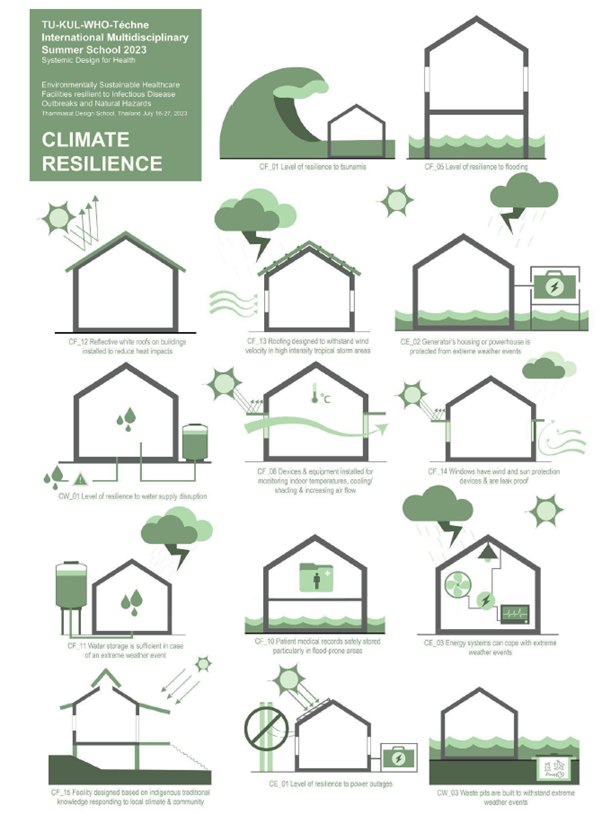
As the climate crisis continues with more extreme weather events increasing the risks to people’s health, healthcare systems and facilities, it is becoming more urgent to address the climate resilience and environmental sustainability for primary healthcare facilities. This paper presents an international multidisciplinary summer school jointly organized by Thammasat University (Thailand), KU Leuven Faculty of Architecture (Belgium), in collaboration with World Health Organization (WHO) Téchne and WHO Country Office for Thailand, with the participation of partner universities from South-East Asia, to examine these issues and develop solutions. This research is about the development of a Comprehensive Resilience Assessment System (CRAS), an academic draft of an online checklist for primary healthcare centers, in suburban and rural settings in South-East Asia which are climate resilient and environmentally sustainable in the face of infectious disease outbreaks and/or natural hazards. Taking a systems thinking and a whole-of-society approach this paper outlines the specificities of primary healthcare centers and their role in an ever-warming climate, the summer school research methodology in terms of literature reviewed, preliminary data collected, and the novel pedagogical research-by-design process undertaken to produce the Comprehensive Resilience Assessment System online tool as a form of environmental assessment for primary healthcare centers.
Downloads
Article Details

This work is licensed under a Creative Commons Attribution-NonCommercial-NoDerivatives 4.0 International License.
All material is licensed under the terms of the Creative Commons Attribution 4.0 International (CC-BY-NC-ND 4.0) License, unless otherwise stated. As such, authors are free to share, copy, and redistribute the material in any medium or format. The authors must give appropriate credit, provide a link to the license, and indicate if changes were made. The authors may do so in any reasonable manner, but not in any way that suggests the licensor endorses you or your use. The authors may not use the material for commercial purposes. If the authors remix, transform, or build upon the material, they may not distribute the modified material, unless permission is obtained from JARS. Final, accepted versions of the paper may be posted on third party repositories, provided appropriate acknowledgement to the original source is clearly noted.
References
Ali, R .H., Afify, M. M., Abdel-Meniem, W., & Othman, A. A (2022). Analysis of sustainability assessment rating systems for existing healthcare buildings. IOP Conference Series: Earth and Environmental Science, 1113,012015.https://iopscience.iop.org/article/10.1088/1755-1315/1113/1/012015
Andreae, S. (2025, June 3). Climate change and global health: What actions are healthcare leaders taking?. World Economic Forum. https://www.weforum.org/agenda/2022/11/climate-change-global-health-actionshealthcare-leaders/
Castro, M. D., Mateus, R., & Bragança, L. (2015). A critical analysis of building sustainability assessment methods for healthcare buildings. Environment, Development and Sustainability, 17, 1381-1412. https://doi.org/10.1007/s10668-014-9611-0
De Wandeler, K., & Lo, A. (2022, September 26). International multidisciplinary summer school: Systemic design for health - infectious diseases prevention and control. Thammasat Design School. https://issuu.com/tds.thammasat/docs/summer_school_2022_booklet_220925
De Wandeler, K., & Lo, A. (2025). Exploring systems thinking and systemic design: Insights from a summer school experiment addressing urban health crises. The Journal of Architectural/Planning Research and Studies (JARS), 22(1), 1-24. https://doi.org/10.56261/jars.v22.267810
Doucet, I., & Janssens, N. (2011). Editorial: Transdisciplinarity, the hybridisation of knowledge production and space-related research. In I. Doucet & N. Jannssens (Eds.), Transdisicplinary knowledge production in architecture and urbanism: Towards hybrid modes of inquiry: urban and landscape perspectives (pp. 1-14). Springer.
Gupta, R., Vahanvati, M., Häggström, J., & Halcomb, J. S (2021, July 6). A Practical guide to climate-resilient buildings and communities. United Nations Environment Programme (UNEP). https://www.unep.org/resources/practical-guide-climate-resilient-buildings
Hadorn, G. H., Hoffman-Riem, H., Biber-Klemm, S., Grossenbacher-Mansuy, W., Joye, D., Pohl, C., Wiesmann, U., & Zemp, E. (Eds). (2008). Handbook of transdisicplinary research. Springer. https://doi.org/10.1007/978-1-4020-6699-3
Jahn, T., Bergmann, M., & Keil, F. (2012). Transdisciplinarity: Between mainstreaming and marginalization. Ecological Economics, 79, 1-10. https://doi.org/10.1016/j.ecolecon.2012.04.017
Jones, P., & Van Ael, K. (2022). Design journeys through complex systems: Practice tools for systemic design. BIS Publishers.
Lo, A., & De Wandeler, K. (2024). Collaborative systemic design for health towards a postpandemic reassessment of cosmopolitanism. In 2023 ACSA/EAAE teachers conference, educating the cosmopolitan architect:Teachers proceedings (pp. 404-411). ACSA Press. https://doi.org/10.35483/ACSA.Teach.2023.59
Rigolot, C. (2020). Transdisciplinarity as a discipline and a way of being: Complementarities and creative tensions. Humanities and Social Sciences Communications, 7(100), 1-5. http://doi.org/10.1057/s41599-020-00598-5
Roggema, R. (2017). Research by design: Proposition for a methodological approach. Urban Science, 1(1), 2.https://doi.org/10.3390/urbansci1010002
Thammasat Design School Official. (2023, June 30). Introduction WHO Thailand country office | Richard Brown– WHO Thailand [Video]. YouTube. https://www.youtube.com/watchv=c0JtzIHdfHo&list=PL6yIRpnwpdeiG7ikbuCItZcF6BwiePc05
Thammasat Design School & KU Leuven. (2023). Comprehensive resilience assessment system (CRAS) for primary healthcare facilities [Google Form].https://docs.google.com/forms/d/e/1FAIpQLSd-Bn5qlbzq4DyxnvgKVz4jSms6mvkH-Sd_dD3b7yZza0DyGw/viewform?pli=1
United Nations Human Settlements Programme (UN-Habitat). (2022). World cities report 2022: Envisaging the future of cities. https://unhabitat.org/world-cities-report-2022-envisaging-the-future-of-cities
United Nations. (2023, December 3). COP28: The climate crisis is also a health crisis. UN News. https://news.un.org/en/story/2023/12/1144292
World Health Organization (WHO). (2016, November1).Guidelines on core components of infection prevention and control programmes at the national and acute health care facility level.https://www.who.int/publications/i/item/9789241549929
World Health Organization (WHO). (2018). Infection prevention and control assessment framework at the facility level. https://iris.who.int/items/e7b27920-31ab-4e84-afd0-dc36055ca266
World Health Organization (WHO). (2020). WHO guidance for climate-resilient and environmentally sustainable health care facilities. https://iris.who.int/items/5c2a74d6-61d2-4087-8e17-dd3d46a217f2
World Health Organization (WHO). (2021). Checklists to assess vulnerabilities in health care facilities in the context of climate change.https://iris.who.int/items/8a0bd60d-dc38-468f-b2c9-f610e26f5e24
World Health Organization (WHO). (2025, March 26). Primary health care. https://www.who.int/news-room/fact-sheets/detail/primary-health-care
World Health Organization (WHO) & Pan American Health Organization (PAHO). (2015). Hospital safety index:Guide for evaluators (2nd ed.).https://iris.who.int/items/d6092688-a502-420b-99e7-e31c57847f26
World Health Organization & United Nations Children’s Fund (UNICEF). (2018). A vision for primary health care in the 21st century: Towards universal health coverage and the sustainable development goals.https://iris.who.int/items/8214e9f3-c961-462c-ae9b-690320ef816b
World Meteorological Organization (WMO). (2023, August 3). Exceptional heat and rain, wildfires and floods mark summer of extremes.https://wmo.int/media/news/exceptional-heat-and-rain-wildfires-and-floodsmark-summer-of-extremes
