
Indoor Air Quality Investigation of Fresh Markets in Hot and Humid Climates: A Case Study in Thailand
Article Sidebar
Main Article Content
Abstract
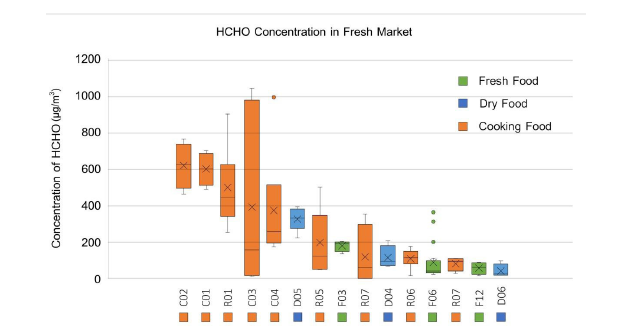
The issue of poor air quality in fresh market facilities poses a public health threat, particularly in association with the food supply chain. This study assessed the indoor air quality (IAQ) of various food retailers and aimed to (a) identify IAQ problems, (b) investigate the source of indoor air contamination in the fresh market, and (c) recommend better design practices for IAQ in fresh markets. The IAQ of 33 food retailers in four fresh markets in Bangkok, Thailand, was measured for ten parameters: temperature (T), relative humidity (RH), air velocity, particle matter (PM2.5, PM10), carbon dioxide (CO2), ozone (O3), formaldehyde (HCHO), total volatile organic compounds (TVOC), and bioaerosols. The result found mean values of IAQ parameters in 33 food retailers that exceeded the threshold limit values (TLVs) of the SOOK, Thailand’s well-being building standards, were PM2.5 of 30 μg/m3, HCHO of 124 μg/m3, and TVOC of 733 μg/m3. The retail stall provides fresh food products that produce wastewater from product displays and preparation, which had the highest averages of RH and bioaerosols, with RH of 66.4% and bioaerosols of 1,346 CFU/m3. The retail facilities with cooking activities, such as open kitchen restaurants, noodle restaurants, and cafés, had high averages, with PM2.5 of 51 μg/m3, HCHO of 216 μg/m3, TVOC of 922 μg/m3, and bioaerosols of 1,154 μg/m3. The stall provides dry food products with an average TVOC of 986 μg/m3, exceeding TLVs. A zoning-based approach was proposed as a design guideline to improve IAQ in fresh markets. Fresh food (FF), Dry Food (DF), and Cooking Food (CF) zoning should be carefully designed to lower the risk of cross-contamination.
Downloads
Article Details

This work is licensed under a Creative Commons Attribution-NonCommercial-NoDerivatives 4.0 International License.
All material is licensed under the terms of the Creative Commons Attribution 4.0 International (CC-BY-NC-ND 4.0) License, unless otherwise stated. As such, authors are free to share, copy, and redistribute the material in any medium or format. The authors must give appropriate credit, provide a link to the license, and indicate if changes were made. The authors may do so in any reasonable manner, but not in any way that suggests the licensor endorses you or your use. The authors may not use the material for commercial purposes. If the authors remix, transform, or build upon the material, they may not distribute the modified material, unless permission is obtained from JARS. Final, accepted versions of the paper may be posted on third party repositories, provided appropriate acknowledgement to the original source is clearly noted.
References
Agarwal, N., Meena, C. S., Raj, B. P., Saini, L., Kumar, A., Gopalakrishnan, N., Kumar, A., Balam, N. B., Alam,T., & Kapoor, N. R. (2021). Indoor air quality improvement in COVID-19 pandemic. Sustainable Cities and Society, 70, 102942. https://doi.org/10.1016/j.scs.2021.102942
Al-Gheethi, A., Ma, N. L., Rupani, P. F., Sultana, N., Yaakob,M. A., Mohamed, R. M. S. R., & Soon, C. F. (2023).Biowastes of slaughterhouses and wet markets:an overview of waste management for disease prevention.Environmental Science and Pollution Research, 30(28), 71780-71793.https://doi.org/10.1007/s11356-021-16629-w
Andualem, Z., Gizaw, Z., Bogale, L., & Dagne, H. (2019).Indoor bacterial load and its correlation to physical indoor air quality parameters in public primary schools.Multidisciplinary Respiratory Medicine, 14(2), 1-7.https://doi.org/10.1186/s40248-018-0167-y
Arı, A., Arı, P. E., Yeni̇soy-Karakaş, S., & Gaga, E. O. (2020).Source characterization and risk assessment of occupational exposure to volatile organic compounds (VOCs) in a barbecue restaurant. Building and Environment, 174, 106791.https://doi.org/10.1016/j.buildenv.2020.106791
American Society of Heating, Refrigerating and Air-Conditioning Engineers (ASHRAE). (2022). Ventilation and acceptable indoor air quality (ANSI/ASHRAE Standard 62.1-2022). https://www.ashrae.org/file%20library/technical%20resources/standards%20and%20guidelines/standards%20addenda/62_1_2022_x_20221108.pdf
Chang, Y.-T., Liu, W.-T., Chen, I.-C., Chiang, C.-C., & Lau, S.H. (2023). The indoor concentration and size distribution of airborne bacteria in a typical traditional market. Aerosol and Air Quality Research, 23(8),220402.https://doi.org/10.4209/aaqr.220402
Chen, Z., Xin, J., & Liu, P. (2020). Air quality and thermal comfort analysis of kitchen environment with CFD simulation and experimental calibration. Building and Environment, 172, 106691. https://doi.org/10.1016/j.buildenv.2020.106691
Goh, C. S., & Chong, H.-Y. (2023). Opportunities in the sustainable built environment: Perspectives on humancentric approaches. Energies, 16(3), 1301. https://doi.org/10.3390/en16031301
Hawkins, V. R., Marcham, C. L., Springston, J. P., Miller, J.D., Braybrooke, G., Maunder, C., Feng, L., & Kollmeyer,B. (2020). The value of IAQ: A review of the scientific evidence supporting the benefits of investing in better indoor air Quality. ERAU Scholarly Commons.https://commons.erau.edu/publication/1500
Jung, C.-C., Wu, P.-C., Tseng, C.-H., & Su, H.-J. (2015).Indoor air quality varies with ventilation types and working areas in hospitals. Building and Environment, 85,190-195. https://doi.org/10.1016/j.buildenv.2014.11.026
Kim, M., Yoon, C., Park, J., Lee, K., Zoh, K.-D., Lim, M., & Lee, S. (2024). Invisible threats in daily life: Evaluating VOCs, metals, and hazards of household cleaning products by type. Indoor Air, 2024(1), 2125845. https://doi.org/10.1155/2024/2125845
Lin, B., Dietrich, M. L., Senior, R. A., & Wilcove, D. S. (2021). A better classification of wet markets is key to safeguarding human health and biodiversity. The Lancet Planetary Health, 5(6), e386-e394. https://www.thelancet.com/journals/lanplh/article/PIIS2542-5196(21)00112-1/fulltext
Liu, Q., Son, Y. J., Li, L., Wood, N., Senerat, A. M., & Pantelic, J. (2022). Healthy home interventions: Distribution of PM2. 5 emitted during cooking in residential settings. Building and Environment, 207(B), 108448. https://doi.org/10.1016/j.buildenv.2021.108448
Ma, N., Aviv, D., Guo, H., & Braham, W. W. (2021).Measuring the right factors: A review of variables and models for thermal comfort and indoor air quality.Renewable and Sustainable Energy Reviews, 135, 110436.https://doi.org/10.1016/j.rser.2020.110436
Manibusan, S., & Mainelis, G. (2022). Passive bioaerosol samplers: A complementary tool for bioaerosol research:A review. Journal of Aerosol Science, 163,105992.https://doi.org/10.1016/j.jaerosci.2022.105992
Megahed, N. A., & Ghoneim, E. M. (2021). Indoor air quality: Rethinking rules of building design strategies in post-pandemic architecture. Environmental Research,193,110471. https://doi.org/10.1016/j.envres.2020.110471
Mizumoto, K., Kagaya, K., & Chowell, G. (2020). Effect of a wet market on coronavirus disease (COVID-19)transmission dynamics in China, 2019–2020.International Journal of Infectious Diseases, 97, 96-101.https://doi.org/10.1016/j.ijid.2020.05.091
Nadimpalli, M. L., & Pickering, A. J. (2020). A call for global monitoring of WASH in wet markets. The Lancet Planetary Health, 4(10), e439-e440.https://www.thelancet.com/journals/lanplh/article/PIIS2542-5196(20)30204-7/fulltext
Naguib, M. M., Li, R., Ling, J., Grace, D., Nguyen-Viet, H., &Lindahl, J. F. (2021). Live and wet markets: food access versus the risk of disease emergence. Trends in Microbiology, 29(7), 573-581.https://doi.org/10.1016/j.tim.2021.02.007
Suanburi, M., Kemawat, N., Adunyarittagun, D., &Chatpunnarangsee, K. (2021). The challenges of operating a seafood business during a new emerging phase of COVID-19 pandemic: A case study of fresh-food markets in Ladprao district. In The 13th NPRU National Academic Conference (pp. 1831-1841.https://publication.npru.ac.th/bitstream/123456789/1472/1/npru_217.pdf
Te Kulve, M., Loomans, M., Boerstra, A., & Schrock, D. (2022). Exploring PM2. 5 Exposure of Chefs in Professional Kitchens. ASHRAE Journal, 64(09), 16-26. https://www.halton.com/app/uploads/2022/09/Schrock-September-2022-for-posting-at-Halton.pdf
Temkin, A. M., Geller, S. L., Swanson, S. A., Leiba, N. S.,Naidenko, O. V., & Andrews, D. Q. (2023). Volatile organic compounds emitted by conventional and “green”cleaning products in the us market.Chemosphere,341,139570.https://doi.org/10.1016/j.chemosphere.2023.139570
Tran, V. V., Park, D., & Lee, Y.-C. (2020). Indoor air pollution, related human diseases, and recent trends in the control and improvement of indoor air quality. International Journal of Environmental Research and Public Health, 17(8), 2927. https://doi.org/10.3390/ijerph17082927
Wei, D.-J., Liu, W.-T., Chin, H.-T., Lin, C.-H., Chen, I.-C., &Chang, Y.-T. (2021). An investigation of airborne bioaerosols and endotoxins present in indoor traditional wet markets before and after operation in Taiwan: A case study. International Journal of Environmental Research and Public Health, 18(6), 2945.https://doi.org/10.3390/ijerph18062945
Wu, Y.-C., Chen, C.-S., & Chan, Y.-J. (2020). The outbreak of COVID-19: An overview. Journal of the Chinese Medical Association, 83(3), 217-220.https://doi.org/10.1097/JCMA.0000000000000270
Zhang, A., Deng, N., Shen, C., Hao, R., Liu, J., Wang, Y., &Long, Z. (2020). Survey study on Chinese commercial kitchen exhaust fume systems in Tianjin. Building and Environment, 171, 106629.https://doi.org/10.1016/j.buildenv.2019.106629
Zhao, Y., & Zhao, B. (2018). Emissions of air pollutants from Chinese cooking: A literature review. Building Simulation, 11, 977-995.https://doi.org/10.1007/s12273-018-0456-6
Zhao, Y., & Zhao, B. (2020). Reducing human exposure to PM2.5 generated while cooking typical Chinese cuisine.Building and Environment, 168, 106522.https://doi.org/10.1016/j.buildenv.2019.106522
